Textile and garment production struggles due to lack of fabric
Vietnam’s underdeveloped fabric production is making it difficult for textile and garment businesses to take advantage of free trade agreements, including the Europe – Vietnam Free Trade Agreement (EVFTA).
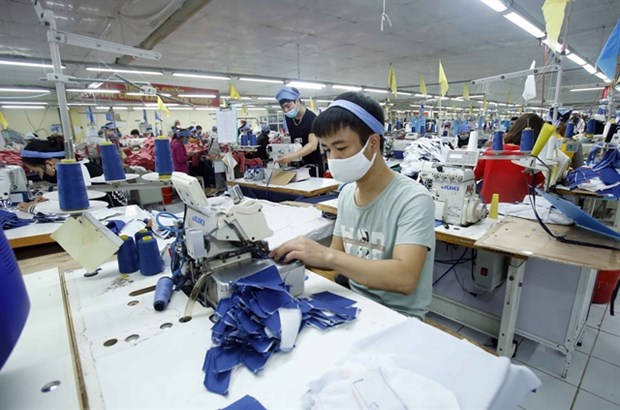 Textile and garment businesses are struggling to make use of free trade agreements, since most fabrics and other materials have to be imported. (Photo: VNA)
HCM City (VNS/VNA) – Vietnam’s underdeveloped fabric production is making it difficult for textile and garment businesses to take advantage of free trade agreements, including the Europe – Vietnam Free Trade Agreement (EVFTA).
The textile and garment industry exports nearly 40 billion USD worth of products and requires around 10 billion metres of fabric each year.
The rate of domestic materials used by textile and garment businesses in Vietnam is only about 40-45 percent, according to the Ministry and Industry and Trade.
The local fabric industry produces around 2.3 billion metres of fabric a year, meeting only 25 percent of the country’s demand. Over 7 billion metres of fabric material for production and export is imported from China, Taiwan and the Republic of Korea.
In 2019, Vietnam imported around 13 billion USD worth of fabric for the textile and garment industry. The amount of fabric produced domestically is often used to make low or medium quality clothing, and typically does not meet the requirements of clothing manufacturing and exporting businesses.
Tran Tuan Anh, Minister of Industry and Trade, said the country’s production of cotton, fibres and dyes does not satisfy the textile and garment industry’s demand.
Not enough attention is being given to dyeing technology and environmental protection to develop the textile dyeing industry, so businesses are reluctant to invest in textile production or form start-ups in fashion design.
Vietnam’s textile and garment industry focuses mostly on manufacturing, with low added value.
While the industry has many opportunities from Vietnam’s free trade agreements with other economies, around 60 percent of exports comes from FDI companies.
The EVFTA’s rules of origin regarding textiles and garments is referred to as “from fabric onward”, meaning a garment product’s fabric has to be woven, finished, cut, and sewn in Vietnam.
Truong Van Cam, deputy chairman of the Vietnam Textile and Apparel Association, said that due to the lack of fabric materials, FTA rules of origin make it harder for businesses to use their values.
Investment in fabric production has faced challenges including a lack of funds and expensive technologies. As a result, while the textile and garment industry has seen exports rise over the years, imports of fabric materials have also risen.
An investment of around 30 billion USD is needed in order for the industry to be able to produce the remaining 8 billion metres of fabric, according to the association.
Luong Hoang Thai, director of the Multilateral Trade Policy Department under the Ministry of Industry and Trade, said the EVFTA’s rules of origin allow businesses to import fabric from Korea (which has an FTA with the EU), but Vietnam and the RoK would have to hammer out technical specifications and decide how to examine and confirm the origin of the fabric.
Nevertheless, the amount of fabric imported from the RoK only makes up 15.2 percent of imports, and fabric from China and Taiwan can be cheaper than from the RoK.
Than Duc Viet, general director of the textile and garment company May 10, said that the industry should focus on investing in automation to save costs and maximise profits, adding that the company’s automation helps it deal with challenging stages that require a great deal of precision./.




You should also see
Government urged to probe gold traders to prevent possible market manipulation
The National Assembly (NA) Standing Committee has asked the Government and the Prime Minister to investigate gold trading firms to promptly address any violations in business activities and possible market manipulation, amid soaring domestic prices.


See more
 Business
US dollar continues gaining against Vietnamese dong, hitting exchange ceiling
The US dollar has continued to strengthen against the Vietnamese dong (VND) as the exchange rate hit the ceiling limit across commercial banks on April 16 morning.
 Business
Tra Vinh exports organic coconut flower nectar to Australia
The Tra Vinh Farm Co., Ltd (Sokfarm) in the Mekong Delta province of Tra Vinh has successfully exported its first shipment of organic coconut flower nectar products to Australia - the fifth main importer of the locality’s product.
 Business
Real estate market thrives, entities ready to re-enter market
The real estate market has witnessed positive developments, with a slew of projects, including billion-dollar projects, being announced and called for investment in the first quarter of 2024.
 Business
Central bank to resume gold bar bidding after 11 years
The State Bank of Vietnam (SBV) will resume gold bar bidding after 11 years, aiming to increase the supply of gold to the market, promptly and immediately settle the high difference in domestic and international gold prices, thus ensuring the gold market operates in a safe and stable, healthy, open, transparent and effective manner in accordance with the Prime Minister's direction.
 Business
Hai Phong Techfest connects Vietnamese, RoK businesses
The Department of Science and Technology of the northern port city of Hai Phong is organising the International Techfest Connect 5+, a science and technology festival to promote connectivity in the northern coastal region, from April 15-16.
