Trans-Vietnam highway project lags two years behind schedule
The trans-Vietnam 2,744-km-long Ho Chi Minh Highway Project was planned to open in 2020 but so far only around 86 percent of the work has been completed, Minister of Transport Nguyen Van The told National Assembly deputies on May 24.
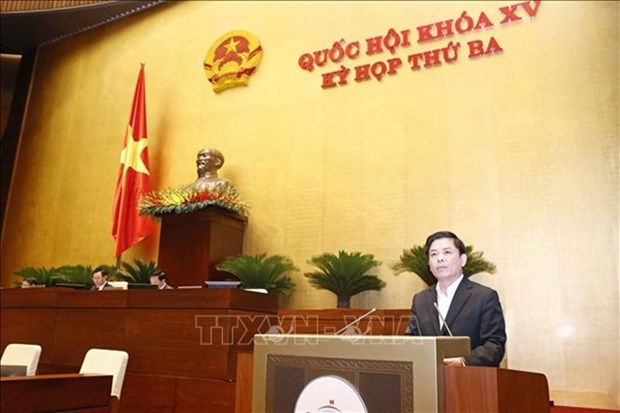 Minister of Transport Nguyen Van The speaks at the session. (Photo: VNA)
In particular, the Government has yet to arrange investment for about 171km of the highway, he said.
The Ho Chi Minh Highway project approved by the National Assembly in 2004 was once expected to be completed in 2010, with a total length of 3,183km, including its main line of 2,499km and a western branch of 684km long.
Passing through 28 provinces and cities from Pac Po in the northern province of Cao Bang to Dat Mui in the southernmost province of Ca Mau, the highway project was estimated to receive a total investment of 99,170 billion VND (4.3 billion USD).
However, in 2013, the National Assembly passed Resolution 66/2013/QH13 to adjust several contents, including delaying the opening time of the whole route to 2020. In the period after 2020, some sections will be upgraded according to highway standards.
Reporting to the National Assembly on May 24 on the implementation of the resolution, The said that so far, 2,362km have been completed, reaching 86.1 percent of the whole route and about 258km of branch lines were completed too.
"Other 211 km of the highway are under construction while the remaining 171 km has not yet been allocated capital for implementation," The said.
"The Ho Chi Minh Highway is an important work, having great significance in politics, economy, national defence-security, hunger eradication and poverty alleviation. The Party and State pay great attention and allocate resources to implement the project," The said.
From 2000 to 2011, the project's progress was on track.
However, due to the influence of the global economic crisis, the Government issued Resolution No 11/NQ-CP on February 24, 2011, on stopped or delayed projects, including component projects of the Ho Chi Minh Highway.
Therefore, from 2011 to the end of 2015, although investments for projects were approved, very few traffic projects, including the Ho Chi Minh Highway, were implemented.
"Due to limited resources, by the end of 2020, the Government couldn't arrange enough capital to connect the whole route as per the goal of Resolution No 66/2013/QH13," The said.
The Government asked for further investment to complete the highway, The said, proposing that making the existing National Highway No 32 and National Highway No 21 connect with the Ho Chi Minh Highway, instead of opening a new route Co Tiet -Cho Ben in the northern province of Phu Tho.
Examining the Government's report on the implementation of Resolution No 66/2013/QH13, the NA's Science, Technology and Environment Committee found that during the five years from 2017 to 2021, the project implementation only reached about 8 percent of the total volume and the project was now nearly two years behind the planned schedule.
The committee proposed the Government direct the review and careful calculation of data, ensuring consistency and accuracy in allocating resources for the project, said the committee’s chairman Le Quang Huy.
"It is necessary to clarify the basis for determining the capital demand of the project," Huy said.
The committee agreed with the Government's proposal to make use of National Highway 32 and National Highway 21 as the section of Co Tiet - Cho Ben had not been invested, to promote the efficiency of the entire highway, Huy said./.





You should also see
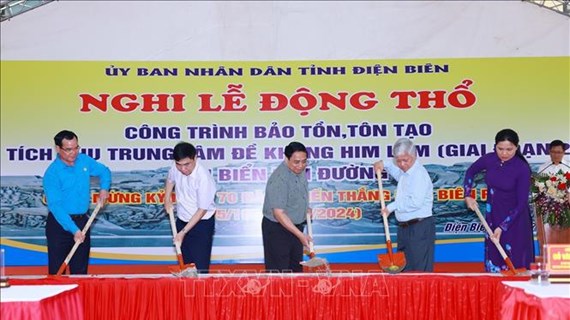
PM attends ceremony to start work on Him Lam resistance centre renovation project
Prime Minister Pham Minh Chinh on April 17 attended a ceremony to start work on a project to renovate Him Lam resistance centre, a part of the Dien Bien Phu complex of fortifications in the northern mountainous province of Dien Bien.



See more
 Business
Thu Duc city seeks investment in 11 PPP projects
Authorities of Thu Duc city, Ho Chi Minh City, held a conference on April 17 to draw investment in 11 public-private partnership (PPP) projects in the fields of education, culture and sports, with a total capital of over 2 trillion VND (83.3 million USD).
 Videos
Real estate market thrives, entities ready to re-enter market
The real estate market has witnessed positive developments, with a slew of projects, including billion-dollar projects, being announced and called for investment in the first quarter of 2024.
 Business
Forum discusses support for women-owned firms to join supply chains
A forum on supporting women-owned businesses to join supply chains through sustainable development tools took place in Hanoi on April 17.
 Business
Satisfaction of administrative services improves
Vietnamese citizens had greater satisfaction with the administrative services provided by State agencies last year, according to the Satisfaction Index of Public Administration Services (SIPAS) 2023 announced by the Ministry of Home Affairs (MoHA) on April 17.
 Business
Petrol prices increase slightly on April 17
The retail prices of petrol were adjusted up from 3pm on April 17 by the Ministry of Industry and Trade and the Ministry of Finance.
