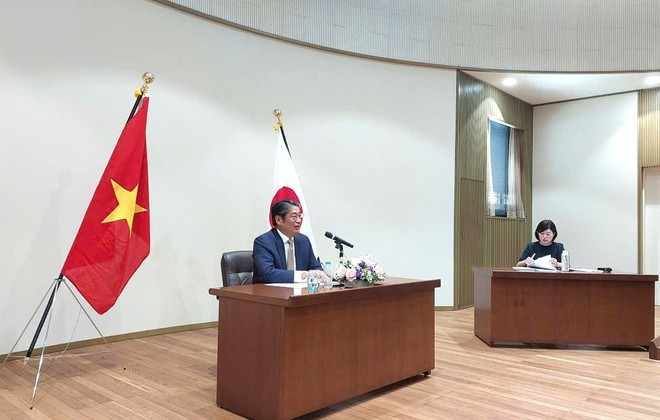
Hanoi (VNA) – Within the framework of the Comprehensive Strategic Partnership, Vietnam and Japan will continue to step up cooperation to help maintain peace and stability in the region, Japanese Ambassador to Vietnam Ito Naoki told the press on the occasion of the 52nd anniversary of diplomatic ties (September 21, 1973 – 2025).
He further stated that Japan will accompany Vietnam in “writing a story of peace.”
The Ambassador stressed that bilateral relations are now at their closest stage ever, with substantial progress made across science and technology, innovation, digital and green transformation, strategic infrastructure, energy, environment, and investment climate improvement.
The two countries have identified four priority cooperation areas promising major breakthroughs. These include science and technology, strategic infrastructure, improvement of the investment climate, and defence cooperation.
Among these, science-technology, innovation, digital and green transformation, semiconductors, and AI have been defined as new pillars of cooperation by high-ranking leaders. In the semiconductor field, joint training and research programmes have already begun delivering results.
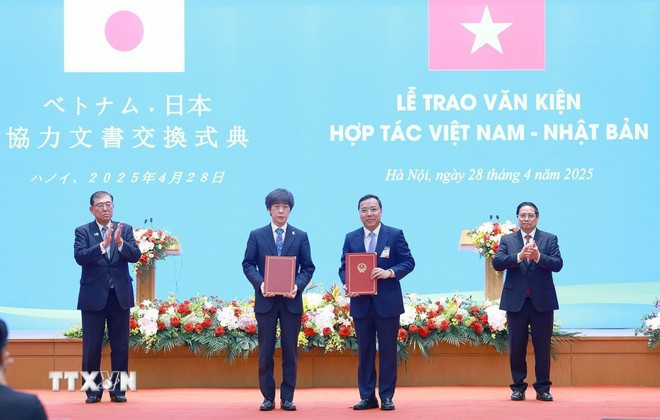
A joint international research programme involving five Vietnamese and five Japanese universities will be launched in October, bringing more than 60 Vietnamese PhD students to Japan. Japan is expected to host 250 doctoral students, equivalent to half of Vietnam’s target of training 500 PhDs by 2030.
In AI, the Japan International Cooperation Agency (JICA) is partnering with the Matsuo Laboratory at the University of Tokyo to strengthen human resource training and research at Hanoi University of Science and Technology and the National Innovation Centre (NIC).
On green transition and energy, both countries are promoting investment projects worth around 20 billion USD, including offshore wind power and LNG-to-power plants. Japan is also considering a 300 million USD programme loan this year to support Vietnam’s climate response and green transition.
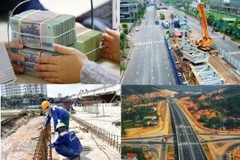
According to the ambassador, Japan is also working to leverage its strengths in cooperation with Vietnam in infrastructure, especially projects that improve the environment and enhance utilities for Hanoi residents. Recently, the Yen Xa Wastewater Treatment Plant, funded by a 200 million USD Japanese ODA loan, was inaugurated. In addition, work has begun on the "North Hanoi Smart City" project, aiming to build an urban area that harmoniously combines Japanese culture and technology. Hanoi Metro Line 2 is expected to start construction in October this year, and the Japanese side wishes to continue cooperating to extend it to Noi Bai Airport.
Economic ties are also thriving. Japanese investment in Vietnam has reached 80 billion USD, with over 2,000 Japanese businesses operating, about 60% of which plan to expand within the next two years. Bilateral trade now totals 50 billion USD annually.
In security and defence, Japan’s Foreign Minister is expected to visit Hanoi this year to co-chair the Japan–Vietnam Cooperation Committee. The first “2+2” dialogue at the deputy minister level in foreign and defence affairs will also be held to foster defence industry collaboration and equipment transfer.
Cultural and people-to-people exchanges continue to serve as a solid foundation for bilateral friendship. Ito noted that cultural and sports events are frequently organised, highlighting the opera Princess Anio to be staged in Yokohama next year, reenacting the love story between a Japanese merchant and a Vietnamese princess. Football cooperation between the Japan Football Association (JFA) and the Vietnam Football Federation (VFF) is also underway, including coaching support. In June 2026, leading Japanese club Kawasaki Frontale will tour Hanoi and Ho Chi Minh City.
Ready to accompany Vietnam
Ito praised Vietnam’s ongoing reforms, which are opening new opportunities for strengthening bilateral ties and expanding business cooperation. Japan hopes that efforts such as simplifying administrative procedures, expediting licensing, decentralising authority, and effectively utilising ODA will further improve the investment climate.
He underlined the need for Vietnam to develop high-quality human resources, particularly in key sectors such as semiconductors and AI, while further improving the investment climate to attract international capital and link it with domestic strengths.
With Resolution 68 on private sector development, Japan can share its experience in connecting domestic and foreign enterprises, boosting productivity, and empowering Vietnamese businesses. The Ambassador also noted that Japan operates a two-tier local government system and stands ready to share lessons with Vietnam./.