Vietnam drives int’l cooperation in quantum technology

Vietnam is pursuing a focused approach to quantum technology, rather than trying to compete head-to-head with leading technology powers across the full spectrum of quantum research.

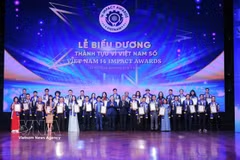
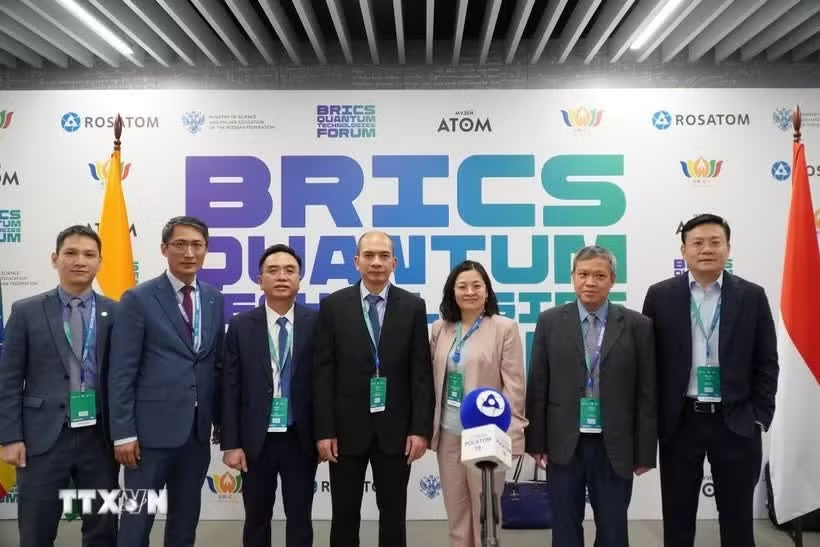
Vietnamese delegation to the forum (Photo: VNA)

Moscow (VNA) – A delegation from the Vietnam Academy of Science and Technology (VAST), led by Prof. Dr. Tran Tuan Anh, attended the first BRICS Quantum Technologies Forum held in Moscow on June 7–8.

Co-hosted by the Russian Ministry of Science and Higher Education and the State Atomic Energy Corporation Rosatom, the event drew more than 300 attendees from BRICS countries and partner nations, providing a platform for policymakers, scientists, research institutions, universities, and tech enterprises to debate the latest in quantum science and technology.

A VAST report was delivered by Director of the Institute of Physics Assoc. Prof. Dr. Dinh Van Trung, outlining Vietnam’s approach to advancing quantum science and technology.

Leveraging Vietnam’s strengths in maths, theoretical physics and computational science, VAST is zeroing in on research areas that match national capabilities, including quantum simulation, algorithms, materials, sensing, post-quantum cryptography and information security apps.

Alongside open discussions, the Vietnamese delegation held bilateral and multilateral meetings with international counterparts to share views on Vietnam’s quantum development, global trends and partnership opportunities inside the BRICS framework.

Addressing a plenary session, Russian Minister of Science and Higher Education Valery Falkov stressed the ample potential for scientific and educational cooperation among BRICS nations in the quantum domain.

Collaboration between Russian research institutes and universities under national quantum computing and quantum communications roadmaps has enabled substantial progress in the field, he said.

Director General of Rosatom Alexey Likhachev underscored the importance of advanced technologies in ensuring national sovereignty. He pointed to Russia’s extensive experience in exporting hi-tech capabilities through nuclear energy projects, which have helped partner countries develop new industries, bolster workforce training, and advance scientific research.

Likhachev also confirmed Russia’s readiness to share that expertise with partners.

Members of the BRICS Nuclear Energy Platform issued a joint statement recognising quantum computing’s growing role in shaping the future of energy, and called for tighter cooperation among BRICS countries to accelerate quantum computing development and unlock nuclear energy’s full potential.

Talking with policymakers, scientists, and media at the forum, Anh said Vietnam is pursuing a focused approach to quantum technology, rather than trying to compete head-to-head with leading technology powers across the full spectrum of quantum research.

He said Vietnam’s strategy centres on cultivating a quality workforce, establishing strong research groups, bolstering shared research infrastructure, and expanding collaboration with leading international scientific centres, a step-by-step buildup of internal capability in a domain defined by long investment cycles and steep foundational science requirements.

Beyond policy and strategy discussions, the forum offered technical visits to some of Russia’s premier quantum research facilities, including the Russian Quantum Centre, the Cold-Ion Quantum Computing Laboratory, the Laboratory of Coherent Microoptics and Radiophotonics, the Lebedev Physical Institute, MISIS University, and a lab specialising in superconducting quantum technologies.

Participants described the international dialogue among nascent “quantum communities” at the Moscow forum as a critical first step toward a sustainable BRICS quantum ecosystem built on mutual respect, trust and equality.

The overall goal is to advance quantum technologies in ways that solidify the technological base of BRICS nations and accelerate industrialisation through quantum-driven innovation./.
VNA

See more

At Expo Tel Aviv in Israel (Photo: VNA)

Digital transformation fuels demand for cybersecurity talent

According to the National Cybersecurity Association (NCA), cyberattacks are rising in both frequency and severity. Attackers are targeting critical infrastructure, personal data, and public services with increasingly advanced methods. This isn't just a technical glitch, but a systemic vulnerability requiring a workforce that can analyse and respond in real time.

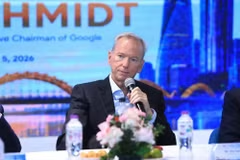
Billionaire Eric Schmidt, former Chairman and CEO of Google and former Chairman of the US National Security Commission on Artificial Intelligence (NSCAI) (Photo: NIC/VietnamPlus)

Vietnam well-positioned to become global AI hub: Eric Schmidt

Vietnam possesses significant advantages and strong potential to emerge as a global centre for artificial intelligence (AI), according to billionaire Eric Schmidt, former Chairman and CEO of Google and former Chairman of the US National Security Commission on Artificial Intelligence (NSCAI).

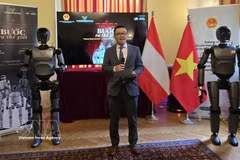
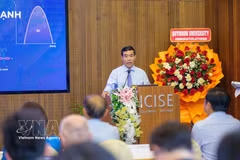
Vietnamese Ambassador to Austria Vu Le Thai Hoang speaks at the event. (Photo: VNA)

Vietnam shows off homegrown humanoid robots in Austria

The event paired a robotics showcase with an innovation networking session, spotlighting Vietnamese companies’ research, development and technological mastery in robotics, automation and artificial intelligence.

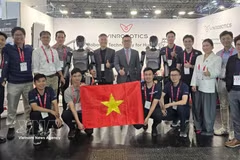
Vietnamese delegates at the 2026 IEEE International Conference on Robotics and Automation (ICRA 2026). (Photo: VNA)

Vietnamese tech draws attention at Austria robotics forum

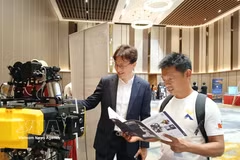
Representing Vietnam were VinRobotics and VinDynamics, two tech subsidiaries of Vingroup. They showcased "Make in Vietnam" humanoid robots, demonstrating the country’s growing capacity to integrate into the global robotics value chain.

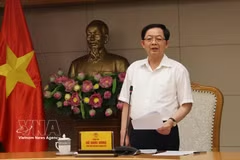
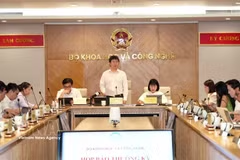
Deputy Prime Minister Ho Quoc Dung speaks at the meeting of the Government task force on strategic technology development on June 4. (Photo; VNA)

Deputy PM demands tangible results in strategic tech development

Deputy PM Ho Quoc Dung pressed ministries and agencies to rapidly convert their assigned tasks into concrete action plans with clearly defined responsibilities, and effectively launch projects that create strategic technology products capable of sharpening national competitiveness.

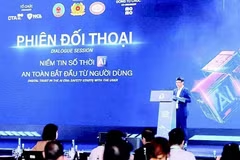
A panel discussion on “Digital trust in the AI era: Security starts with the users” at the Digital Trust in Finance 2026 forum (Photo: nhandan.vn)

Protecting users crucial in building digital trust: Experts

In Vietnam, digital transformation in the finance and banking sector is accelerating cashless payments, expanding access to financial services, improving market transparency and supporting economic growth and macroeconomic management.

Illustrative image

Proactive cybersecurity essential in age of AI-powered crime: experts

According to Dr. Le Minh Nghia, Chairman of the Vietnam Financial Consulting Association (VFCA), AI has become a key driver reshaping the global financial industry. In Vietnam, the technology is already widely used in banking and finance for credit analysis, electronic customer identification (eKYC), risk management, service personalisation and real-time transaction processing.

Dr Nguyen Huu Ha, Deputy Director of the Gia Lai Department of Science and Technology, speaks at the scientific workshop on recent advances in the study of strongly correlated electron systems opened in the central province on June 1, 2026. (Photo: VNA)

Global physicists discuss strongly correlated electron materials advances

The workshop aims to achieve three key objectives providing a platform for academic exchange and strengthening collaboration between leading international scientists and young researchers, including doctoral students; promoting multidimensional scientific dialogue on major open questions in the field; and initiating new directions for international research cooperation with the active participation of Vietnam's physics community.

Tra Vinh University attracts a growing number of students and interns from Vietnam and abroad for study and research programmes. (Photo: VNA)

Fostering skilled workforce for innovation era: experts

Experts said close coordination among State management agencies, research institutes, universities, and businesses will improve training quality and serve the dual goals of quality education and practical research application.