Vietnam expands bear rescue centre in Bach Ma National Park

Bears used to be often held captive in Vietnam for their bile, which is thought to have healing effects according to traditional medicine.

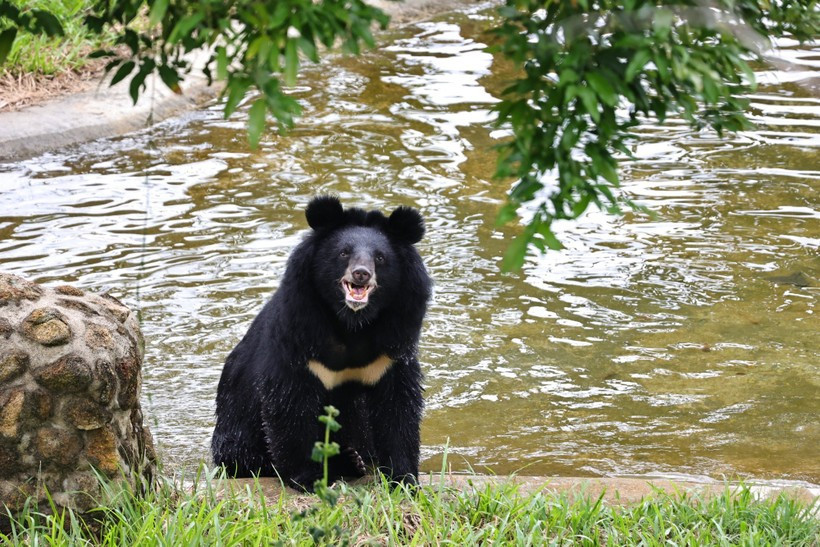
A bear at the Vietnam Bear Rescue Centre of Bach Ma National Park, Hue city.

Hanoi (VNA) – Construction has begun on the second phase of the Vietnam Bear Rescue Centre in Bach Ma National Park in the central city of Hue, marking another step towards ending bear bile farming nationwide by the end of 2026.

The project, which covers 12.5 hectares, was implemented under a memorandum of understanding signed in 2017 between the Vietnamese Government and Animals Asia.

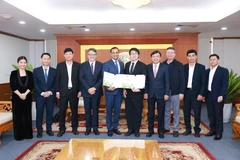
The groundbreaking ceremony on September 10 was jointly organised by the Vietnam Administration of Forestry (VNFOREST) under the Ministry of Agriculture and Environment, the management board of the Vietnam bear rescue project, and the Animals Asia Foundation (AAF).

This marks an important milestone in Vietnam’s efforts to fully end bear bile farming nationwide by the end of 2026.

Representatives from Animals Asia, the Vietnam Administration of Forestry, the Hue Forest Protection Sub-department, the Region 2 Forest Protection Sub-department, and Bach Ma National Park at the groundbreaking ceremony.

Phase 1 of the project, inaugurated in October 2023, has already delivered key facilities, including a modern veterinary hospital, a 30-day quarantine area built to international standards, bear houses, and four large semi-natural enclosures.

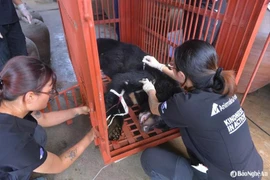
Since then, the centre has successfully rescued 19 Asiatic black bears from various provinces, and all the animals were voluntarily transferred by local households. This voluntary handover demonstrates growing public support for the Government’s policy of ending bear bile farming.

The second phase, with an investment of more than 13.4 billion VND (536,000 USD) funded entirely through non-refundable aid from the AAF, will expand the centre’s capacity with additional infrastructure, accommodation for staff and veterinarians, and more space for exhibitions and outdoor education programmes to raise public awareness.

Once completed, the centre is expected to serve as a leading wildlife rescue facility and conservation education hub in central Vietnam.
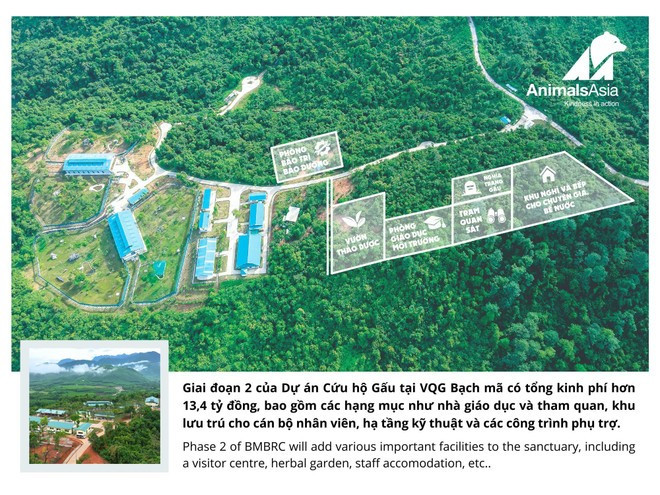
gau-1.jpg
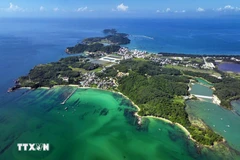
The grounds of the Vietnam Bear Rescue Centre in Bach Ma National Park. (Photo: VietnamPlus)

Dr Jill Robinson, founder and CEO of the AAF, said the groundbreaking ceremony marked not just a construction project but an important milestone, symbolising strong cooperation and a shared vision for a safe future for rescued and endangered bears in Vietnam.

Between April and June this year, the AAF, in coordination with forestry authorities and international partners, conducted surveys across 12 provinces, recording 156 bears still being kept in households. The organisation has been working with bear owners to find practical solutions and to encourage voluntary transfers.

With the combined capacity of its rescue centres in Tam Dao and Bach Ma, the AAF has pledged to work with VNFOREST, local forest protection units, and relevant authorities to ensure that no bear is left behind.

To date, 290 bears have been successfully rescued in Vietnam, including eight voluntarily transferred by households in 2025 alone.

These results demonstrate broad public support and reaffirm Vietnam’s strong commitment to wildlife conservation and biodiversity protection, an AAF representative said.

Bears used to be often held captive in Vietnam for their bile, which is thought to have healing effects according to traditional medicine.

The AAF has launched a "#nobearleftbehind” hashtag campaign with the goal of rescuing all bears held in captivity in Vietnam./.
VNA

See more

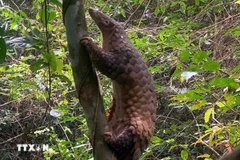
Sunda pangolins (Manis javanica), also known as the Javan pangolin, are listed in Group IB – critically endangered and strictly protected from all commercial exploitation (Photo: VNA)

Quang Ngai releases rare pangolin back into nature

Initial verification showed that the animal weighed 3.7kg and measured over 60cm. It was identified as a Sunda pangolin (Manis javanica), also known as the Javan pangolin, listed in Group IB – critically endangered and strictly protected from all commercial exploitation.

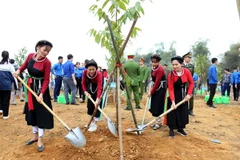
Residents of Tuyen Quang province take part in the One Billion Trees Programme. (Photo: VNA)

Tree-planting programme exceeds one-billion-tree goal

The total comprises 573.9 million scattered trees and 865.2 million trees grown in concentrated plantations, equivalent to 429,125 hectares of forest. Provinces posting the strongest results include Phu Tho with 177.9 million trees, Lao Cai with 108.8 million, and An Giang with 98.5 million.

Construction activity is one of the causes of air pollution in Hanoi. (Photo: VNA)

Hanoi takes urgent measures to curb air pollution

The city requires the enhanced application of advanced technologies and remote monitoring systems, including satellite remote sensing, drones, and AI-integrated traffic cameras, to monitor, detect, and strictly address the illegal burning of garbage, straw, and agricultural by-products.

The World Bank delegation holds working session with Can Tho city People's Committee and relevant units (Photo: VNA)

World Bank delegation surveys Can Tho urban resilience project

The project is jointly financed by the WB with up to 250 million USD and a 10-million-USD non-refundable grant from the Swiss State Secretariat for Economic Affairs (SECO), along with counterpart funding from the Vietnamese Government. Its goal is to build a climate-resilient and sustainable city that can drive socio-economic growth across the Mekong Delta, mitigate flood vulnerability in central Can Tho, and improve inter- and intra-regional transport connectivity.

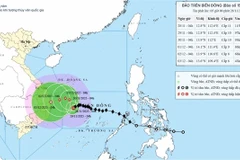
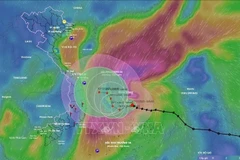
The direction of Storm Koto as of 04:00 on November 27. (Photo: VNA)

Lam Dong province’s coastal localities brace for Storm Koto

Local authorities have activated round-the-clock duty operations, continuously updated storm warnings and flood information and intensified inspections of riverside and seaside areas, low-lying zones, and locations at high risk of landslides and deep flooding.

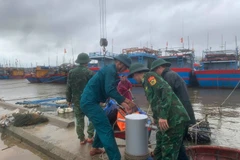
Border guard officers at Ky Ha Port Border Gate are assisting residents in securing their boats. (Photo: VNA)

VPA General Staff directs urgent response to Storm Koto

Military Regions 4, 5 and 7 were tasked with directing provincial military commands to advise local authorities, review response plans, and coordinate with relevant departments and sectors to identify disaster-prone areas, including locations at risk of flash floods, landslides, major dykes, embankments and reservoirs, and flood-prone zones, particularly those heavily affected by recent rains.

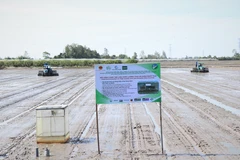
In 2024–2025, the project has implement seven pilot models in Can Tho city and the provinces of Vinh Long, Dong Thap, and An Giang. (Photo: VNA)

One-million-hectare high-quality, low-emission rice project changes mindset of producers

A project on sustainable development of one million hectares of high-quality, low-emission rice cultivation associated with green growth in the Mekong Delta by 2030 has so far helped shift the awareness and mindset of rice producers toward greater responsibility and toward adopting production trends aligned with global orientations for “green development.”

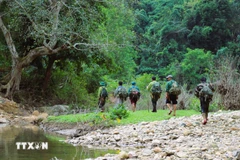
Two rangers check a camera trap in jungle of the Saola Nature Reserve in Hue city. (Photo: VNA)

Vietnam’s forests show signs of wildlife recovery

Vietnam’s forests are among the world’s most biodiverse, yet wildlife remains threatened by habitat loss and snaring. A new WWF-Vietnam survey, using 350,000 camera-trap days across 21 forests, reveals urgent conservation needs and signs of recovery.