Vietnam, India's Uttar Pradesh forge closer ties at Int’l Trade Expo 2024

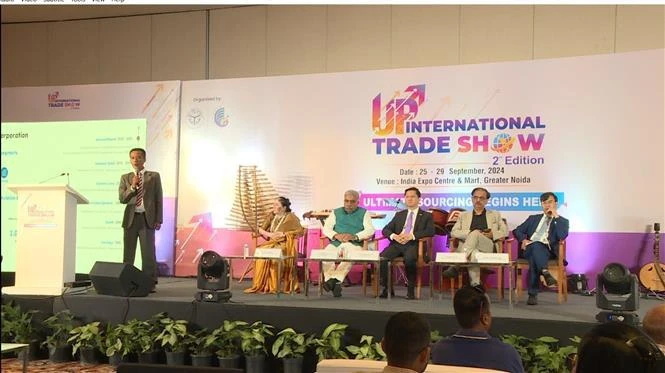
The Vietnam-Uttar Pradesh tourism workshop and the Vietnam-India silk and apparel trade seminar took place on the second day of the Uttar Pradesh International Trade Expo 2024 in Uttar Pradesh state, northern India on September 26. ​

At the Vietnam-Uttar Pradesh tourism workshop (Photo: VNA)

New Delhi (VNA) – The Vietnam-Uttar Pradesh tourism workshop and the Vietnam-India silk and apparel trade seminar took place on the second day of the Uttar Pradesh International Trade Expo 2024 in Uttar Pradesh state, northern India on September 26.

Officials and business representatives from both sides pledged to bolster their partnership via facilitating market entry for agricultural goods, processed food, apparel, footwear and services.

Vietnamese Ambassador Nguyen Thanh Hai underlined Vietnam's focus on Uttar Pradesh, citing its dynamic economy, numerous Buddhist pilgrimage sites, and vast investment potential in food processing, apparel, renewable energy, infrastructure, civil aviation, MSMEs, and information technology.

Highlighting Vietnam's tourism strengths, Hai showcased its stunning natural landscapes, spiritual and cultural sanctuaries, and rich cuisine. He noted the growing popularity of Indian restaurants in Vietnam and proposed increasing direct flight frequencies and streamlining visa procedures to facilitate travel between the two countries.

Currently, e-visas are available for all Indian citizens, valid for three months with multiple entries. Vietnam has also suggested exploring more visa options through bilateral discussions.

Uttar Pradesh Minister of MSME Rakesh Sachan extended an invitation to investors, particularly those in the tourism and hospitality sector, to explore opportunities in the state, which has emerged as a prominent spiritual destination in India.

At the silk and apparel trade seminar co-hosted by the Ministry of Industry and Trade’s Vietnam Trade Promotion Agency, the Vietnamese Embassy in India’s Trade Office and the Indian Silk Export Promotion Council, Chief Representative of the agency's Central and Central Highlands Regional Office Bui Xuan Lich urged Vietnamese and Indian firms to enhance technology transfer, collaborate within production chains, and engage in professional trade promotion activities.

A representative of the Vietnam Sericulture Association expressed the country's interest in partnering with India to produce quality dual-system silkworm eggs, invest in weaving, dyeing, printing, and apparel manufacturing, and establish chain-linked models in silk production. This marks the association's first trade promotion activity in India, a country that accounts for 90% of Vietnam's silk export revenue.

The discussions underscored how Vietnam and India could leverage each other's strategic locations to serve as gateways to South Asia and the Association of Southeast Asian Nations (ASEAN), respectively./.

VNA

See more

Experts said that Vietnam’s economic outlook continues to be underpinned by stable foreign direct investment inflows and public investment, which is playing an important role in driving growth. (Photo: thoibaotaichinh.vn)

Foreign investors maintain strong confidence in Vietnam’s market

Looking ahead to 2026, prospects remain bright as manufacturing, economic growth and foreign investment in Vietnam are expected to stay robust, with the country forecast to post the highest growth rate in the region this year, according to Adam Sitkoff, Executive Director of the American Chamber of Commerce (AmCham) in Vietnam.

Toy production at a Hong Kong-invested factory (Photo: VNA)

Vietnam targets deeper market penetration in Hong Kong in 2026

Vietnam-Hong Kong trade hit 62.3 billion USD in the first 11 months of 2025, soaring 73.1% annually. Vietnamese exports to Hong Kong amounted to 36.8 billion USD, a 90.6% hike, ranking fourth among Hong Kong’s import sources, while imports from Hong Kong stood at 25.5 billion USD, up 52.9% and ranking third.

Vietnam’s start-up market enters restructuring phase

Vietnam’s start-up market enters restructuring phase

In 2026, venture capital inflows into Vietnam’s start-up ecosystem are expected to recover gradually, though in a more selective manner. VinVentures forecasts that capital will focus on start-ups that have survived the rigorous screening of 2024–2025, possess clear business models, strong commercialisation capacity, and the ability to generate real cash flows.

Workers process tra (pangasius) for export (Photo: VNA)

Vietnam–Singapore trade continues to thrive

For the year as a whole, Vietnam retained its position as Singapore’s 10th largest trading partner. Bilateral trade reached a record high of nearly 40 billion SGD, up 26.2% from the previous peak of 31.67 billion SGD recorded in 2024.

Eric Van Vaerenbergh, an energy expert and lecturer at the Brussels Engineering School (ECAM) (Photo: VNA)

Belgian expert optimistic about Vietnam’s economic outlook

Vietnam should move from a growth model based mainly on expanding capital and labour to one driven by productivity improvements. He said that this requires enhancing the quality of the workforce, particularly engineers, technicians, and managers in industrial sectors.

Workers at the VSIP Hai Phong industrial and urban complex, which specialises in producing electronic components for office equipment. (Photo: VNA)

Roadmap aims to improve business climate and boost competitiveness

By the end of 2026, Vietnam aims to rank among the world’s top 50 performers in the United Nations Sustainable Development Goals, advance at least three places in the International Property Rights Index, and climb at least one position in the Global Innovation Index.

Vietnam is strengthening its position in the technology value chain, becoming a major manufacturing hub for complete consumer electronics products. (Photo: VNA)

ESG standards offer opportunities to reposition Vietnam’s electronics firms

The 2025-2027 period will be a critical turning point, as exporters to the European market will be required to strictly comply with ESG standards, including net-zero emissions roadmaps, labour standards, corporate governance and transparency requirements. As a key export sector, the electronics industry is being directly and strongly affected by this shift.