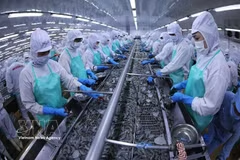
Rang Dong Light Source and Vacuum Flask JSC has applied a digital transformation strategy and increased its revenue and profit. (Photo courtesy of the firm)
Decision No 360/QD-TTg aims to improve the operational efficiency andcompetitiveness of SOEs on the basis of technology and innovation capacity,management.
The move will allow more effective mobilisation, allocation and use of socialresources, while developing state capital and assets at enterprises.
Earlier, experts asked for more drastic changes as despite many efforts in restructuringand improving state-owned enterprises (SOEs), results have not been as good asexpected.
According to the Ministry of Finance (MoF), in 2016-2020, 180 enterprises wereequitised. However, this included only 39 out of 128 enterprises on the listapproved by the Prime Minister. In 2021, three SoEs were equitized, but nonewas on the list approved by the Prime Minister.
Regarding the initial sale of shares, the total selling value was 22.7 trillionVND (987 million USD) or 23 percent of the plan.
The MoF said in 2016-20, 177.4 trillion VND was collected through divestment,about 6.5 times the book value.
Though several successful divestment enterprises could be listed, such asSabeco, Vinamilk or Rang Dong, in general, only 106 enterprises divestedcapital according to the approval decisions of the Prime Minister, equal to 30 percentof enterprises required to do so. In 2021, 18 businesses divested capital,earning 4.4 trillion VND.
Director of the MoF’s Corporate Finance Department, Dang Quyet Tien, said thatthe slow progress of equitisation and divestment of state capital was due tolarge-scale enterprises, which owned a lot of land and the sale of statecapital as well as the pandemic.
More importantly, Tien said, SOE leaders were not determined and indecisive,which has hindered the improvement of the local SOEs, which were set to serveas a fulcrum for the economy.
Chairman of the Vietnam International Arbitration Centre Vu Tien Loc said:“There is a lack of strong enterprises to play a leading role and promote thedevelopment of small and medium-sized enterprises to develop accordingly.”
Improving the scale and efficiency of enterprises
At the request to speed up the restructuring of SOEs, the MoF has developed adraft project aiming to restructure SOEs, focusing on corporations in 2021-25.
In the earlier meeting on February 14 with the Government Standing Committee onthe draft project, Politburo member and Prime Minister Pham Minh Chinh toldministries and branches to focus on perfecting institutions and policies,ensuring the state economy played a leading role and State enterprises played acore role in increasing operational efficiency.
SOE restructuring must focus on solving issues at the weak and loss-makingenterprises and maintaining, consolidating and developing efficient ones withgood branding.
At the same time, the PM said the restructuring was a separate matter. “Don’tdefine the restructuring as the implementing equitisation of enterprises,” hesaid.
At the same time, PM Chinh ordered a simplified administrative procedure forlocal equitisation, in which everything must be done substantively andeffectively without losing brand and corporate identity.
Head of the Ministry of Planning and Investment (MPI), Nguyen Chi Dung, saidthat in 2022, the ministry would focus on implementing the draft after it isapproved.
He said the MPI would consolidate and develop several large-scale and effectivestate-owned economic groups, planning to focus on 17 large SOEs in importantand necessary industries and fields for the development of the economy such asenergy, industry, finance, agriculture, telecommunications and infrastructure.
Academy of Finance economist Dinh Trong Thinh told local media: “It isimportant that when the restructuring is done, it must completely innovate themanagement mechanism and separate the capital ownership and the right to managethe enterprise in the SOEs so that the enterprise can promote efficiency inproduction and business.
Thinh said the determination of ministries and branches was needed, adding thatit was necessary to specify which industries and businesses must berestructured, divested, equitised or sold so that there would be specific plansand schedules for them./.
VNA