Vietnam plans major solar power growth
Over 100 provincial government officials, investors and other stakeholders have gathered in Ho Chi Minh City to discuss policies for the developmnet of solar energy.
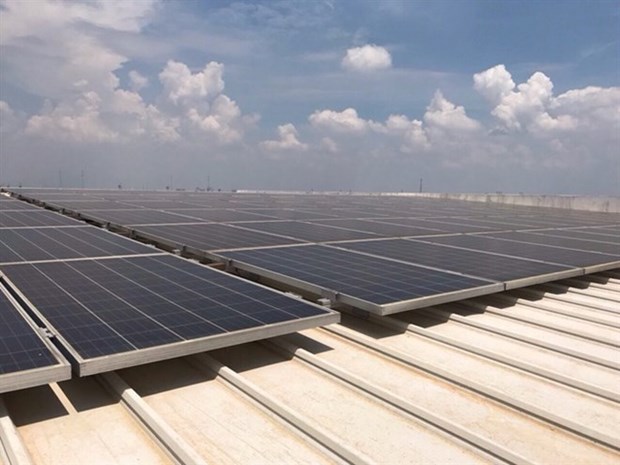 Over 100 provincial government officials, investors and other stakeholders have gathered in Ho Chi Minh City to discuss policies for the development of solar energy (Photo: VNA)
HCM City (VNA) - Over 100 provincial government officials, investors and other stakeholders have gathered in Ho Chi Minh City to discuss policies for the development of solar energy.
”We would like to provide guidance to investors, local governments and financial institutions about how to develop solar energy in Vietnam,” Pham Trong Thuc, deputy head of the Ministry of Industry and Trade’s Electricity and Renewable Energy Agency, said in his speech at a workshop on “Introduction of circular 16/2017/TT-BCT on solar power project development and standardized power purchase agreement for solar power projects”.
He explained the contents of the circular and took questions from participants.
Consultants from the Deutsche Gesellschaft für Internationale Zusammenarbeit (GIZ) shared the international perspective on solar power development in Vietnam, and made a presentation on international and regional experiences in the technical and financial assessment of solar power projects.
Solar has been high on the agenda in Vietnam since the publication of the Prime Minister’s decision 11/2017 in April, which fixed the price for solar power at 9.35 cents/kWh.
It also sets June 2019 as the deadline for solar power plants to be built and connected to the grid to receive the guaranteed solar feed-in tariff (FIT) price.
”In this context, the workshop is an opportunity for local governments to gain deeper understanding of the circular and insights into the latest solar developments, which will be helpful for better assessment and approval of solar power plants at provincial levels,” said Sonia Lioret, head of the GIZ’s Renewable Energy and Energy Efficiency Project.
Solar projects require high upfront investments. In some provinces, land availability or grid capacity limit the number of projects that can be approved by local and central authorities.
“It is therefore important to carefully assess the general viability of these new solar projects. This includes in particular the choice of site, experience of all parties and contract partners involved in the project and the quality of equipment and installation to avoid project failures or economic underperformance,” Lioret added.
“As solar power is still quite new in Vietnam, and having in mind that all projects have to be built and connected by June 2019, we believe that the combination of local knowledge and international experience will be a great recipe for successful solar power projects”, Rainer Brohm, a German solar energy expert said.
According to the Vietnamese Government’s targets, solar power is expected to become the main new renewable energy source in the future, with an installed capacity to be increased from around 6-7 MW by the end of 2017 to 850 MW by 2020 (equivalent to 1.6 percent of the country’s power generation) and 12,000 MW by 2030 (equivalent to 3.3 percent of the country’s power generation).-VNA
”We would like to provide guidance to investors, local governments and financial institutions about how to develop solar energy in Vietnam,” Pham Trong Thuc, deputy head of the Ministry of Industry and Trade’s Electricity and Renewable Energy Agency, said in his speech at a workshop on “Introduction of circular 16/2017/TT-BCT on solar power project development and standardized power purchase agreement for solar power projects”.
He explained the contents of the circular and took questions from participants.
Consultants from the Deutsche Gesellschaft für Internationale Zusammenarbeit (GIZ) shared the international perspective on solar power development in Vietnam, and made a presentation on international and regional experiences in the technical and financial assessment of solar power projects.
Solar has been high on the agenda in Vietnam since the publication of the Prime Minister’s decision 11/2017 in April, which fixed the price for solar power at 9.35 cents/kWh.
It also sets June 2019 as the deadline for solar power plants to be built and connected to the grid to receive the guaranteed solar feed-in tariff (FIT) price.
”In this context, the workshop is an opportunity for local governments to gain deeper understanding of the circular and insights into the latest solar developments, which will be helpful for better assessment and approval of solar power plants at provincial levels,” said Sonia Lioret, head of the GIZ’s Renewable Energy and Energy Efficiency Project.
Solar projects require high upfront investments. In some provinces, land availability or grid capacity limit the number of projects that can be approved by local and central authorities.
“It is therefore important to carefully assess the general viability of these new solar projects. This includes in particular the choice of site, experience of all parties and contract partners involved in the project and the quality of equipment and installation to avoid project failures or economic underperformance,” Lioret added.
“As solar power is still quite new in Vietnam, and having in mind that all projects have to be built and connected by June 2019, we believe that the combination of local knowledge and international experience will be a great recipe for successful solar power projects”, Rainer Brohm, a German solar energy expert said.
According to the Vietnamese Government’s targets, solar power is expected to become the main new renewable energy source in the future, with an installed capacity to be increased from around 6-7 MW by the end of 2017 to 850 MW by 2020 (equivalent to 1.6 percent of the country’s power generation) and 12,000 MW by 2030 (equivalent to 3.3 percent of the country’s power generation).-VNA





You should also see

VNA marks 70th anniversary of Dien Bien Phu Victory with various activities
The Vietnam News Agency (VNA) hosted an array of activities to celebrate the 70th anniversary of the Dien Bien Phu Victory (May 7, 1954 - 2024).



See more
 Business
Quang Ninh attracts additional 115 million USD from Japan investors
The Quang Ninh Economic Zone Authority (QEZA) presented investment certificates to two Japanese projects worth 115 million USD in total at a conference held at Song Khoai Industrial Park (IP) on April 19.
 Business
Central bank plans to auction gold bars on April 22
The State Bank of Vietnam (SBV) will auction SJC-branded gold bars on April 22, a representative of the central bank said on April 19.
 Business
Hanoi to host Vietnam Medipharm Expo 2024
The 31st Vietnam International Medical and Pharmaceutical Exhibition (Vietnam Medipharm Expo 2024) is scheduled to take place in Hanoi from May 9 to 12, an official of the Ministry of Health (MoH) told a press conference on April 19.
 Business
Japan's Takashimaya plans to expand investment in Vietnam
Takashimaya, a Japanese operator of upscale department stores, plans to open a shopping centre in Hanoi in 2026 that will be the company's first new location abroad in eight years, Japanese newspaper Nikkei reported.
 Business
Localities get ready for fourth FDI boom
As the year 2024 is expected to witness the start of the fourth wave of foreign direct investment (FDI) to Vietnam, localities nationwide are getting ready to absorb foreign capital flows.
