Vietnam races to complete digital transformation in healthcare sector

The Ministry of Health is accelerating digital transformation to meet evolving demands amidst rapid sci-tech advancement, coupled with emerging public health challenges.

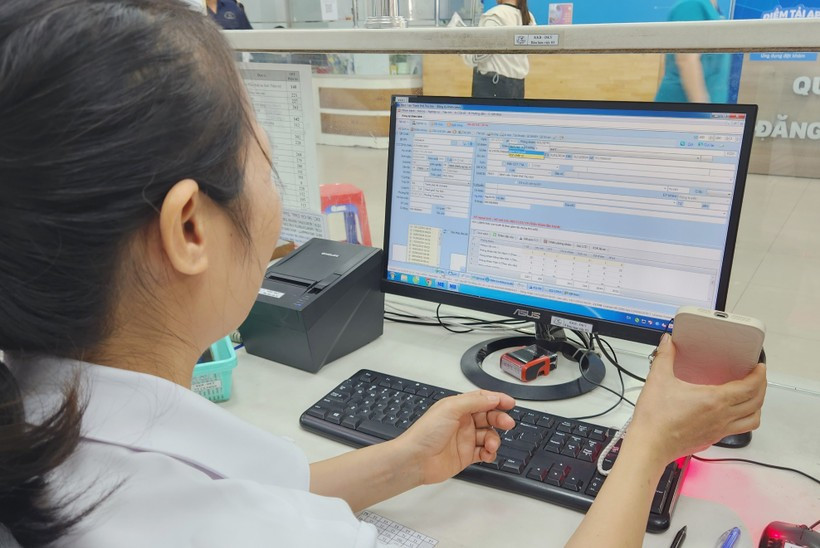
The healthcare sector is stepping up digital transformation to create favourable conditions for patients. (Photo: VietnamPlus)

Hanoi (VNA) – The Ministry of Health is accelerating digital transformation to meet evolving demands amidst rapid sci-tech advancement, coupled with emerging public health challenges.

The Government has laid the legislative groundwork for this shift over the past years, with Resolution No. 17/NQ-CP, issued in March 2019, setting out core tasks for building an e-government between 2019 and 2020, with a vision extending to 2025. It placed citizens at the centre of governance and singled out healthcare as a priority field for digital transformation. The resolution paved the way for interconnected health information systems designed to make public services more transparent, efficient, and people-focused.

Under the decision on national digital transformation until 2025 with vision to 2030, the Prime Minister highlighted key missions for the healthcare sector, including expanding telemedicine, online medical consultations and remote diagnosis capabilities to reduce the burden on higher-level facilities while improving healthcare accessibility for residents in mountainous areas. Besides, the sector must focus on electronic health records standardisation to create a comprehensive personal healthcare database platform.

Deputy Minister of Health Tran Van Thuan underscored that the ministry has seen consolidating the grassroots healthcare system as the foundation and digital transformation as the lever for change.

There will no longer be a gap between advanced technology and grassroots medical stations, he said, adding AI is supporting imaging diagnostics while risk factors for cardiovascular disease, cancer, and chronic illnesses are digitised and tracked through electronic health records.

Vietnam is eyeing a provincial-level smart healthcare network, where each locality establishes its own digital health ecosystem with electronic records, telemedicine, early disease warning systems, and AI-powered diagnostics. This marks a shift from reactive healthcare to predictive healthcare, from manual administration to data-driven governance.

Director of the National Health Information Centre Do Truong Duy described electronic health records as a pillar in the sector’s digital transformation, helping improve examination quality, optimise management, archive, and information sharing, while ensuring accuracy and security of public health data.
xet-nghiem.jpg
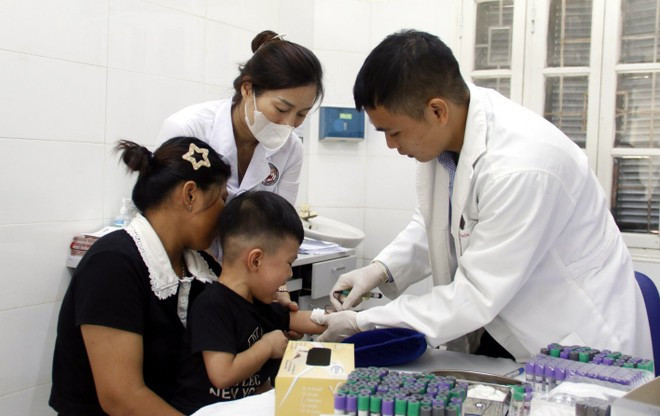
Medical staff conduct blood testing. (Photo: VietnamPlus)

The e-records particularly enhance transparency in professional regulation compliance. These systems are developing into comprehensive databases for research and disease pattern evaluation, serving as foundations for procurement planning and pharmaceutical and medical supply bidding processes.

So far, 301 medical facilities nationwide have successfully implemented electronic medical records, which is modest compared to the Government’s targets. Primary obstacles include financial constraints, technological infrastructure limitations, human resources shortages, and inadequate coordination between sectors and administrative levels.

Under the Prime Minister’s Directive No. 07 in March 2025, all ministries and localities are requested to accelerate the national digital transformation agenda. The directive set a hard deadline for all hospitals nationwide to fully implement electronic medical records by September 30, 2025.

To remove barriers, the Ministry of Health issued a document, providing specific technical guidance for hospitals to carry out e-health records. The move aims to simplify procedures, standardise systems, and give hospitals both the legal and technical basis to execute digital reforms on schedule./.


VNA

See more

Maternal and child healthcare in Tuyen Quang province. (Photo: VNA)

Vietnam on path to become a healthy nation

Resolution 72 not only focuses on health care but is also closely interlinked with other sectors, helping to build a solid foundation for sustainable national development and create momentum for Vietnam to “take off” and further integrate into the world.

The emergency ward at Bach Mai Hospital, Hanoi. (Photo: VNA)

Health sector targets free hospital fee for all

The total value of medical expenses not covered by the health insurance fund is estimated at around 24.8 trillion VND (942 million USD) per year. Health insurance contributions remain low, at 4.5% of the salary or reference base used for calculation.

Sen. Lieut. Gen. Vongsone Inpanphim, Lao Deputy Minister of National Defence and Director of the General Department of Politics presents the Friendship Order of Laos to Vietnam’s Central Military Hospital 108. (Photo: VNA)

Vietnam, Laos expand cooperation in military medicine

Over the past two decades, many Vietnamese experts have undertaken long-term missions at the Central Hospital 103 to provide training and technical assistance, contributing to the successful treatment of complex cases. The Central Military Hospital 108 has also trained 206 Lao doctors, six nurses and two engineers — a clear demonstration of substantive, long-standing cooperation.

Deputy Minister Do Xuan Tuyen (left) and Alberto Anaya Gutiérrez, General Secretary of the Mexican Workers' Party (PT). (Photo: VNA)

Vietnam, Mexico boost medical cooperation

As both nations look to keep their long-standing partnership in good health, the health ministries of Vietnam and Mexico have been accelerating cooperation, especially in traditional medicines.

The opening of Vietnam Medi-Pharm 2025 and Vietmedicare Expo in Ho Chi Minh City on November 27, 2025. (Photo: VNA)

Major medical, pharmaceutical exhibitions kick off in HCM City

The 33rd Vietnam International Medical and Pharmaceutical Exhibition (Vietnam Medi-Pharm 2025) and the International Exhibition on Pharmaceuticals, Medical Devices and Healthcare (Vietmedicare Expo 2025) kicked off at the Saigon Exhibition and Convention Centre on November 27.

Doctors Do Thi Ngoc Linh (left) and Le Diep Linh at the RCS membership certificate award ceremony in London. (Photo: VNA)

Vietnamese surgeons honoured with prestigious Royal College Fellowship

The fact that the Vietnamese doctors have been awarded with FRCS certificate proves Vietnam’s surgical expertise has met international standards, contributing to improving the quality of treatment at home, expanding academic cooperation with world leading medical institutions and inspiring younger doctor to pursue higher standards.

Doctors from Military Hospital 175 perform surgery on a patient on Truong Sa Island. (Photo: Military Hospital 175)

First successful open-chest surgery performed at Truong Sa infirmary

The successful emergency operation on a patient with serious chest injuries in Truong Sa showed that Vietnam’s military medical forces are now capable of handling complex emergencies at sea, boosting the confidence of soldiers and fishermen living and working on remote islands.