Vietnam sets out strategy to build stronger global national image

Vietnam is now taking steps to enhance its global profile through a comprehensive communication strategy aimed at promoting the country’s image overseas for the 2026–2030 period, with a vision to 2045.

The beauty of Long Bien Bridge – a cultural and historical symbol of Hanoi. (Photo: VNA)

Hanoi (VNA) - Amid intensifying globalisation, countries are increasingly competing not only in economic performance but also in reputation, image and influence on the international stage. Vietnam is now taking steps to enhance its global profile through a comprehensive communication strategy aimed at promoting the country’s image overseas for the 2026–2030 period, with a vision to 2045.

As a nation rich in cultural identity and actively integrating into the world economy, Vietnam faces growing demand for a more systematic and professional approach to national branding. For the first time, a unified national message and visual identity framework has been developed to serve as a consistent foundation for communication and promotion activities abroad.
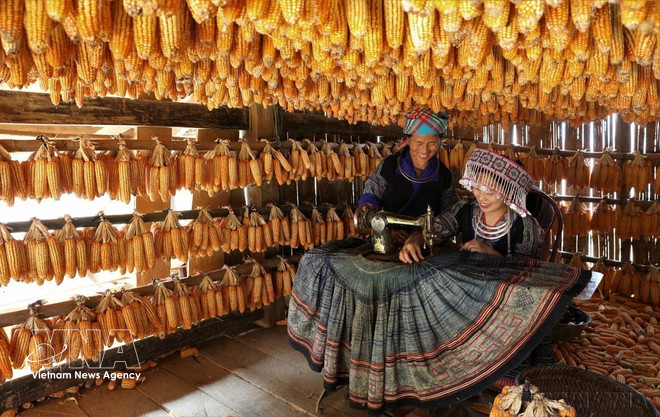
vnanet-potal-72-nam-nhiep-anh-viet-nam-1531953-1532025-lan-toa-ve-dep-van-hoa-con-nguoi-viet-nam-den-the-gioi-7910494.jpg
The unique “Corn House” in Mang Mu (Mu Cang Chai, Lao Cai province), a favourite destination for many visitors during the rice harvest season. (Photo: VNA)

Nguyen Van Thuat, Deputy Director General of the Department of Grassroots Information and External Information under the Ministry of Culture, Sports and Tourism, described the strategy as a significant step forward in political, strategic and practical terms.

He said the move was driven by three main reasons. First, global competition now extends beyond economic indicators to include national image, trust and influence. In a rapidly evolving digital media environment, perceptions of countries can spread widely and quickly, but can also be shaped in undesirable ways without clear strategic direction.

Second, Vietnam is entering a new stage of development aimed at prosperity and deeper international integration. This requires coherent national narratives that accurately reflect the country’s core values and can be translated into communication messages to strengthen national soft power.

Third, past efforts to promote Vietnam’s image have often been fragmented, with ministries, sectors, localities and media organisations implementing their own initiatives. The new strategy seeks to establish a unified framework to ensure clearer positioning and stronger global resonance.

A key focus of the strategy is the development of a national digital communication ecosystem, including the application of big data and artificial intelligence to improve outreach effectiveness. Cross-border digital platforms and global social networks are expected to enable faster, wider and more cost-efficient engagement with international audiences.

Big data and AI technologies will also help analyse audience behaviour and trends in different markets, allowing communication messages to be tailored to specific target groups. At the same time, a synchronised digital ecosystem is expected to strengthen coordination among stakeholders, ensuring consistent implementation of national messages across communication channels.

Despite these opportunities, shortcomings remain, particularly the lack of a unified strategic framework in the past, which has led to scattered promotion efforts.

Therefore, the strategy aims to address this by establishing a shared national messaging system and visual identity, strengthening inter-agency coordination mechanisms, and applying digital technologies and common data systems to standardise content, monitor effectiveness and make timely adjustments.

Observers believe that, if implemented consistently and effectively, the strategy will help enhance Vietnam’s national image and increase its influence and visibility on the global stage in the years ahead./.
VNA

See more

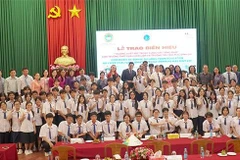
Delegates and students pose for a commemorative photo. (Photo: baocantho.com.vn)

Four more Can Tho schools earn French education accreditation

The recognition of six schools under the Label FrancEducation programme is expected to create momentum for expanding education cooperation between French and Can Tho institutions, contributing to human resources development and friendship between the two countries.

A seminar at the programme (Photo: VNA)

Event promotes inclusion, empowerment for youth with disabilities

A key feature of the programme will be the dialogue “The Inspirers – Family Support on the Journey of Resilience”, where exemplary families and inspirational figures will share stories of overcoming adversity and spread messages of compassion, understanding and community responsibility in building an inclusive and humane society.

UN Resident Coordinator in Vietnam Pauline Tamesis (Photo: VNA)

South–South cooperation promotes rights, justice for women and girls

UN Resident Coordinator in Vietnam Pauline Tamesis commended Vietnam’s sustained commitment to gender equality, noting advances in budgeting, land use, social insurance and domestic violence prevention under the recent review of the Convention on the Elimination of All Forms of Discrimination against Women (CEDAW).

Party General Secretary To Lam presents Nhan Dan newspaper with the first-class Labour Order on March 11. (Photo: VNA)

Nhan Dan newspaper must act as ideological vanguard, shield, information sensor: Party chief

In a keynote address at a ceremony in Hanoi marking the 75th anniversary of the newspaper’s first issue on March 11, General Secretary Lam highlighted its more than seven decades of evolution while maintaining its role as the Party’s sharp ideological weapon, an effective information and communication channel for Party committees and authorities at all levels, and a trusted platform for Party members and people.

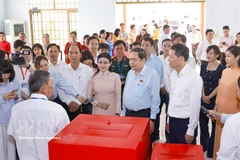
A poster celebrating the Election Day (Photo: VNA)

Final preparations underway for Election Day

In Hanoi, local authorities have increased the dissemination of election-related information through community loudspeaker systems, information boards, official websites and verified social media pages, helping officials, Party members and residents better understand their rights and responsibilities as voters.

NA Chairman Tran Thanh Man inspects a constituency in Dong Nai province. (Photo: VNA)

Dong Nai works to ensure workers cast vote on Election Day

With the utmost regard for citizens’ electoral rights and responsibilities, and in a spirit of creating optimal conditions for workers, especially those employed in industrial parks and non-state enterprises, the provincial leader has requested that no overtime be scheduled during voting hours.

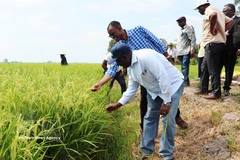
Zambia's Minister of Agriculture Reuben Mtolo Phiri (first, left), learns about the OM19 rice variety grown at Tien Thuan cooperative in Thanh Quoi commune,, Can Tho city (Photo: VNA)

Can Tho shares agricultural transformation experience with Zambia

Rice production remains Can Tho’s key industry. Alongside maintaining production, Can Tho has encouraged value chain linkages among farmers, cooperatives and businesses, while accelerating the application of science and technology, mechanisation and digital transformation in farming.

Staff members of the Hanoi Public Administrative Service Centre handle administrative procedures for local residents. (Photo: VNA)

Hanoi: 95% of administrative procedures to be handled from home

The plan targets that at least 80% of administrative procedures under the city’s authority will be provided as fully online public services, while more than 95% of applications will be received and processed entirely online. By June 30, 2026, about 80% of administrative procedures are expected to be restructured based on integrated data systems, with the figure rising to 95% by the end of the year.