Vietnam struggles to preserve biodiversity
Preserving biodiversity in Vietnam was the main topic of discussion at a workshop on May 5 in Hanoi.
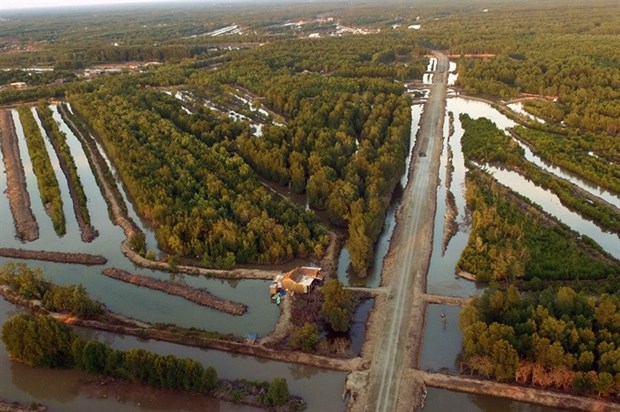 The tropical margrove forest in Ca Mau Cape National Park. (Photo: VNA)
Hanoi (VNA) - Preserving biodiversity in Vietnam was the main topic of
discussion at a workshop on May 5 in Hanoi.
Nguyen Quoc Dung, from the Forest Inventory and Planning Institute under the Ministry of Agriculture and Rural Development emphasised the need for a strategic framework and action plan for the Core Environment Programme (CEP)’s phase 3 (2018-2022), building a legal framework for biodiversity corridors in Vietnam.
Marine protected areas and mangroves in Vietnam are smaller than in other nations so biodiversity corridors will help develop biodiversity.
“It is necessary to set up detailed projects for coastal provinces in the context of Vietnam being affected by climate change,” Dung said.
"Forests have been planted in the country to cope with climate change, with 42 projects in coastal provinces. [But]we have no national-scale project for the restoration of coastal forests and biodiversity preservation, although Vietnam has high biodiversity,” he said.
“Restoring and preserving biodiversity is very difficult and costly here.”
Problems and disagreements between agencies on biodiversity preservation hamper the work, harming scientific research and environmental protection projects.
Pham Hung Cuong, from the Vietnam Academy of Science and Technology, said developing ecosystems in remote areas owned by local people should be based on saving the native ecosystem.
“Biodiversity in traditional farming must be associated with natural landscape,” he said.
“Vietnam should learn from developed countries like Japan to maintain and restore the traditional ecosystem.”
An expert from the Ministry of Natural Resources and Environment said a shortage of financial resources for environmental protection, limited staff capacity, ineffective international co-operation and poor State management were issues they face when building legal documents on biodiversity corridors.
Sumit Pokhrel, deputy chairman of the Bangkok-based Environment Operation Centre, the unit responsible for coordinating the CEP in the region, detailed three main targets of CEP Strategic Framework and Action Plan: green growth and reducing carbon emissions, climate change adaptation and disaster risk management and biodiversity landscape and natural resources.
At the workshop, Pokhrel said a great challenge was building biodiversity in all six CEP nations.
CEP’s phase 3 will have four main tasks: facilitating regional collaboration and the management of natural resources; providing policy advice and technical support for member nations, supporting information management, and supplying financing and investment services.
Prof. Nguyen The Chinh, director of the Institute of Strategy and Policy on Natural Resources and Environment said the Vietnamese Party and Government affirmed their commitment to addressing challenges of natural resources, the environment and climate change through promulgating many policies to ensure sustainable development.
The CEP, funded mainly by Asian Development Bank, has been implemented in the six nations of the Greater Mekong Sub-region (The GMS countries are Cambodia, China, Laos, Myanmar, Thailand, and Vietnam), for ten years.-VNA
Nguyen Quoc Dung, from the Forest Inventory and Planning Institute under the Ministry of Agriculture and Rural Development emphasised the need for a strategic framework and action plan for the Core Environment Programme (CEP)’s phase 3 (2018-2022), building a legal framework for biodiversity corridors in Vietnam.
Marine protected areas and mangroves in Vietnam are smaller than in other nations so biodiversity corridors will help develop biodiversity.
“It is necessary to set up detailed projects for coastal provinces in the context of Vietnam being affected by climate change,” Dung said.
"Forests have been planted in the country to cope with climate change, with 42 projects in coastal provinces. [But]we have no national-scale project for the restoration of coastal forests and biodiversity preservation, although Vietnam has high biodiversity,” he said.
“Restoring and preserving biodiversity is very difficult and costly here.”
Problems and disagreements between agencies on biodiversity preservation hamper the work, harming scientific research and environmental protection projects.
Pham Hung Cuong, from the Vietnam Academy of Science and Technology, said developing ecosystems in remote areas owned by local people should be based on saving the native ecosystem.
“Biodiversity in traditional farming must be associated with natural landscape,” he said.
“Vietnam should learn from developed countries like Japan to maintain and restore the traditional ecosystem.”
An expert from the Ministry of Natural Resources and Environment said a shortage of financial resources for environmental protection, limited staff capacity, ineffective international co-operation and poor State management were issues they face when building legal documents on biodiversity corridors.
Sumit Pokhrel, deputy chairman of the Bangkok-based Environment Operation Centre, the unit responsible for coordinating the CEP in the region, detailed three main targets of CEP Strategic Framework and Action Plan: green growth and reducing carbon emissions, climate change adaptation and disaster risk management and biodiversity landscape and natural resources.
At the workshop, Pokhrel said a great challenge was building biodiversity in all six CEP nations.
CEP’s phase 3 will have four main tasks: facilitating regional collaboration and the management of natural resources; providing policy advice and technical support for member nations, supporting information management, and supplying financing and investment services.
Prof. Nguyen The Chinh, director of the Institute of Strategy and Policy on Natural Resources and Environment said the Vietnamese Party and Government affirmed their commitment to addressing challenges of natural resources, the environment and climate change through promulgating many policies to ensure sustainable development.
The CEP, funded mainly by Asian Development Bank, has been implemented in the six nations of the Greater Mekong Sub-region (The GMS countries are Cambodia, China, Laos, Myanmar, Thailand, and Vietnam), for ten years.-VNA




You should also see

Semiconductor workforce development a breakthrough: PM
Human resources development in semiconductors should be considered a breakthrough in personnel training, Prime Minister Pham Minh Chinh said at a conference in Hanoi on April 24.



See more
 Environment
Heavy showers, hail hit Lao Cai
Heavy showers accompanied by hail suddenly poured down in the northern mountainous province of Lao Cai at around 6:30pm on April 24.
 Environment
Drought at peak dry season impacts over 20,000ha of farmland
About 20,090ha of farmland and over 2,600 households have been hit by drought and water scarcity in the central region, Central Highlands, and southeastern region, which are now in the peak period of the 2023 - 2024 dry season.
 Environment
Hoa Phat steel products certified to meet greenhouse gas inventory standard
Vietnamese steel giant Hoa Phat Group has announced that BSI - the UK's leading international certification organisation - certified ISO 14064-1:2018 standard and ISO 14067:2018 on greenhouse gas inventory for steel products of its subsidiary - Hoa Phat Dung Quat Steel JSC.
 Environment
Vietnam supports global agreement on plastic pollution
A delegation of Vietnamese negotiators joined those from 176 countries worldwide at the fourth session of the Intergovernmental Negotiating Committee (INC-4) on plastic waste in Ottawa, Canada, on April 23.
 Environment
Consultation workshop on Cambodia’s Funan-Techo canal held in Can Tho
The Vietnam National Mekong Committee (VNMC) on April 23 held a consultation workshop on Cambodia’s proposed Funan-Techo canal project which has raised concerns about potential impacts on the Mekong river.
