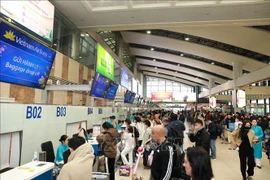
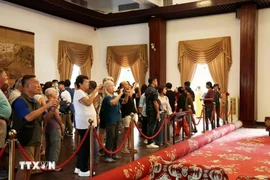
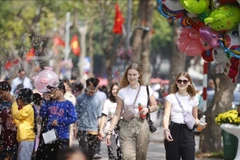
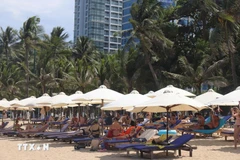
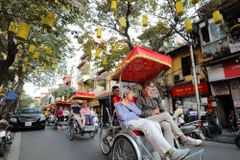
Hanoi (VNA) - International arrivals in January 2025 were up 18.5% from the previous month and 36.9% year-on-year, according to data released by the General Statistics Office on February 6.
With 2.1 million foreign visitors, January 2025 set a new record for Vietnam’s tourism sector, surpassing the nearly 2 million arrivals recorded in January 2020. The figure also exceeded pre-pandemic levels, standing 37.8% higher than in January 2019.
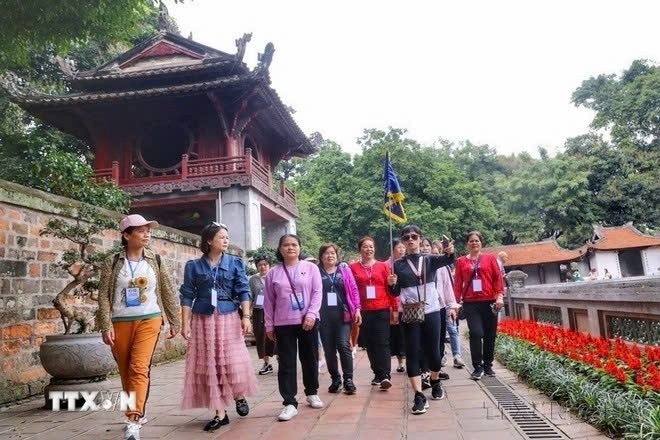
China reclaimed its position as Vietnam’s top source market after several months of being overtaken by the Republic of Korea. In January 2025, 575,000 Chinese visitors arrived in Vietnam, accounting for 27.7% of total foreign arrivals—an increase of 54% from January 2024 (373,500 visitors).
The Republic of Korea ranked second with 417,000 arrivals (20.1%), followed by Cambodia (100,000), the United States (93,000), and Taiwan (China) (91,000). Other key markets included Japan, Australia, India, Malaysia, and Thailand.
The strong recovery of the Chinese market is attributed to strengthened cooperation between the Vietnam National Authority of Tourism, the Ministry of Culture, Sports and Tourism, and Chinese partners. In particular, Prime Minister Pham Minh Chinh’s visit to Chongqing and Kunming in November 2024 played a key role in fostering tourism and cultural exchanges between the two countries.
The market also saw impressive growth from Cambodia. While 2024 recorded 475,000 Cambodian visitors to Vietnam, January 2025 alone welcomed 100,000 arrivals. This surge propelled Cambodia from ninth place to third among Vietnam’s top 10 tourism markets.
These gains highlight the success of Vietnam’s extended visa policy. Under Resolution 128/NQ-CP, effective August 15, 2023, unilateral visa exemptions for 13 countries were extended from 15 to 45 days, making travel to Vietnam more attractive.
Vietnam’s record-breaking tourism numbers reflect the industry’s recovery efforts and strategic policy adjustments. While Asia’s tourism sector has been slower to bounce back compared to other regions, Vietnam’s proactive approach has yielded strong results.
One key factor has been policy reform. The Vietnam National Authority of Tourism and the Ministry of Culture, Sports and Tourism have submitted major proposals, leading to government resolutions that support the industry’s growth.
Vietnam has also revamped its promotional strategies, diversifying markets and expanding public-private partnerships. Efforts to introduce new tourism products—such as agricultural tourism, railway tourism, nighttime experiences, wellness retreats, and digital marketing—have further boosted the country’s appeal.

In a government meeting on February 5, Prime Minister Pham Minh Chinh emphasized that tourism and services are among Vietnam’s key economic drivers. He noted that the sector made a strong post-pandemic recovery in 2024, laying the groundwork for continued expansion in 2025.
To sustain this momentum, the Prime Minister called for further innovation in tourism offerings and additional measures to attract international visitors. A key priority is refining visa policies, including exploring short-term visa exemptions for select tourist groups. These efforts aim to encourage longer stays and higher spending, strengthening Vietnam’s position as a leading travel destination./.