Vietnam uses remote sensing to monitor rice production
The use of satellite earth observation date to monitor rice production in the Red River and Mekong Deltas was discussed at a workshop in Hanoi on October 25.
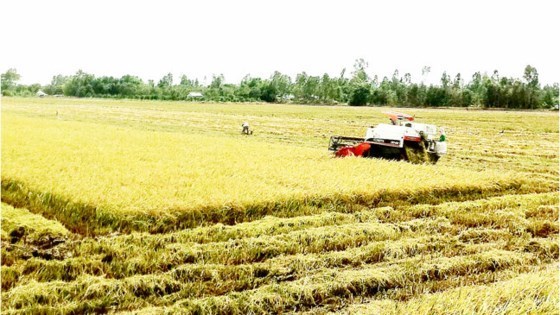 Signals collected from the satellite every six or 12 days can help calculate rice productivity in Vietnam (Source: VNA)
Hanoi (VNA) – The use of
satellite earth observation date to monitor rice production in the Red River
and Mekong Deltas was discussed at a workshop in Hanoi on October 25.
The workshop on remote sensing application in agricultural production in Vietnam was jointly held by the Ministry of Agriculture and Rural Development and the Swiss Embassy.
Nguyen Quang Dung, Director of the National Institute of Agricultural Planning and Projection (NIAPP), said the project on remote sensing application in rice production in 10 provinces of the Red River and Mekong Deltas has been launched since 2012.
The two-phase project conducted studies using finance from the Swiss Agency for Development and Cooperation and other international partners, he said.
Dung said rice production in Vietnam has been monitored from the Sentinel satellite of the European Space Agency, with the algorithm and model developed by Sarmap Company of Switzerland and the International Rice Research Institute.
Signals collected from the satellite every six or 12 days can help calculate rice productivity in Vietnam.
Assoc. Prof. Dr. Pham Quang Ha, from the NIAPP, said losses caused by natural disasters can be evaluated by remote sensing technology, thus assisting insurance activities to ease risks facing farmers.-VNA
The workshop on remote sensing application in agricultural production in Vietnam was jointly held by the Ministry of Agriculture and Rural Development and the Swiss Embassy.
Nguyen Quang Dung, Director of the National Institute of Agricultural Planning and Projection (NIAPP), said the project on remote sensing application in rice production in 10 provinces of the Red River and Mekong Deltas has been launched since 2012.
The two-phase project conducted studies using finance from the Swiss Agency for Development and Cooperation and other international partners, he said.
Dung said rice production in Vietnam has been monitored from the Sentinel satellite of the European Space Agency, with the algorithm and model developed by Sarmap Company of Switzerland and the International Rice Research Institute.
Signals collected from the satellite every six or 12 days can help calculate rice productivity in Vietnam.
Assoc. Prof. Dr. Pham Quang Ha, from the NIAPP, said losses caused by natural disasters can be evaluated by remote sensing technology, thus assisting insurance activities to ease risks facing farmers.-VNA





You should also see
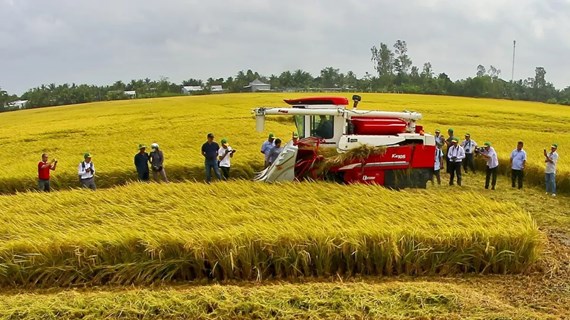
Brand building for Vietnamese agricultural products needed to boost exports
Vietnam's agricultural development has gained many achievements in recent times, with seven commodities recording annual export turnover of over 3 billion USD, namely wood and wooden products, shrimp, coffee, rice, rubber, vegetables and fruits, and cashew nuts. These products are present in most of the world's major import markets such as the US, the European Union (EU) and Japan.


See more
 Sci-Tech
Networking event held for Vietnamese, Korean innovation firms
An investment promotion event was held in the northern port city of Hai Phong on April 15, aiming to connect Vietnamese and Korean enterprises in the field of innovation and start-up.
 Sci-Tech
Vietnam racing in AI development
The Ministry of Science and Technology (MoST) has proposed the Government approve a national strategy on artificial intelligence (AI) research, development and application by 2030.
 Sci-Tech
Viettel opens data centre in Hanoi’s Hoa Lac hi-tech park
The military-run telecom service provider Viettel on April 10 inaugurated its data centre in Hoa Lac Hi-tech Park in Hanoi - one of the largest data centres in Vietnam so far.
 Sci-Tech
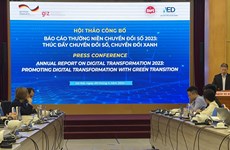
Report on digital transformation 2023 launched
The annual Report on Digital Transformation 2023 was launched by the Ministry of Planning and Investment (MPI) and the German Agency for International Cooperation (GIZ) at a press conference in Hanoi on April 9, providing enterprises with an insight into the twin green and digital transition trend in the world.
 Sci-Tech
Building of legal corridor for AI development, application underway: Official
The building of legal regulations related to virtual assistants in particular and artificial intelligence (AI) applications in general in Vietnam has been drastically implemented, said Deputy Minister of Information and Communications (MIC) Nguyen Phu Tien at a press conference in Hanoi on April 8.
