Vietnamese, Chinese business associations cooperate in industrial development
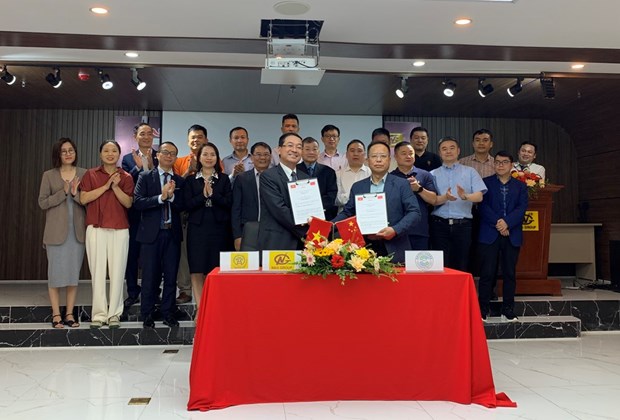 At the signing ceremony. (Photo: VNA)
Hanoi (VNA) - The Hanoi Supporting Industries Business Association (HANSIBA) and Association for Trade Promotion of Small and Medium-sized Enterprises (SMEs) of China’s Suzhou city on May 9 signed a Memorandum of Understanding (MoU) for cooperation in industrial development.
Speaking at the signing ceremony, Nguyen Hoang, Chairman of HANSIBA, said that Vietnamese businesses wish to cooperate with international partners, including those from Suzhou city to tap the potential market of industrial products and accessories in both the ASEAN region and the world.
Hanoi boasts specialised industrial parks for supporting industries and high technology developed under a new generation ecosystem with full facilities to serve the demand of manufacturers, Hoang noted. Enterprises in the city are also capable of operating hi-tech production chains.
The official emphasised that the association has offered preferential policies for high-tech enterprises manufacturing in Vietnam, including those from Suzhou city.
In terms of traffic and geography, Vietnam and China share a border of almost 1,400 km, which facilitates the transport of products to markets in the world in the most convenient and cheapest way, he said.
Pan DongMing, acting head of the Association for Trade Promotion of Small and Medium-sized Enterprises (SMEs) of Suzhou city said regarding geographical advantages, enterprises in Suzhou have a great advantage because Suzhou is close to Shanghai city and seaports.
It takes a week to transport goods from Shanghai to Hanoi by waterways, he said adding that it takes only 2-3 days via roads./


You should also see
Dien Bien soldiers, youth volunteers meet in Hanoi


See more
 Business
French auction house to open office in Vietnam
 Business
3,400 taels of SJC-branded gold bars successfully auctioned
 Business
HCM City seeks to draw remittances in infrastructure
 Sci-Tech
FPT, NVIDIA ink MoU to build 200 million USD AI factory
 Business
