Vietnam’s early response to COVID-19 praised on Australian news site

Australia’s news site 7news.com.au on April 13 posted an article which stressed that with its early decisive action, extensive testing, vigorous quarantining and social unity, Vietnam has so far avoided the devastation of the COVID-19 seen in Europe and the United States, despite sharing a border with China.
Vietnam’s early response to COVID-19 praised on Australian news site ảnh 1Soldier helps transport luggage of a man who finishes concentrated quarantine (Source: VNA)

Sydney (VNA) – Australia’s news site 7news.com.au on April 13 postedan article which stressed that with its early decisive action, extensivetesting, vigorous quarantining and social unity, Vietnam has so far avoided thedevastation of the COVID-19 seen in Europe and the United States, despitesharing a border with China.

The article, writtenby Chris Humphrey and Bac Pham of the Australian Associated Press (AAP), saidthat with only several hundreds of infections, Vietnam’s response to the pandemic has been praised by the World Health Organisation.

It cited the country’sofficial statistics as saying that there are currently more than 75,000 peoplein quarantine. The country has so far conducted more than 121,000 tests, fromwhich over 260 cases were confirmed.

To date, there havebeen no virus-related deaths, and infection rates remain significantly lowerthan in the Republic of Korea, Singapore and even Taiwan which have all beenwidely praised in global media for their effective responses to the pandemic.

The article also quotedKidong Park, the WHO’s representative to Vietnam, as saying that the country’searly response to the crisis was critical. Its first risk assessment exercisewas conducted in early January - soon after cases in China started beingreported.

The country quicklyestablished a National Steering Committee for COVID-19 Prevention and Controlunder the auspices of a Deputy Prime Minister which immediately implemented anational response plan.

Despite having a lownumber of confirmed cases, Vietnam has applied national social distancing from April 1, afar faster and more decisive response than that seen in Britain or Italy, wherecases ran into the many thousands before public life was shut down.

According to thearticle, much of Vietnam’s success can be ascribed to its social unity. PrimeMinister Nguyen Xuan Phuc recently described Vietnam’s efforts to contain thevirus as the “spring general offensive of 2020”.

Vietnamese schoolshave been closed since January, and mass quarantining began on March 16. Sincethen, tens of thousands of people entering the country from badly hit nationshave been put into compulsory quarantine in vast military-style camps. By March25, international flights ceased altogether.

There is no easingof these restrictions yet in sight. The vast majority of domestic flights,trains and buses have been halted, and anyone leaving Hanoi, which sees the largest number of infection cases in the country, is quarantined upon arrival in almost any other province.

At times Vietnameseresponses to the crisis have been severe, the article said, adding that officialsigns in Ho Chi Minh City warn that those not wearing a face mask who are foundto have infected another person with a dangerous disease could face up to 12years in prison.

Yet though thesestrict measures have so far translated into a relatively successful outcome, itremains to be seen whether Vietnam or other nations with similar responses areable to contain the spread of the virus in the long run, it added./.
VNA

See more

ST Telemedia Global Data Centres (Thailand), an affiliate of Singapore Telecom, is developing three data cehtres in Thailand including this facility on Rama IX Road in Bangkok. (Photo: bangkokpost)

Thailand tightens regulations on data centres

The new rules focus on controlling investment scale, electricity and water consumption, environmental impacts, and preventing investors from reserving resource quotas beyond their actual needs.

A road is under construction in Dong Nai city, Vietnam. (Photo: VNA)

ADB: Southeast Asia needs 7.1 trillion USD in infrastructure investment by 2040

ADB estimates that the region will need an average of 476 billion USD in infrastructure investment annually during 2026–2040, equivalent to 8.7% of GDP. However, at current investment levels, government budget resources would cover only around 45% of this demand, leaving an annual financing gap of 264 billion USD.

Kyodo News publishes an article titled “Sculptures by Japanese, Vietnamese artists on display in Yokohama,” (Screenshot photo)

Japanese media widely cover top Vietnamese leader ’s visit

Japanese media have continued extensive coverage of General Secretary of the Communist Party of Vietnam (CPV) Central Committee and President To Lam’s activities in Japan, highlighting his meetings with representatives of leading financial institutions at the Tokyo Stock Exchange, witnessing of cooperation agreement signing and participation in cultural exchanges.

Thailand pushes for establishment of ASEAN emergency public health centre

Thailand pushes for establishment of ASEAN emergency public health centre

The draft agreement stipulates that ACPHEED will comprise three specialised centres based in three ASEAN member states. Vietnam will oversee the centre for prevention and preparedness; Indonesia will host the centre for detection and risk assessment; and Thailand will be responsible for the centre for response and risk communication.

Indonesia designates 31 mln ha of waters as conservation areas

Indonesia designates 31 mln ha of waters as conservation areas

Head of the Convention and Marine Resource Balance working team at the ministry’s Directorate of Ecosystem Conservation Ahmad Sofiullah said this week that it is a strategic effort to ensure the sustainability of Indonesia’s marine ecosystems.

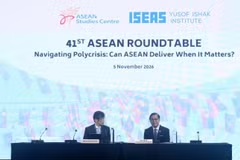
Thai Deputy Prime Minister and Minister of Foreign Affairs Sihasak Phuangketkeow (R) takes part in the Q&A session at the 41st ASEAN Roundtable. (Photo: VNA)

Thailand calls on ASEAN to proactively address polycrisis

Thai Deputy Prime Minister and Minister of Foreign Affairs Sihasak Phuangketkeow noted that no single member state could tackle challenges ranging from major-power competition and economic fragmentation to climate change and energy and food security on its own. Regional cooperation is therefore a strategic imperative, enabling ASEAN not only to overcome crises but also to sustain its development momentum.

Palm oil and palm oil-based products are among Indonesia’s promising export commodities. (Photo: VNA)

Indonesia to launch commodity export monitoring platform next year

DSI will draw on data from customs authorities, trade activities and the financial system, alongside contracts and documents uploaded by exporting companies. The platform will monitor the volume, quality, prices and destination markets of various commodities, as well as transactions between related parties.