Vietnam’s tuna export orders to increase: VASEP

The Vietnam Association of Seafood Exporters and Producers (VASEP) forecast tuna export orders will increase sharply in the last months of the year due to decreasing inventories in major export markets and the recently signed Vietnam-Israel Free Trade Agreement.
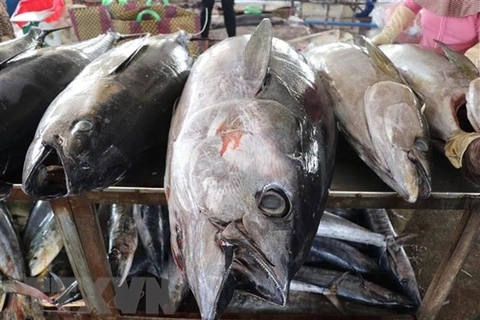
Vietnam’s tuna export orders to increase: VASEP ảnh 1Fishermen harvest tuna in Khanh Hoa province (Photo: VNA)
Hanoi (VNA) - The Vietnam Association of Seafood Exporters andProducers (VASEP) forecast tuna export orders will increase sharply in the lastmonths of the year due to decreasing inventories in major export markets andthe recently signed Vietnam-Israel Free Trade Agreement.

VASEP said domestic tuna exporters could expect positive prospects in thesecond half of this year.

The association said the stockpiled quantity of tuna in the US - one of themain markets of Vietnam has begun to decrease and importers were consideringspeeding up imports.

By the end of the year, major markets such as the US will have many festivals,so consumer demand will increase. Meanwhile, preferential tariffs are anadvantage that has pushed EU importers to seek orders from Vietnam.

Over the past seven months of this year, Vietnam's tuna exports reached nearly 445.6million USD, down 31% year-on-year, VASEP said.

While exports of high-value fresh, frozen and dried tuna products decreased 46%,shipments of processed and canned tuna goods saw a modest rise of 4% to over 204million USD, it said.

Besides, exports to the EU, Mexico, Israel and Thailand had recorded highgrowth over the same period of 2022.

The EU market showed signs of recovery, with a growth rate of 28% in June andJuly, earning Vietnam a turnover of 12 million USD per month. Notably, in thebloc, exports to the Netherlands also continuously grew remarkably while thatto Germany maintained an increase of 30% in June and July.

At the same time, Vietnamese tuna exports to Mexico and Chile also recordedsignificant hikes of 100% and 90%, respectively. Meanwhile, tuna shipments toThailand also soared 65% in the last two months.

According to Nguyen Ha, tuna market expert of VASEP, in the context thatexports to the main traditional markets had all declined, Israel had emerged asa potential market.

In the first half of this year, Vietnamese tuna exports to Israel hit nearly 25million USD, up 92% over the same period last year.

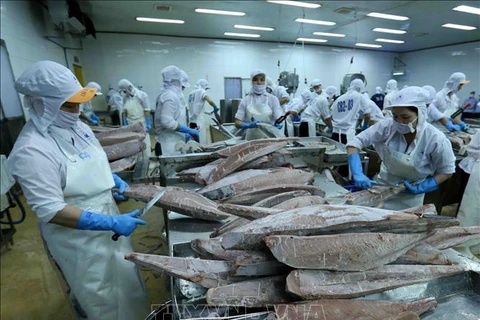
Frozen tuna meat and fillets still accounted for the highest proportion of 47%.The export value of this product group saw a yearly hike of 29%. Meanwhile, theexport turnover of canned tuna increased 375% and other processed tuna productssurged 83%.

Despite being a small country, with no natural resources and limited domesticlabour resources, Israel's consumer demand was quite large and solvency washigh, so there remained ample room for Vietnam's tuna exports to the market, Hasaid.

Especially, the Vietnam-Israel FTA (VIFTA), signed on July 25, would open upopportunities for Vietnam's seafood exports, including tuna, to access theIsraeli market and lucrative Middle East region, Ha said.

To penetrate the Israeli market, VASEP Secretary General Truong Dinh Hoe suggestedthat tuna exporters ensure product quality, carefully study market information,promote credibility and be responsible.

He vowed that VASEP would accompany, research carefully and disseminate marketinformation to businesses.

To facilitate tuna exports, businesses petitioned the Ministry of Agricultureand Rural Development and the Ministry of Industry and Trade to grant morequotas for imported raw tuna as domestic tuna raw material could meet only 25%of demand for processing and export, the Binh Dinh Fishery JSC Co suggested./.
VNA

See more

Ben Thanh Market in Ho Chi Minh City attracts a large numbers of domestic and international visitor.( Photo: VNA)

Vietnam targets 50 million international visitors by 2030

The Ministry of Culture, Sports and Tourism has outlined three scenarios for 2027–2030. Under the high-growth scenario, international arrivals would rise 15–18 percent annually to reach 45–50 million, while domestic tourism would reach around 160 million trips. Total tourism revenue is projected at 80–90 billion USD.

Factories and production facilities in the Chu Lai Open Economic Zone, Da Nang city, are equipped with modern production lines. (Photo: VNA)

Ready-built factories gain from new manufacturing FDI wave

Ready-built factories attracted 73% of new manufacturing FDI in northern Vietnam over the past two quarters, as foreign investment continued to surge at the region's industrial hubs during the first eight months of 2026. The trend points to growing demand for premises that can be put into operation quickly.

Vietnamese durian industry pivots from volume to value

Vietnamese durian industry pivots from volume to value

Durian has morphed from a high-value crop into a strategic Vietnamese export. But as output climbs and importing markets tighten rules on quality, food safety and traceability, the industry must pivot from volume growth to sustainable value chains, better quality and diversified markets.

A display area for Mid-Autumn Festival cakes at a supermarket (Photo: VNA)

Mid-Autumn Festival cake market heats up at affordable end

Industry insiders say competition is no longer just about the cake itself. Product quality, packaging, brand reputation, delivery services and personalisation are increasingly shaping consumer choices in a market crowded with both domestic and foreign players.

Minister of Foreign Affairs Le Hoai Trung (Photo published by VNA)

Vietnam, India set 25 billion USD trade goal

Vietnam and India agreed to make better use of complementary strengths, ease market access difficulties and facilitate business activities toward achieving the 25 billion USD bilateral trade target.

Delegates at the meeting between Vietnamese businesses operating in Cambodia and the Council for the Development of Cambodia (CDC) on September 14. (Photo: VNA)

Vietnamese businesses seek to expand investment in Cambodia

Vietnam currently has 223 investment projects in Cambodia with total registered capital of nearly 3.4 billion USD. Vietnamese companies operate in agriculture, particularly large-scale farming, finance and banking, telecommunications, aviation, processing, trade and services.

Children visit President Ho Chi Minh's hometown and learn about his childhood. (Photo: VNA)

Vietnam's tourism sector faces labour shortage

A 2026 survey by Hoteljob.vn found that nearly 90% of tourism businesses planned to recruit. In Ho Chi Minh City alone, 89.7% of businesses were hiring, while 71.8% said recruitment was difficult or very difficult. The biggest shortages were among frontline workers, particularly in housekeeping, engineering, food service, front-office operations, and kitchens.

Octopus processing for export at Huy Nam Company in An Giang province. (Photo: VNA)

New opportunities for Vietnam’s seafood exports

The Vietnam-EFTA Free Trade Agreement brings together two groups of highly complementary economies. EFTA members Switzerland, Norway, Iceland and Liechtenstein have strengths in technology, innovation, finance, clean energy and sustainable development, while Vietnam is one of Asia’s most dynamic economies and is emerging as a major regional manufacturing, trade and investment hub.

The saponin content of Lai Chau ginseng can reach as high as 23.85% in its natural state, a remarkably high level compared to many other ginseng species. (Photo: baolaichau.vn)

Lai Chau ginseng development gains momentum

Blessed with rare and distinctive ecological values, the northern mountainous province of Lai Chau is stepping up efforts to conserve and develop its native ginseng, with the medicinal plant expected to play a growing role in the forest-based economy and local livelihoods.

The Vietnamese delegation poses for a group photo at the third meeting of the Vietnam-Canada Joint Economic Committee (Photo: VNA)

Vietnam, Canada broaden economic cooperation beyond trade

Vietnam is currently Canada’s largest trading partner in ASEAN. Building on the Comprehensive and Progressive Agreement for Trans-Pacific Partnership (CPTPP), the two countries are expanding bilateral economic ties into higher value-added areas such as clean energy, critical minerals, advanced technology, manufacturing and value-chain linkages.