Vingroup completes design of two ventilator models for COVID-19 treatment

Vingroup has announced it has completed the design and is preparing to introduce to the market two invasive ventilator models which adhere strictly to international standards while achieving a significantly high localisation rate in design and manufacture.
Vingroup completes design of two ventilator models for COVID-19 treatment ảnh 1A Vsmart VFS-410 ventilator model (Photo courtesy Vingroup)


Hanoi (VNA) -
Vingroup has announced it has completed the design and ispreparing to introduce to the market two invasive ventilator models whichadhere strictly to international standards while achieving a significantly highlocalisation rate in design and manufacture.

It took just three weeks forVingroup engineers (Vinfast and Vinsmart) to complete manufacturing of the twomodels – VFS-410 and VFS-510 – with the strong support of relevant ministries,domestic and foreign health experts and Medtronic as Vingroup’s US-based partner.

Despite being developed basedon the original community-shared design by Massachusetts Institute ofTechnology (MIT), Vsmart VFS-410 is a “made in Vietnam” product which ismanufactured and completed entirely by the Vingroup ecosystem.

Vingroup's engineering teamdesigned the entire operating principle for VFS-410 ventilator and produced itscircuit boards, mechanical components besides software and design developmentto enable it to have features comparable to high-end portable invasiveventilators on the market.

Dueto the global scarcity of materials for ventilator production, Vingroup hasactively researched to address the situation by self-producing or localising upto 70 percent of its ventilator components including extremely important andmodern components such as blower, boards (PCBA controller, power), keyboard,display, battery and case.

These ventilators will continueto be tested by leading hospitals and experts in Vietnam and will be evaluatedby the Medical Council of all levels to ensure compliance with pre-circulationregulations to support COVID-19 prevention and control.

It is expected that the firstbatch of ventilators will be available on the market on May 15./. 
VNA

See more

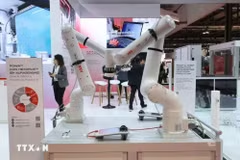
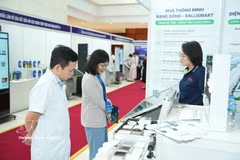
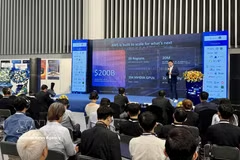
An exhibition space at the “Da Nang Semiconductors and High-Tech 2026” conference, organised by the Da Nang People’s Committee. (Illustrative photo: VNA)

Mobilising international resources to drive Vietnam’s technology development

Vietnam previously focused mainly on attracting overseas experts and intellectuals to work in the country over the long term, but this approach encountered certain difficulties. Cooperation methods are now shifting towards greater flexibility, allowing experts to take part in conferences and scientific seminars, contribute to addressing major national challenges, or participate in short-term training and research programmes.

Assoc. Prof. Dr. Dinh Ngoc Thach, lecturer and researcher in automatic control theory and robotics at the French National Conservatory of Arts and Crafts (Cnam) (Photo: VNA)

Core technologies key to sustainable robotics development in Vietnam: expert

Vietnam should select suitable robotic platforms and gradually build capacity in core technologies, including sensing, environmental perception, positioning, state estimation, AI, control and system integration. This will help develop technologies applicable across multiple sectors while avoiding fragmented investment and dependence on a single product category.

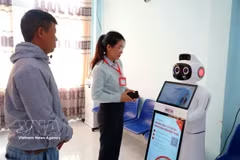
AI robots have become effective assistants in providing administrative services and reducing the workload of officials in Lam Dong province (Photo: VNA)

AI robots help streamline administrative procedures

Operating around the clock, AI robots provide information on administrative procedures, required documents, processing times, fees and relevant regulations, complementing assistance from civil servants.

High prospects for Vietnam-Italy cooperation in robotics industry

High prospects for Vietnam-Italy cooperation in robotics industry

Vietnam and Italy have highly complementary strengths in this robotics field. Italy has experience in machinery manufacturing, industrial robotics applications and an established business network, while Vietnam has a dynamic market, strong demand for production modernisation and a promising young engineering workforce.

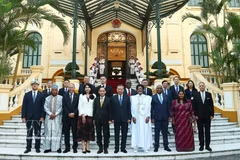
General Secretary of the Communist Party of Vietnam (CPV) Central Committee and President To Lam and the foreign ambassadors at the meeting (Photo: VNA)

Top leader receives new foreign ambassadors

Vietnam wishes to step up cooperation with the countries in such areas as economy, trade and investment; cutting-edge science and technology applications, semiconductors, artificial intelligence, new materials, digital transformation, sustainable agriculture, the environment, energy and renewable energy, the marine economy and maritime transport.

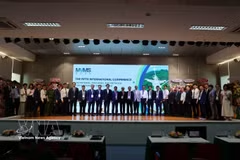
Delegates at the event (Photo: VNA)

Over 400 scientists attend international material conference

Discussions focus on six key areas, including advanced materials and their applications for sustainable development; environmentally friendly material processing technologies; product lifecycle engineering; sustainable machine design; low-carbon industries and the circular economy; and artificial intelligence and digital transformation in material and mechanical engineering.

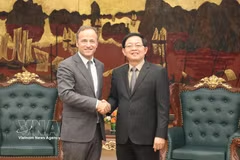
Deputy Prime Minister Ho Quoc Dung (R) and Pierre Barnabé, Chief Operating Officer of French technology group Dassault Systèmes. (Photo: VNA)

Vietnam, France step up cooperation in AI, digital twin technology

At the meeting, the Deputy PM praised the group's contributions to promoting technology cooperation between Vietnam and France, particularly its collaboration with the Ministry of Finance and the National Innovation Centre (NIC) to establish a Centre of Excellence (CoE) for digital twins and artificial intelligence (AI) in Hanoi.

Rigobert Pinga Pinga, Acting Representative of OIF for Asia-Pacific speaks at the event. (Photo: VNA)

Franconomics 2026 explores human-centred technological transformation

Addressing the opening ceremony, Nguyen Anh Tuan, Rector of VNU-IS, said Franconomics was launched in 2019 as a multidisciplinary platform connecting scientists, policymakers, businesses and international organisations to discuss socio-economic issues relevant to Vietnam and the Francophone community.

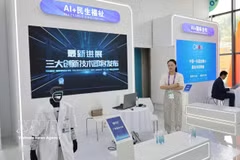
A new technology exhibition area arranged within the framework of the International Research and Innovation Funders Forum in Hanoi (Photo: VNA)

Vietnam promotes int'l cooperation in science, technology and innovation

Science is opening up new opportunities in artificial intelligence, healthcare, semiconductors and clean energy, while challenges such as climate change, energy security and epidemics require international cooperation. Science, technology, innovation and digital transformation are central to Vietnam’s new growth model.

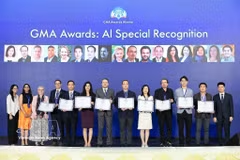
GMA Awards are presented to honour outstanding AI courses at the Global MOOC & Online Education Conference 2026. (Photo: VNA)

Responsible AI, teaching overhaul, global ties dominate GMC 2026

Panelists said AI can support knowledge delivery, information processing and personalised learning, but cannot replace teachers in building independent thinking, critical capacity, emotional intelligence and humanistic values. Universities therefore need to overhaul teaching, testing and assessment and redefine lecturers’ role in an AI-integrated environment.

An overview of the seminar (Photo: VNA)

Coordinated development of energy, AI and infrastructure needed for industrial growth

Vietnam is emerging as a regional bright spot for data infrastructure development, driven by growing demand for AI, cloud computing, 5G commercialisation and digital transformation. However, the country needs coordinated preparations, including green power supplies, international submarine cable connectivity and operational capabilities meeting global standards.

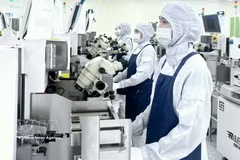
Production line at Hana Micron Vina Co., Ltd in Bac Ninh city (Photo: VNA)

Vietnam works to bridge gap between chip research and commercialisation

According to the Ministry of Science and Technology, Vietnam’s semiconductor industry has made notable progress. In 2025, it generated more than 21 billion USD in revenue and attracted over 14 billion USD in foreign investment through more than 240 projects. The country is now home to around 60 chip design companies and over 7,000 semiconductor design engineers.