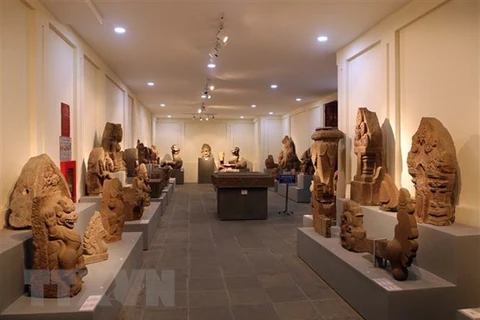
1,500-year-old Cham ruins discovered in Binh Dinh

Artefacts unearthed at the Chau Thanh Tower ruins in Binh Dinh have helped archaeologists place the oldest date of these structures to between the 4th and 6th centuries.
1,500-year-old Cham ruins discovered in Binh Dinh ảnh 1Experts at the conference to announce early results of archaeological excavations of the Chau Thanh Tower remains in Binh Dinh. (Photo courtesy of sggp.org.vn)
Binh Dinh (VNS/VNA) - Artefacts unearthed at the ChauThanh Tower ruins in Binh Dinh have helped archaeologists place the oldest dateof these structures to between the 4th and 6th centuries.

The provincial Department of Culture and Sports and the Vietnam Institute ofArcheology hosted a conference to announce the early results of archaeologicalexcavations of the Chau Thanh Tower remains in Nhon Thanh ward, An Nhon town, BinhDinh on August 18.

Pham Van Trieu, deputy head of the Historical Archeology Department at theInstitute of Archeology, said the unit has uncovered three architectures of twodistinct stages based on stratigraphy, building techniques, and constructionmaterials.

Bricks, tiles, ornamental ceramic pieces, laterite, many statue fragments,porcelain, and small pieces of gold were also found, among many more antiques,architectural materials, and stoneware.

Trieu believes that the findings of the third phase continue to provide crucialinformation for verifying the official scale of the Chau Thanh Tower andpinpointing the site of the main temple.

"Through the findings, it can be said that this ruins exists a large-scaletower architecture, and reflecting the entire historical period of the ancientChampa capital," he said.

The third excavation also helps identify the oldest date of the Chau ThanhTower remains in the 4th to 6th century.

Similar findings were discovered in ancient architectural works at Tra KieuCitadel (Quang Nam), Co Luy (Quang Ngai), and Ho Citadel (Phu Yen).

They are evidence of the three-hundred-year era of territorial unification,which created a common nation.

Notably, the results of the excavations at Chau Thanh demonstrate the earlyimpact of Hindu culture on the spiritual lives of the Cham people.

Le Dinh Phung of the Vietnam Association of Archeology, said the remains of ChauThanh Tower are one of two large-scale ancient Cham architectural works thatshed light on historical evidence of the initial capital of the Lam Ap Kingdomin Binh Dinh.

Phung added that this archaeology would contribute to the clarification of BinhDinh’s culture and history as well as Champa's historical culture after it hasbeen merged into the Vietnamese cultural flow.

Huynh Van Loi, deputy director of the provincial Department of Culture andSports, praised the archaeological findings at the Chau Thanh Tower.

The cultural sector of Binh Dinh plans to collaborate with the Institute ofArcheology and scientists in order to continue investigating and clarifying theliterary, historical, and religious significance of the Chau Thanh Tower ruins./.
VNA

See more

Toy production at a Hong Kong-invested factory (Photo: VNA)

Vietnam targets deeper market penetration in Hong Kong in 2026

Vietnam-Hong Kong trade hit 62.3 billion USD in the first 11 months of 2025, soaring 73.1% annually. Vietnamese exports to Hong Kong amounted to 36.8 billion USD, a 90.6% hike, ranking fourth among Hong Kong’s import sources, while imports from Hong Kong stood at 25.5 billion USD, up 52.9% and ranking third.

Vietnam’s start-up market enters restructuring phase

Vietnam’s start-up market enters restructuring phase

In 2026, venture capital inflows into Vietnam’s start-up ecosystem are expected to recover gradually, though in a more selective manner. VinVentures forecasts that capital will focus on start-ups that have survived the rigorous screening of 2024–2025, possess clear business models, strong commercialisation capacity, and the ability to generate real cash flows.

Workers process tra (pangasius) for export (Photo: VNA)

Vietnam–Singapore trade continues to thrive

For the year as a whole, Vietnam retained its position as Singapore’s 10th largest trading partner. Bilateral trade reached a record high of nearly 40 billion SGD, up 26.2% from the previous peak of 31.67 billion SGD recorded in 2024.

Eric Van Vaerenbergh, an energy expert and lecturer at the Brussels Engineering School (ECAM) (Photo: VNA)

Belgian expert optimistic about Vietnam’s economic outlook

Vietnam should move from a growth model based mainly on expanding capital and labour to one driven by productivity improvements. He said that this requires enhancing the quality of the workforce, particularly engineers, technicians, and managers in industrial sectors.

Workers at the VSIP Hai Phong industrial and urban complex, which specialises in producing electronic components for office equipment. (Photo: VNA)

Roadmap aims to improve business climate and boost competitiveness

By the end of 2026, Vietnam aims to rank among the world’s top 50 performers in the United Nations Sustainable Development Goals, advance at least three places in the International Property Rights Index, and climb at least one position in the Global Innovation Index.

Vietnam is strengthening its position in the technology value chain, becoming a major manufacturing hub for complete consumer electronics products. (Photo: VNA)

ESG standards offer opportunities to reposition Vietnam’s electronics firms

The 2025-2027 period will be a critical turning point, as exporters to the European market will be required to strictly comply with ESG standards, including net-zero emissions roadmaps, labour standards, corporate governance and transparency requirements. As a key export sector, the electronics industry is being directly and strongly affected by this shift.

A production line for camera modules and electronic components at the factory of MCNEX VINA Co. Ltd, a Republic of Korean-invested company in Phuc Son Industrial Park, Ninh Binh province. (Photo: VNA)

Science, technology, innovation as engines of economic growth

To ensure that science and technology truly act as a powerful growth engine, experts emphasised the need for the Government to put in place supportive mechanisms and policies that encourage enterprises to invest in research and development, while strengthening cooperation among the State, research institutions and the business sector.