Hanoi to unveil beverage tourism map at 2026 festival
The Hanoi Beverage Tourism Map will feature notable cafés, beverage and cocktail venues with QR codes providing destination information.
The Hanoi Beverage Tourism Map will feature notable cafés, beverage and cocktail venues with QR codes providing destination information.

Phan Duc Nam, Chairman of the Dong Van commune People's Committee, said the locality is focusing not only on flower cultivation but also on improving landscapes, environmental sanitation and tourism services. The goal is to give visitors more reasons to stay longer and return at other times of the year.

Oxalis Adventure urged travellers to be especially wary of sites that appear through online ads or use domains resembling Oxalis's, and should not transfer money until booking details are clearly verified.

The results from the US edition of Condé Nast revealed that Phu Quoc clinched the top spot in Asia with an impressive 95.26 points, outperforming Boracay, Palawan (the Philippines), Bali (Indonesia), and Phuket (Thailand).
Gwendal Poullennec, International Director of the Michelin Guide, has observed that Phu Quoc’s culinary identity is shaped by the interplay between fishing-village food culture and restaurants with an international character. This provides a foundation for the island to develop itineraries offering a variety of experiences and price points.
Vietnam's e-commerce market reached approximately 31 billion USD in 2025, ranking among the world's top 10 and third in ASEAN, she said, adding that this had laid the foundation for digital exports.
Three projects account for part of the financing need, including 13.3 million EUR for the 220kV Ung Hoa substation and connection lines, 18.6 million EUR for the 220kV Tan Viet substation and the 220kV Tan Viet–Gia Loc–Pho Noi line, and 35.3 million EUR for the 220kV substation connecting the Dong Anh–Van Tri transmission line.

Nine Vietnamese businesses and units will take part in the Vietnam-Cambodia Business Networking and Product Promotion Exposition (VIDEX CAMBODIA 2026), scheduled for October 14-17 in Phnom Penh.
Following Hanoi, Ho Chi Minh City and Da Nang, Phu Quoc will become the fourth destination in Vietnam to be covered by the Michelin Guide’s inspectors. Restaurants on the island are set to feature in the Michelin Guide Vietnam 2027, due to be announced in the middle of next year.
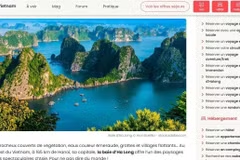
Routard.com noted that despite becoming a major tourist destination, the bay has retained its otherworldly beauty. To fully appreciate the scenery, visitors are advised to spend more time exploring and venture beyond the busiest tourist routes.

Travel companies should play a key role in directing tourist flows and linking the tourism value chain, thus enhancing the competitiveness of the tourism sector. They should go beyond selling tours to understand market demand, design products, connect services, organise tourist flows, manage risks and contribute to shaping destination images.

September alone saw 1.77 million foreign visitors arrive in Vietnam, up 16.1% from the same month last year.

Experts say that to turn advantages into high-value tourist arrivals, tourism promotion needs to move beyond fragmented activities towards large-scale, long-term campaigns tailored to target markets and closely linked to actual visitor experiences.
Within Southeast Asia, Vietnam ranked fifth, trailing Singapore (13th), Indonesia (23rd), Malaysia (26th) and Thailand (38th). Its 6.1% score gain, however, outpaced all four.
Resolution 26-NQ/TW targets a direct GDP contribution of 10–12% by 2030, 45–50 million foreign arrivals, 160 million domestic visitors, and total revenue of 80–90 billion USD.
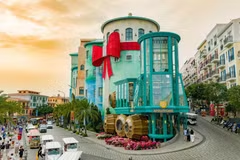
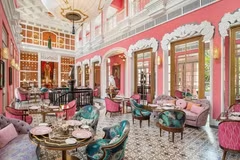
With an entire town recreated on its ceiling, sweeping sunset views and a vantage point for watching fireworks after dark, Apollo Cafe in Phu Quoc offers more than a photogenic backdrop. Designed by Bill Bensley, the venue shows how a café can become an experience travellers deliberately build into their itinerary.
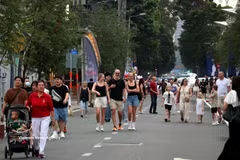
The awards demonstrate that Vietnam's tourism appeal is being recognised across a broad range of areas, from national, urban and heritage destinations to nature-based attractions and tourism products and services, further strengthening the country's presence on the regional and international tourism map

The global travel "bible" Lonely Planet recently announced its list of 13 Hotels in Asia That We Can’t Stop Recommending, gathering accommodations that left a profound impression on its editorial team after their journeys.

In recent years, Ta Xua, dubbed "the paradise of clouds", has emerged as one of the mountainous destinations attracting strong interest from young travellers, particularly for its spectacular sea of clouds stretching across the mountains in the northwestern region.
In the first nine months of 2026, Phu Quoc is estimated to have welcomed more than 8.57 million visitors, up 30.5% year on year. These included more than 1.92 million international visitors, an increase of 60.2%.

A familiar low-cost airline among Southeast Asian travellers, AirAsia describes Phu Quoc in its blog guide to travelling with young children as a destination that feels almost tailor-made for families, with beaches for relaxation, leisure attractions and a wide range of activities to engage children of different ages.

The 2026 honours add to the city’s impressive streak at international tourism awards. In the 2025 WTA, the southern metropolis took home four titles, including business travel and festival and event destination awards, which it had won for four years from 2022 to 2025.

According to the magazine, Phu Quoc was once known primarily for its beaches and relaxed holiday atmosphere. Over the past two years, alongside that appeal, the island has gradually developed its capacity to serve the MICE market, with international resorts, event venues, world-class shows and an expanding flight network.
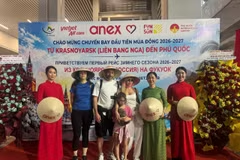
The event not only marked the launch of this year's winter tourism campaign, but also highlighted Phu Quoc's strong appeal to the Russian market, one of the island's most important international tourist markets.

With growing recognition of indigenous knowledge, customs and cultural values as unique assets, ethnic communities in the northern mountainous region are shifting from simply providing tourism services to becoming creators and owners of tourism products, confidently telling their own cultural stories
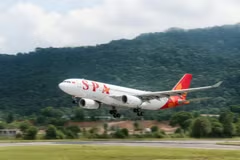
By bringing flight check-in and checked-baggage services directly to hotels, Sun PhuQuoc Airways is offering Phu Quoc a new solution to one of the most challenging stages of the MICE journey: departure.

Phu Quoc remains the biggest contributor to An Giang's international arrivals and tourism revenue. The special zone welcomed more than 1.92 million foreign visitors during the nine-month period, accounting for over 99% of all international arrivals in the province.

Recently highlighting why Phu Quoc is capturing international attention as an emerging MICE powerhouse in Asia, Travel + Leisure remarked that Sunset Town in the southern island functions virtually as an open-air event mega-venue.