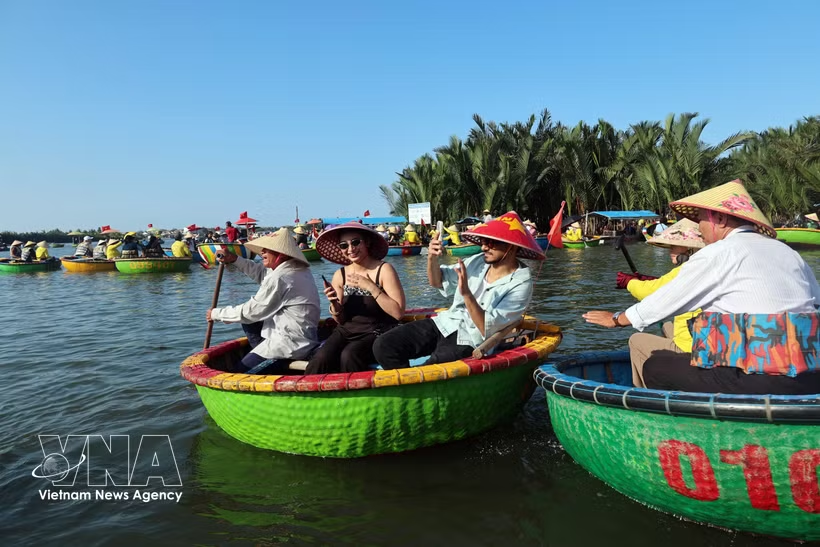
Hanoi (VNA) – Vietnam recorded robust growth in international arrivals during the first five months of 2026, reinforcing its position as one of Asia’s most attractive travel destinations.
The country welcomed nearly 1.8 million foreign visitors in May, up 16.5% year-on-year, according to the Vietnam National Authority of Tourism.
During the first five months of the year, international arrivals reached a record 10.6 million, the highest figure ever recorded for the period. The result represents 42% of the sector’s target of 25 million international visitors for 2026.
At a time when global tourism continues to face challenges stemming from geopolitical tensions, regional conflicts and economic difficulties in many countries, Vietnam is recognised as a safe, stable and appealing destination. Political and social stability, competitive travel costs, expanding international air connectivity and increasingly favourable visa policies have strengthened the country’s competitiveness in the global tourism market.
Although May is traditionally considered a low season for international tourism as many source markets enter their domestic summer holiday period, a record number of foreign arrivals highlights the growing appeal of Vietnam.
The 10 largest source markets during the first five months were China, the Republic of Korea, Russia, Taiwan (China), Cambodia, the US, India, Japan, the Philippines and Australia. China and the RoK remained the two largest markets, accounting for nearly 40% of total international arrivals.
Cambodia rose to the fifth place among Vietnam’s top source markets, reflecting growth potential from neighbouring countries. Rising demand for tourism, shopping, family visits and business exchanges between the two nations has helped stimulate cross-border travel, the authority said.
Russia ranked third among the largest source markets. Following a strong recovery, the number of Russian visitors during the first five months reached about 90% of the total recorded in 2019, indicating that Russia is rapidly regaining its position as one of Vietnam’s key tourism markets.
Meanwhile, India continued to emerge as a highly promising market with strong growth momentum, raising the prospect of reaching one million visitors to Vietnam in 2026.
Japan, while remaining among the leading markets, slipped to the eighth place due to slower growth compared to the overall average. Japanese arrivals rose 11.8% during the period, below the overall growth rate of 14.9% for international visitors.
Southeast Asia is still an important driver of tourism growth. Arrivals from the Philippines surged 71.9%, helping the country move into the ninth place among Vietnam’s largest source markets. Other markets also posted fast expansion, including Cambodia with 40.2%, Indonesia 28.7%, Singapore 28.5%, and Malaysia 21%.
In South Asia, arrivals from India soared by 50.4%, highlighting the market’s significant growth potential.
Tourism experts said geographical proximity, convenient air connectivity and the growing popularity of short-haul regional travel have made Southeast Asia one of the most important growth engines for Vietnam’s tourism industry.
Europe showed the highest growth rate among all regions during the first five months, with arrivals increasing 54.8%. Strong growth continued from several Western and Northern European markets, including Germany, France, the UK, Italy, Denmark, Norway and Sweden. Visitors from Poland rose 51.7%, Switzerland 25.7%, and the Czech Republic 18.1%, helping expand Europe’s share of Vietnam’s international visitor market.
Long-haul markets also delivered positive results, with arrivals from Australia going up 21.2% and those from the UA rising 18.8%, indicating Vietnam’s growing attractiveness among international travellers.
With over 10.6 million international visitors during January–May, Vietnam's tourism industry has gained a solid boost toward the goal of attracting 25 million foreign travellers this year. The performance not only demonstrates the sector’s strong recovery but also contributes to economic growth, services development and trade expansion, supporting the country’s broader socio-economic development goals./.