Hanoi (VNA) – Vietnam is preparing to harness the power of storytelling to strengthen its international image, with plans to establish a “Vietnam Story Bank” as part of a nation-branding and communications strategy extending to 2045.
Under a newly issued plan by the Ministry of Culture, Sports and Tourism, the story bank will serve as a central repository of content to be disseminated across multimedia platforms, helping bring Vietnam’s culture, people and development achievements to audiences worldwide.
Assoc. Prof. Dr. Bui Hoai Son, a full-time member of the National Assembly’s Committee for Cultural and Social Affairs, said the initiative should be built around a comprehensive and structured collection of narratives spanning Vietnam’s history, cultural heritage, festivals, cuisine and the lives of its people.
The repository should also capture the distinct identities of regions and cities across the country. Equally important, he said, is the need to tell the story of modern Vietnam, a nation characterised by peace, innovation, global integration, green growth, digital transformation and a strong sense of international responsibility.
According to Son, the most compelling stories are those rooted in authenticity, featuring real people, real experiences and credible information. The ultimate goal, he said, is to project Vietnam not only as a country rich in history but also as a forward-looking nation shaping its future.
He suggested that content development should adhere to six core principles: accuracy, attractiveness, beauty, authenticity, originality and broad appeal. Stories must be factually sound, engagingly told, emotionally resonant, value-driven and capable of reaching global audiences.
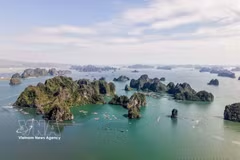
While traditional national symbols such as the ao dai, conical hat, pho, Ha Long Bay and Hoi An Ancient Town remain important, Son argued that Vietnam also needs a refreshed set of contemporary symbols reflecting its transformation. These could highlight the country’s achievements in innovation, creative industries, sustainable development, digitalisation and international cooperation.
Potential narratives, he said, include Vietnam as a nation of peace and reconciliation, a hub of creativity and opportunity, a country of living heritage, and a global culinary destination.
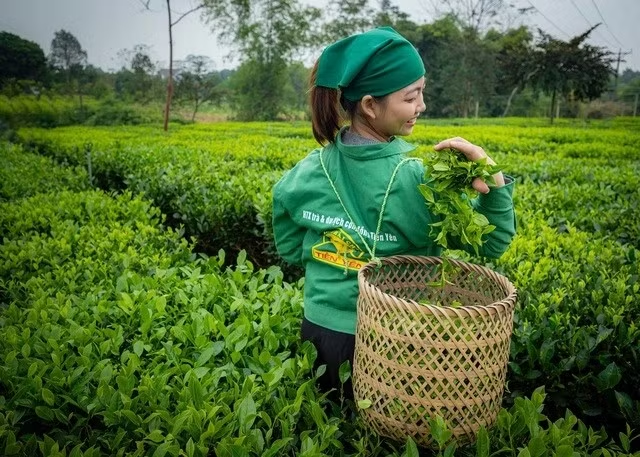
Dr. Nguyen Thu Thuy from the School of Interdisciplinary Sciences and Arts under Vietnam National University, Hanoi said the platform should embrace diverse content formats to maximise usability and engagement.
Beyond photographs, the database could include illustrations, animations and vector graphics inspired by traditional Vietnamese decorative motifs. Individual topics, such as Vietnamese cuisine, could be supported by a range of assets including photo collections, film archives and even game-related content, enabling flexible use across different communication channels.
Thuy also proposed a multi-tiered operating model, with certain resources made freely available while premium content could be accessed through paid services. Diplomatic missions and related public institutions, she suggested, could be granted complimentary access.
Drawing lessons from Thailand’s nation-branding efforts, she noted that the development of promotional content repositories could benefit from public-private partnerships, with businesses and state agencies jointly investing in content creation and management.
Such cooperation, she said, will not only strengthen Vietnam’s international communications strategy but also provide businesses with additional opportunities to showcase their own brands and products in global markets./.