Vietnam-China rail link boosts cross-border tourism after service revival

The international passenger rail route connecting Vietnam and China has served not only as a key transport link but also as a channel for cultural exchange and closer people-to-people connections between countries.

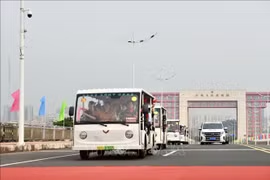
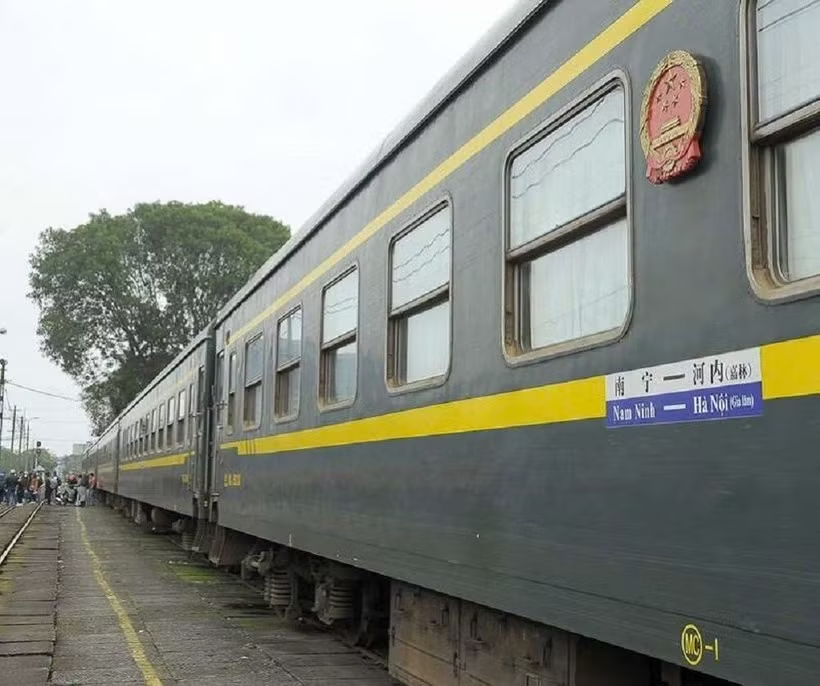
The Vietnam-China international passenger train service. (Photo: baotintuc.vn)

​Hanoi (VNA) – The international passenger rail route connecting Vietnam and China has served more than 31,700 passengers from over 50 countries and territories since it resumed operations a year ago, reflecting a strong rebound in cross-border travel demand after the pandemic.

​The passenger service between Hanoi and Nanning, capital of China’s Guangxi Zhuang Autonomous Region, restarted on May 25, 2025 after a five-year suspension caused by COVID-19 restrictions.

Under the current schedule, train T8701/MR2 departs Nanning for Hanoi each evening, while train MR1/T8702 leaves Hanoi’s Gia Lam station overnight for China.

The rail route has served not only as a key transport link but also as a channel for cultural exchange and closer people-to-people connections between countries.

Irish tourist Grainne, who recently travelled to Vietnam by train for the first time, said rail journeys offered passengers more freedom to move around and enjoy the scenery, making the experience increasingly appealing to international travellers.

To improve services for foreign passengers, operators have introduced multilingual attendants fluent in Vietnamese, Chinese and English, along with smart translation devices capable of supporting more than 70 languages in real time.

The upgraded onboard services are expected to further boost tourism and trade exchanges between Vietnam and China while enhancing the convenience of cross-border rail travel for international visitors./.


VNA

See more

Sun Group officially introduces world-class tourism ecosystems, including Sun Paradise Land Phu Quoc, to the Korean market. (Photo: Sun Group)

Sun Group makes SITF 2026 debut with Phu Quoc flight promotions

For many years, the RoK has remained one of Vietnam’s largest international tourism markets. As travel demand between the two countries continues to grow strongly, Sun Group’s first participation at SITF is seen as a significant step in both the group’s international tourism promotion strategy and Vietnam’s broader efforts to attract global travelers.

Vietnam is emerging as a safe, green, friendly destination with a rich cultural identity (Photo: VNA)

Media plays pivotal role in promoting Vietnam’s tourism growth, global image

Vietnam aims to welcome 25 million international visitors and 150 million domestic travellers in 2026. Alongside the sector’s efforts, strong, responsible and innovative media engagement is expected to play a key role in helping the country achieve its tourism growth ambitions and enhance its position on the global tourism map.

Quan ho folk singers perform and interact with visitors aboard a boat. (Photo: VNA)

Story bank initiative aims to amplify Vietnam’s global profile

Under a newly issued plan by the Ministry of Culture, Sports and Tourism, the story bank will serve as a central repository of content to be disseminated across multimedia platforms, helping bring Vietnam’s culture, people and development achievements to audiences worldwide.

Tourist boats at Tuan Chau International Passenger Port in Ha Long. (Photo: VNA)

Quang Ninh hosts over 10 million visitors in five months

For the remainder of the year, Quang Ninh province plans to host a series of major events as it works to fulfil its target of welcoming 22 million visitors, including 5.2 million foreigners, and generating 65 trillion VND in tourism revenue.

Da Nang honours outstanding travel firms with the “MICE – The Rising Wave” award in recognition of their contributions to attracting MICE visitors to the city. (Photo: VNA)

Da Nang strengthens position as leading MICE destination

Da Nang has continued to promote MICE tourism through support policies and destination marketing initiatives. In 2026, it expanded its MICE promotion programme under the theme “Da Nang – Elevating the MICE Tourism Experience”, offering broader incentives for domestic and international visitors.

Kiss Bridge in Phu Quoc special zone, An Giang province. (Photo: VNA)

RoK media spotlights Phu Quoc’s rise as global tourism destination

According to the Korean media, Phu Quoc is not just a beautiful beach. It is a place where tropical nature, modern entertainment experiences, romantic moments, and a sense of healing converge. An island where people come not only to travel but also to feel happiness with all their senses.

Visitors experience traditional coffee roasting by the Ede ethnic community. (Photo: nhandan.vn)

Buon Ma Thuot named among world's best culinary destinations by National Geographic

Dak Lak produces around 30% of Vietnam’s total coffee output and is home to some of the world’s finest Robusta beans. Coffee culture in the province is far more than an industry; it is a living tradition deeply embedded in daily life, intertwined with the customs of indigenous ethnic communities such as the Ede and M’nong, and the region’s vast green highlands. Visitors to Buon Ma Thuot can enjoy coffee experiences found nowhere else.

Russian tourists enjoy their time on a beach in Nha Trang, Khanh Hoa province. (Photo: VNA)

Vietnam, Russia seek solutions for surging tourism demand

Over 600,000 Russian tourists came to Vietnam in 2025, nearly reaching the record level seen before the COVID-19 pandemic, and the momentum has continued to accelerate in 2026 with more than 500,000 Russian arrivals in the Southeast Asian country in the first four months.

Ba Be Lake covers over 500 hectares of water surface and is surrounded by primary forests and a majestic cave system. (Photo: Internet)

Thai Nguyen aims to turn tourism into economic spearhead

In the new development phase, local authorities identify tourism as an important economic sector helping drive economic restructuring, generate jobs, improve local living standards, and uphold the unique cultural, historical and natural heritage values of Vietnam’s premier tea-growing land.