New growth cycle calls for tourism workforce training aligned with market demands

As Vietnam’s tourism sector enters a new phase of growth and transformation, the industry is calling for a more adaptable workforce to support its rapid and sustainable development.

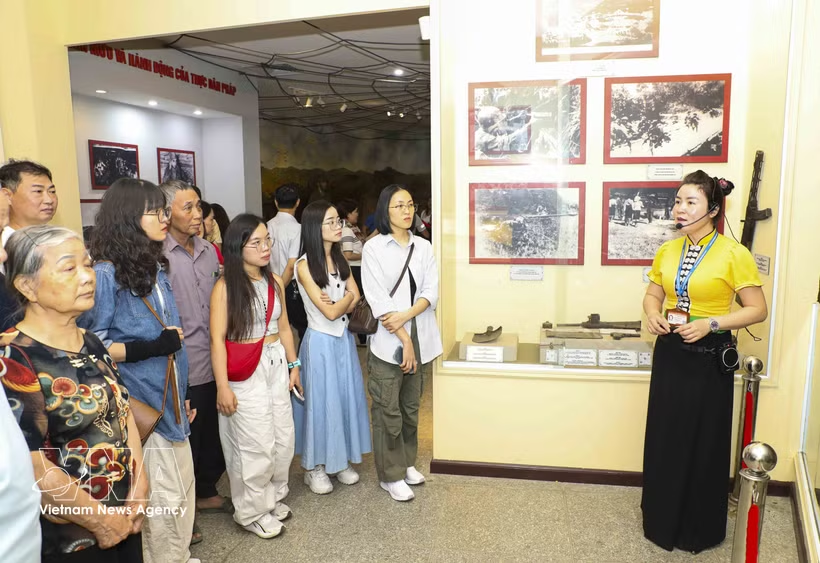
A museum guide provides commentary for visitors at the exhibition hall of the Dien Bien Phu Victory Museum. (Photo: VNA)

Hanoi (VNA) – Following a strong recovery, Vietnam’s tourism sector is entering a new growth cycle marked by profound changes in market scale, consumer behaviour, and operating and promotional models. This evolving landscape requires the tourism workforce to adapt quickly in order to meet the industry's demand for rapid and sustainable development.

According to the National Statistics Office, Vietnam welcomed 2.03 million international visitors in April, bringing the total number of foreign arrivals in the first four months of the year to 8.8 million, equivalent to 35% of the annual target.

Notably, this marked the fourth consecutive month in which the tourism sector recorded more than two million international arrivals, setting a new benchmark for the industry. Domestic tourism also posted robust growth, with 51 million trips recorded during the period, up 7.4% year-on-year.

While these figures underscore Vietnam’s growing appeal as a destination, they also highlight mounting pressure on a tourism workforce widely regarded as both insufficient in number and lacking in quality.

According to a 2024 report by the Vietnam National Authority of Tourism, the sector employed approximately 2.5 million people, including 800,000 direct workers. However, only 45% received formal tourism training, while 35% transitioned from other industries and 20% had no formal training at all.

More significantly, among those trained in tourism, only around 10% hold undergraduate or postgraduate qualifications. About 50% possess vocational or college-level credentials, while 40% have only attended short-term training courses.

Meanwhile, Vietnam’s tourism development plan for 2021–2030, with a vision to 2045, aims for the sector to generate around 10.5 million jobs by 2030, including 3.5 million direct positions. This points to a substantial workforce gap that must be addressed if the industry is to sustain its growth trajectory.

Assoc. Prof. Dr. Nguyen Duc Thang, Vice Rector and dean of the faculty of tourism at the East Asia University of Technology, noted that travellers are increasingly seeking immersive experiences and authentic cultural interactions rather than simply visiting attractions and listening to guided commentary. This shift requires tourism professionals not only to possess strong technical knowledge, but also storytelling abilities, digital skills, creative thinking, and interdisciplinary understanding of cultural industries and creative tourism.

According to Thang, as competition increasingly centres on service quality, the industry's primary challenge is no longer a shortage of general labour, but a lack of highly skilled professionals capable of meeting international standards and working effectively in professional environments from the outset.

Developing such a workforce will require not only efforts from educational institutions but also close collaboration with businesses, from curriculum design and practical training to the creation of professional working environments and competitive remuneration packages that encourage long-term commitment, he recommended.
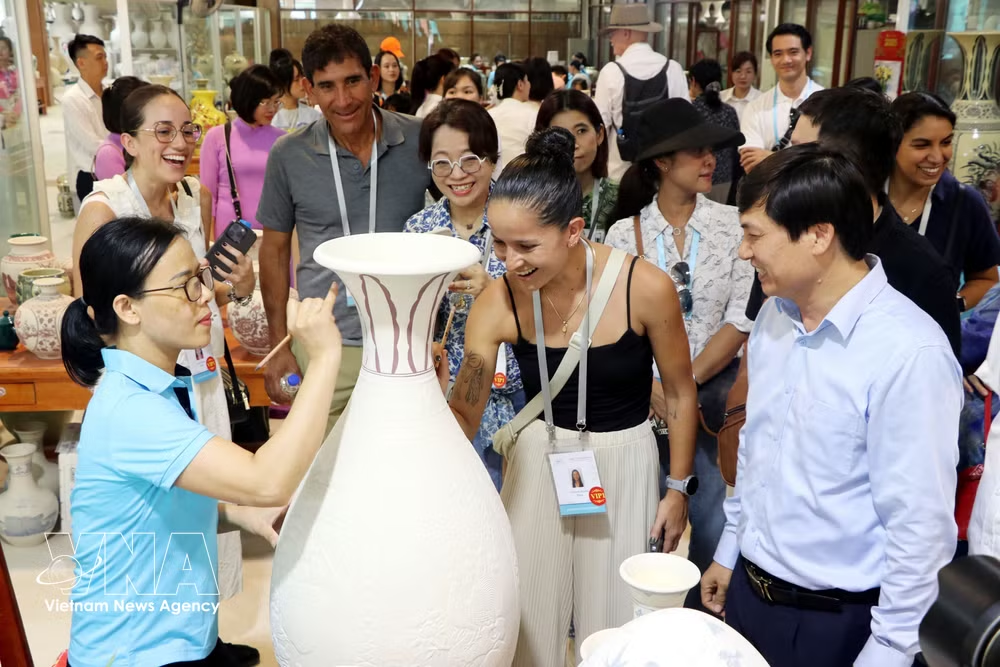
vnanet-hai-phong-chu-dau-pottery.jpg
International visitors explore the traditional craft of Chu Dau pottery in Hai Phong city. (Photo: VNA)

Cao Tri Dung, Chairman of the Vietnam Society of Travel Agents, said the rapid development of Industry 4.0 technologies and digital transformation is reshaping Vietnam’s tourism workforce into two main groups. The first focuses on technology platforms, including data and product digitalisation, marketing innovation, and customer engagement. The second comprises frontline service personnel who interact directly with visitors and deliver tailored travel experiences.

Regardless of their role, workers need core competencies in digital technology, foreign languages and specialised knowledge to meet the demands of international integration. For customer-facing personnel in particular, the ability to personalise services is becoming an increasingly important competitive advantage.

Dung stressed the need to reform training models by strengthening links between educational institutions and businesses, enabling students to undertake internships and gain workplace experience as early and as extensively as possible.

Many experts believe the tourism industry now needs comprehensive research and forecasting to accurately assess medium- and long-term workforce demand, thereby supporting more coordinated and market-oriented training strategies.

In a recent initiative, the Hanoi Department of Tourism organised a specialised training course at a hospital for tour guides and hospitality staff, equipping them with basic first-aid skills and emergency response techniques to enhance visitor safety before professional medical assistance arrives. It has also provided training in professional skills and communication for cyclo drivers, chefs and local communities in tourism destinations to improve service quality.

Meanwhile, Ho Chi Minh City is planning courses on tourism promotion, visitor assistance, communication skills and incident management for frontline service providers, including taxi drivers and other service personnel.

Such initiatives should be replicated more widely to ensure that everyone involved in tourism contributes to a safe, civilised and welcoming destination ecosystem.

Ultimately, investment in tourism workforce development is not merely a response to the industry's practical needs. It is a strategic measure to enhance Vietnam’s service quality and strengthen its competitiveness on the regional and global tourism map./.

VNA

See more

Nam Luc waterfall is situated in Nam Luc 2 village, more than 20 kilometres from the centre of Sin Ho commune, at an altitude of 1,600-1,800 metres above sea level. (Photo: VNA)

Nam Luc waterfall: A hidden “white silk ribbon” in Lai Chau

Located amid the mist-covered mountains of the Sin Ho plateau in the mountainous northwestern province of Lai Chau, the Nam Luc waterfall is emerging as one of the region’s most compelling new destinations for trekking enthusiasts and nature lovers.

A view of the Trang An Scenic Landscape Complex - the first mixed cultural and natural heritage site in Vietnam. (Photo: VNA)

Ninh Binh aims to boost heritage-driven tourism growth

One of the highlights of the Ninh Binh Tourism Week 2026 is the Tam Coc Golden Season Festival at the Tam Coc – Bich Dong tourist site, where visitors can enjoy the vibrant rice harvest landscape alongside traditional cultural activities such as agricultural offerings processions, folk singing and traditional art performances.

Representatives of participating organisations pose for a group photo at the exchange programme marking China Tourism Day on May 19, 2026. (Photo: VNA)

Vietnam, China eye stronger tourism ties through cultural exchanges

Tourism exchanges between the two countries have expanded steadily in recent years, with a growing number of Vietnamese travellers to Chinese destinations such as Guilin, Lijiang, Zhangjiajie and Tianchi Lake, and Chinese tourists continuing to favour Vietnamese destinations including Hanoi, Ho Chi Minh City, Ha Long Bay, Da Nang and Nha Trang.

Several Vietnamese tourism products are introduced to visitors at the fair. (Photo: VNA)

Vietnam captivates visitors at Algeria tourism fair

Vietnam displays large photographs of renowned destinations such as Hoan Kiem Lake, Trang An Landscape Complex, Phong Nha-Ke Bang National Park, Hoi An Ancient Town, Ban Gioc Waterfall and the terraced rice fields of Mu Cang Chai at the International Tourism and Travel Fair (SITEV 2026) in Algeria.

Sun PhuQuoc Airways opens the gateway for the world to experience the paradise Phu Quoc. (Photo: Sun Group)

US media outlines what makes Phu Quoc Southeast Asia’s most sought-after destination

According to TTW, Phu Quoc is emerging as "one of the most desired destinations in Southeast Asia" due to a rare convergence of pristine natural beauty and a heavily invested, modern tourism ecosystem. From sweeping white sands and turquoise waters to global-class resort and entertainment complexes, the island is drawing an increasing number of international travelers seeking an experience that seamlessly balances luxury with a rich local identity.

Local culture makes Vietnamese destinations appealing. (Photo: VNA)

Vietnam targets tourism breakthrough by filling gaps

Industry officials said advances in sci-tech, innovation and digital transformation are already wrenching tourism away from a bulk-volume model toward one built on data, customised experiences and smart governance. Deeper global integration is further widening market access, tightening value chain links and sharpening Vietnam’s destination brand.

The 7 Wonders Day will be held on July 7 to celebrate Ha Long Bay as one of the best known world natural heritage site. (Photo: courtesy of Ha Long Bay - Yen Tu World Heritage Management Department)

7 Wonders Day to spotlight UNESCO heritage jewel Ha Long Bay

A special event entitled 7 Wonders Day with a series of attractions and experiences for both residents and visitors will be held in Ha Long city, Quang Ninh province, on July 7 to honour the elected New 7 Wonders of the World and Nature.

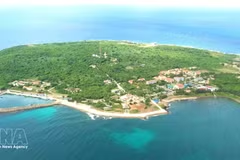
Con Co “steel island”: a green gem in the open sea. (Photo: VNA)

Con Co “steel island”: a green gem in the open sea

Unlike well-established destinations, this small island quietly preserves its layered heritage: tens-of-thousands-year-old basalt formations, pristine tropical forests and enduring wartime memories. Together, they create a distinctive “green gem” in the open sea, subtle yet captivating enough to hold any visitor.

The Hue–Da Nang “Central Heritage Connection” train takes passengers along one of Vietnam’s most spectacular coastal railway routes. (Photo: nhandan.vn)

Heritage rail journey brings new identity to central Vietnam tourism

The heritage train offers passengers not only a means of transport, but also a sense of connection linking destinations across central Vietnam, tourism with transport, and nostalgic memories with contemporary experiences. While older travellers are reminded of journeys from decades ago, younger passengers and international visitors are discovering a greener, culture-rich way to explore the region.

Many Vietnamese travellers love to plan the trip by themselves even when it requires a lot of time. (Photo courtesy of Booking.com)

Vietnamese travellers enjoy planning for trips

The Booking.com’s Travel Trends 2026 data revealed that a growing number of Vietnamese travellers, about 74% of respondents, are channelling “Main Character Planning Energy”, where planning and booking is just as enjoyable as the trip itself.