Vietnam, China step up tourism cooperation through Xinjiang promotion programme

VNAT Deputy Director Nguyen Thi Hoa Mai noted that China has consistently been Vietnam’s largest source of international visitors in multiple periods, including 2011–2020 and 2024–2025. Conversely, Vietnam ranks among the top five outbound markets for China, with Vietnamese arrivals at times exceeding 8 million annually.

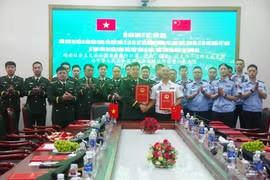
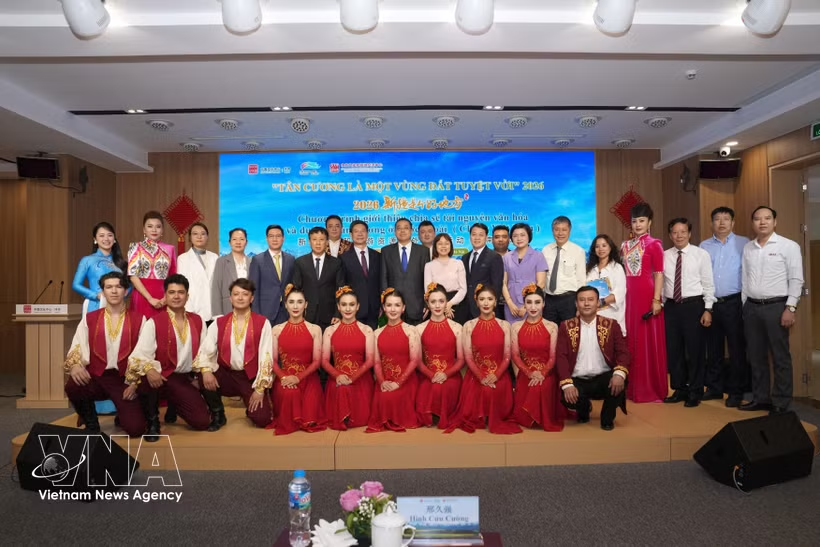
Participants in the tourism promotion programme introducing the cultural and travel potential of the Xinjiang Uyghur Autonomous Region. (Photo: VNA)

Hanoi (VNA) – A tourism promotion programme introducing the cultural and travel potential of the Xinjiang Uyghur Autonomous Region was held in Hanoi on April 27, aiming to further strengthen tourism cooperation between Vietnam and China.

The event, themed “Xinjiang is a wonderful land”, was jointly organised by the Chinese Cultural Centre in Hanoi and the Department of Culture and Tourism of Xinjiang, with support from the Embassy of China in Vietnam and the Vietnam National Authority of Tourism (VNAT).

Speaking at the event, Cultural Counsellor at the Chinese Embassy Xing Jiuqiang highlighted the close ties and long-standing friendship between the two countries, noting that cultural and tourism exchanges serve as a vital bridge connecting their people. The programme also forms part of activities under the Vietnam–China Tourism Cooperation Year 2026–2027, offering Vietnamese visitors deeper insights into China in general and Xinjiang in particular.

With its striking natural landscapes, diverse cultures and historical significance along the Silk Road, Xinjiang holds considerable potential for tourism cooperation with Vietnam, he said.

VNAT Deputy Director Nguyen Thi Hoa Mai noted that China has consistently been Vietnam’s largest source of international visitors in multiple periods, including 2011–2020 and 2024–2025. Conversely, Vietnam ranks among the top five outbound markets for China, with Vietnamese arrivals at times exceeding 8 million annually.

Given Vietnam’s population of over 100 million and China’s more than 1.4 billion, she stressed that there remains vast room for tourism growth between the two countries. Strengthening cooperation will be key to effectively implementing the joint statement on tourism collaboration for 2026–2027 announced by the two countries’ leaders earlier this month.

Mai underlined that tourism is not only about travel experiences but also about fostering mutual understanding and strengthening traditional friendship. Differences in landscapes, culture and lifestyles are key attractions that encourage two-way tourism development.

She added that Vietnam regularly organises tourism promotion activities in major Chinese cities and plans to hold three such programmes in China in 2026, while China frequently hosts similar events in Vietnam.

With improving air connectivity, favourable visa policies and competitive travel costs, the number of tourists travelling between the two countries is expected to continue rising, Mai said, calling on tourism enterprises to actively explore cooperation opportunities and develop distinctive products to meet increasingly diverse demand.

According to Zhang Deshan, Director of the Chinese Cultural Centre in Hanoi, Vietnam remains a key potential market for Chinese tourism. Meanwhile, industry representatives noted that although interest among Vietnamese travellers in Xinjiang has grown in recent years, challenges such as long travel distances and relatively high tour costs remain. Increased promotion and cooperation would help unlock stronger growth in bilateral tourism flows./.

VNA

See more

The Dien Bien Phu campaign headquarters has become a popular tourist attraction in Dien Bien province. (Photo: VNA)

Dien Bien Phu tourism cable car project receives in-principle approval

The project aims to effectively tap the area’s natural landscapes, geographical advantages and distinctive historical value, while creating a high-quality tourism product with strong competitiveness. It is also intended to preserve, honour and promote the value of the Dien Bien Phu Victory special national historical relic site.

Da Lat station is the hub of the roughly 84-km Phan Rang–Da Lat railway (Photo: VNA)

Da Lat city's century-old railway station doubles as tourist draw

It now functions as both a transport hub and a sought-after photo spot. In the early morning, with mist still threaded through the pines, the station radiates an old-world calm. Visitors arrive at dawn to breathe the mountain air and capture iconic images of the highland city.

Ha Long Bay in Quang Ninh province. (Photo: VNA)

Quang Ninh - magnet for affluent Indian travellers

Alongside wedding tourism, Quang Ninh is also seeing robust growth in arrivals of Indian MICE travellers. Delegations of hundreds, and sometimes thousands, of visitors have been coming to the province for conferences, seminars and incentive travel programmes combined with leisure stays.

Visitors explore the Tra Su cajuput forest in An Giang province. (Photo: Tra Su Tourism Area)

Mekong Delta eyes stronger foothold in global tourism

Enriched by the alluvial deposits of the Mekong River, the region stands out for its dense canal network, year-round fruit orchards, biodiversity-rich national parks, and vibrant folk festivals – invaluable assets for developing diverse tourism offerings, from orchard-based eco-tourism and river experiences to cultural, festival, resort and nature conservation tourism.

A Lunar New Year court ceremony of Nguyen Dynasty is reenacted at Thai Hoa Palace in the Imperial Citadel of Hue (Photo: VNA)

Culinary, heritage passports reshape cultural tourism

The central city of Hue is among the first to forge new paths. Its “Hue Tourism Passport” began as a destination brochure in 2018 and has since evolved into the “Hue City Passport” app, with a heritage-passport feature that strings monuments into a structured journey.

Phu Quoc International Airport in Phu Quoc special zone of An Giang province. (Photo: VNA)

Air travel surges to 1.68 million passengers during holiday periods

Domestic air travel accounted for 675,140 passengers and 3,400 tonnes of cargo, marking declines of 7.5% and 11.6%, respectively. In contrast, international transport showed robust growth, surpassing 1 million passengers and reaching 24,050 tonnes of cargo, up 10% in passenger numbers and 10.6% in cargo volume.

International visitors admire the beauty of the My Son Cham sanctuary in Duy Xuyen, Da Nang. (Photo: VNA)

Vietnam records 2 million foreign arrivals in April

The Vietnam National Authority of Tourism (VNAT) said the figures highlight the country’s rising profile as a safe, stable and increasingly compelling destination. It is the first time Vietnam has surpassed 2 million foreign arrivals for four straight months, and the first time the January – April tally has reached 8.8 million.

The Cau Vang (Golden Bridge) in the central city of Da Nang. (Photo: VNA)

Ho Chi Minh City, Da Nang lead Thai tourists’ searches

Data from the online booking platform Agoda shows that Ho Chi Minh City recorded the highest growth in searches from Thailand, reaching 134%, followed by Da Nang with a 58% increase. Other destinations such as Hong Kong (China) saw more modest growth.