Vietnam tightens oversight of adventure tourism with new standard

Tran Hau Ngoc, Vice President of the Commission for Standards, Metrology and Quality of Vietnam (STAMEQ), highlighted that the standard requires comprehensive risk assessments before any activity takes place, covering terrain, weather, route difficulty and emergency preparedness, while also guiding the matching of routes to suitable participant groups.

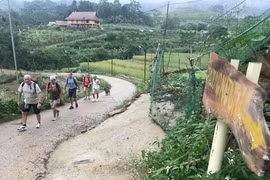
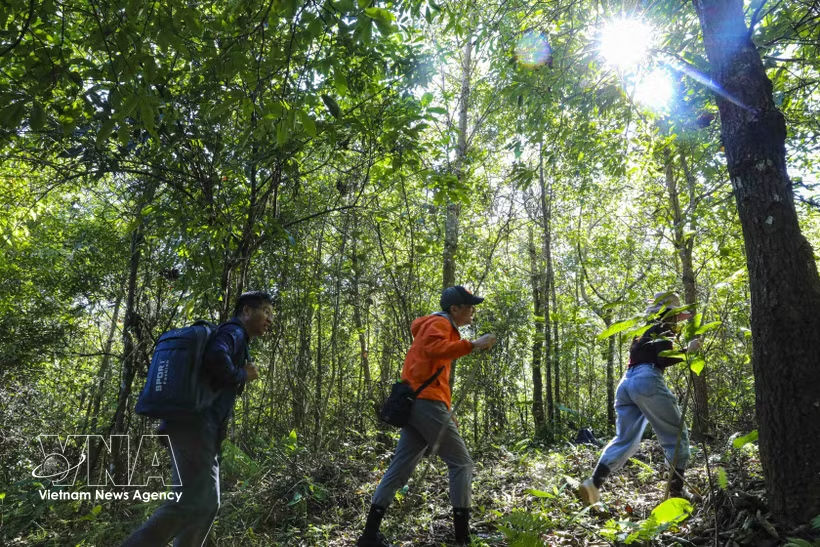
Travellers explore Pu To Co with backpacks and trekking poles, embracing the spirit of adventure. (Photo: VNA)

Hanoi (VNA) – Vietnam has, for the first time, introduced a national standard for adventure tourism, outlining requirements for hiking and trekking activities, with a strong focus on the safety of participants, group leaders and support staff.

The country’s adventure tourism sector is expanding rapidly, drawing young travellers and international visitors to activities such as trekking, caving, kayaking and paragliding. However, safety and management challenges remain. The newly issued national technical standard TCVN 14602:2026 – ISO 3021:2023 is seen as a significant step towards bringing greater consistency and oversight to the sector, particularly in hiking and trekking.

Tran Hau Ngoc, Vice President of the Commission for Standards, Metrology and Quality of Vietnam (STAMEQ), highlighted that the standard requires comprehensive risk assessments before any activity takes place, covering terrain, weather, route difficulty and emergency preparedness, while also guiding the matching of routes to suitable participant groups.

​The framework marks Vietnam’s first unified set of rules for hiking and trekking, introduced amid a spate of mountain-related accidents. It is expected to improve risk control and guide the sector towards safer, more sustainable growth. Previously, the absence of common standards meant risks often fell on travellers, with accountability unclear when incidents occurred.

​The standard also introduces clear criteria for grading routes by characteristics and difficulty, acting as a “filter” to raise industry standards and phase out poorly managed operators. It further sets high requirements for the qualifications and ongoing training of guides and group leaders, who play a central role in managing risks on site and ensuring participants are fully informed.

​Pham Hai Quynh, Director of the Asian Tourism Development Institute (ATI), said the new rules are likely to shift competition in the sector from price to safety and professionalism, and should eventually be tied to licensing conditions to strengthen risk management and support sustainable development.

vnanet-vna-potal-chinh-phuc-dinh-fansipan-trong-tam-tay-moi-du-khach-8144338.jpg
Visitors capture moments during their ascent of Mount Fansipan – the “Roof of Indochina”. (Photo: VNA)

​Despite growing demand, many adventure tours in recent years have been run informally or semi-professionally, lacking standardised safety procedures and weather monitoring, leading to cases of travellers getting lost, exhausted or injured. This has reinforced the urgency of implementing the new standard.

​Quynh noted that TCVN 14602:2026 provides both a legal and technical foundation for businesses to enhance accountability and improve safety, while helping position Vietnam as a reliable and professional destination. The standard also extends to third parties such as equipment suppliers, transport providers and local service operators, creating a comprehensive “safety value chain”, alongside stricter requirements for guide credentials and equipment inspections.

​Experts believe that, given Vietnam’s natural advantages, adventure tourism offers strong potential to attract international visitors. The adoption of the standard is expected to streamline operations, improve service quality and support informed consumer choices, while aligning the sector with international practices and fostering sustainable growth.

​Environmental protection is also a key pillar, with the standard requiring trekking activities to follow “leave no trace” principles and minimise ecological impact, especially as many destinations face increasing pressure from rising visitor numbers./.

VNA

See more

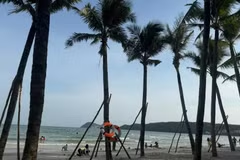
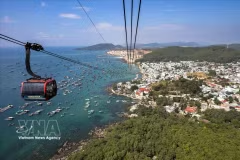
A corner of Phu Quoc island (Photo: VNA)

Phu Quoc becomes new hotspot for Korean tourists

Korean media reported on May 2 that Phu Quoc, once a hidden gem two decades ago, has undergone one of Vietnam’s most dramatic makeovers thanks to massive infrastructure upgrades and a proliferation of luxury resorts.

Participants in Trang An Marathon 2025 (Photo: VNA)

Ninh Binh turns sporting events into tourism engine

In 2025 and early 2026, Ninh Binh hosted a lineup of high-profile international sports events, including the World Triathlon Development Regional Cup & National Championships 2025, AFC Champions League Two, the ASEAN Club Championship, the SEA V.League, and the Li-Ning Vietnam International Series 2025 badminton tournament.

A performance staged at the opening ceremony of the Sa Pa Summer Festival 2026 in Lao Cai province on April 29, 2026. (Photo: VNA)

Sa Pa Summer Festival underway

The festival serves as a key highlight in the locality’s series of cultural and tourism activities, featuring a wide range of distinctive events, including the Fansipan rose festival, the Sa Pa brocade festival and Ban Ho commune’s cultural and tourism day.

Participants in the tourism promotion programme introducing the cultural and travel potential of the Xinjiang Uyghur Autonomous Region. (Photo: VNA)

Vietnam, China step up tourism cooperation through Xinjiang promotion programme

VNAT Deputy Director Nguyen Thi Hoa Mai noted that China has consistently been Vietnam’s largest source of international visitors in multiple periods, including 2011–2020 and 2024–2025. Conversely, Vietnam ranks among the top five outbound markets for China, with Vietnamese arrivals at times exceeding 8 million annually.

The northern province of Phu Tho welcomes nearly 6.5 million visitors during the 2026 Hung Kings Commemoration Day and the Hung Kings Temple Festival (Photo: VNA)

Phu Tho serves nearly 6.5 million visitors during Hung Kings Commemoration Day 2026

According to the provincial Department of Culture, Sports and Tourism, this year’s festival and the Ancestral Land Culture - Tourism Week 2026 featured a wide range of activities across the Hung Kings Temple historical relic site and surrounding areas, drawing pilgrims and tourists from major cities including Hanoi, Hai Phong, Quang Ninh and Ho Chi Minh City.

A key highlight in Huong Tra eco-village is a cluster of nine ancient fragrant rosewood trees, aged between 100 and 150 years. (Photo: VNA)

Fragrant rosewood festival draws crowds in Da Nang

Festival-goers can enjoy a wide range of activities, including hot air balloon rides offering panoramic views of the eco-village, traditional 'ao dai' performances, music exchanges, art sketching and programmes honouring women’s beauty. Outdoor experiences such as jogging, cycling under blooming rosewood trees and a “wish string” ritual add to the appeal.

The main gate of Mau Temple in Hung Yen province. (Photo: VNA)

Hung Yen rolls out vibrant cultural and culinary activities for upcoming holiday

Hung Yen welcomed around 3.9 million visitors in 2025, including approximately 71,000 international arrivals, with tourism revenue estimated at 1.7 trillion VND (64.05 million USD). In the first quarter of 2026 alone, the province received about 1.7 million visitors, including 35,000 foreigners, underscoring its growing appeal as a cultural tourism destination.

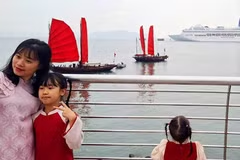
The red sails are expected to become a unique visual highlight and popular check-in feature (Source: Quang Ninh's online portal)

Quang Ninh launches traditional sailboat tours along Ha Long Bay

The initiative follows strong public and visitor interest during the recent Lunar New Year (Tet), when the sight of the traditional wooden boat with its signature red sails drew widespread attention, both on-site and across social media, particularly among international tourists.

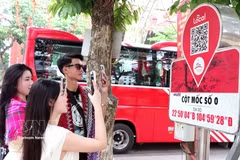
Visitors scan a QR code on the Km0 Ha Giang marker to access tourism information. (Photo: VNA)

Vietnam’s tourism sector accelerates with AI

Chairman of the Vietnam Tourism Association Vu The Binh said AI is opening up new opportunities, from analysing trends and personalising products to optimising promotion, revenue management and visitor flow forecasting, while shaping a smart tourism ecosystem.