Vietnam’s tourism sector accelerates with AI

Chairman of the Vietnam Tourism Association Vu The Binh said AI is opening up new opportunities, from analysing trends and personalising products to optimising promotion, revenue management and visitor flow forecasting, while shaping a smart tourism ecosystem.

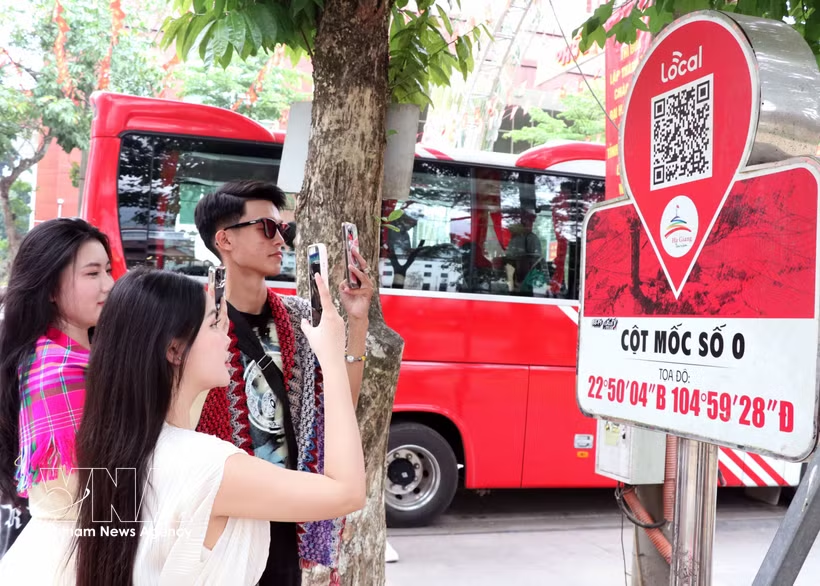
Visitors scan a QR code on the Km0 Ha Giang marker to access tourism information. (Photo: VNA)

Hanoi (VNA) – In recent years, Vietnam’s tourism sector has posted steady gains in revenue and arrivals, but to boost competitiveness and ensure sustainable growth, the “smokeless industry” is shifting towards technology-driven, value-based development, with artificial intelligence (AI) emerging as a key catalyst for breakthroughs.

In practice, AI is increasingly embedded in how travellers plan, explore and experience their journeys, especially among younger tourists. A survey by Booking.com shows that 99% of Gen Z use AI before trips, with 42% receiving personalised recommendations and 40% researching destinations and timing. During their journeys, many continue using AI to translate languages, signs and menus (53%) or access information on heritage sites and museums (47%).

Chairman of the Vietnam Tourism Association Vu The Binh said AI is opening up new opportunities, from analysing trends and personalising products to optimising promotion, revenue management and visitor flow forecasting, while shaping a smart tourism ecosystem. If properly guided, AI can also help conserve resources, cut costs and emissions, and enhance sustainable destination management.

From a business perspective, Pham Ha, President and CEO of LuxGroup, noted that competition now lies between systems that are more efficient, agile and greener, with AI acting as a powerful productivity lever. When effectively applied, one employee can achieve the output of three to five, while also narrowing the gap between large and small firms and enabling wider access to global markets, laying the foundation for more inclusive growth.

To accelerate the adoption of AI, Big Data and the Internet of Things (IoT) in destination management and tourism promotion, Vietnam has rolled out a range of programmes, including the National Digital Transformation Programme and initiatives to develop smart tourism, positioning the sector as a spearhead of the economy.

Resolution No. 80-NQ/TW of the Politburo on cultural development also highlights the need to strengthen digital infrastructure and apply advanced technologies such as AI, Big Data and virtual technologies in cultural production, distribution and management, providing a key foundation for tourism to better leverage cultural resources in the digital environment.

In recent years, tourism businesses have stepped up the use of technology and data to optimise operations and enhance visitor experiences, with solutions such as virtual assistants, guiding robots, multilingual audio guides and real-time translation emerging. However, challenges remain, including fragmented data, uneven digital capacity, limited resources among small and medium-sized enterprises, and a shortage of skilled personnel combining tourism and technology expertise.

To address these bottlenecks, Deputy Director General of the Vietnam National Authority of Tourism Pham Van Thuy stressed the need for stronger coordination among the State, businesses, communities and international partners. He underscored that successful digital transformation depends on changes in mindset and action, urging tourism enterprises to proactively adopt new technologies, particularly AI, while investing in high-quality human resources capable of mastering them.

At the same time, data-driven tourism is gaining traction, with decisions on products, pricing and experiences increasingly based on behavioural data and AI forecasts. According to Dr .Nguyen Anh Tuan, Director of the Institute for Tourism Development Research, building a national digital tourism ecosystem with open data and multi-stakeholder connectivity is essential, alongside policies to promote AI adoption and pilot AI-powered destinations.

Meanwhile, Luong Thanh Nam, CEO of Vietnam Hospitality Solutions JSC, advised that, given limited resources, businesses should begin by assessing their workforce, technology infrastructure and financial readiness to choose suitable transformation pathways. Experts also caution that while AI can enhance efficiency, it cannot replace human roles, and as automation grows, ensuring data security and delivering distinctive, authentic experiences will become increasingly critical./.​

VNA

See more

Golf campaign boosts Vietnam’s tourism brand globally

Golf campaign boosts Vietnam’s tourism brand globally

Within this strategy, golf serves as a “common language” while Tourism Ambassador Greg Norman, with his global reputation and the iconic “Great White Shark” image, plays the role of a compelling storyteller.

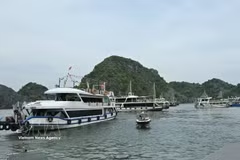
Tour boats await visitors to explore Lan Ha Bay at the Cai Beo tourist boat pier. (Photo: VNA)

New cruise route linking Ha Long and Lan Ha Bays launched

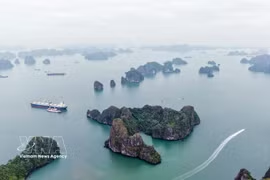
The launch of a new cruise service connecting Ha Long Bay in Quang Ninh province and Lan Ha Bay in neighbouring Hai Phong city marks a significant step in enhancing regional connectivity and promoting the conservation and value of the UNESCO-recogniaed Ha Long Bay – Cat Ba Archipelago.

A visitor poses for check-in photos while touring the World Heritage Site of the Thang Long Imperial Citadel. (Photo: VNA)

Hanoi launches holiday tourism drive for April 30–May 1 holiday

According to the Hanoi Department of Tourism, this year’s strategy focuses on expanding travel beyond the urban core to destinations such as Ba Vi, Soc Son, Huong Son and Son Tay, offering eco-tourism, wellness getaways, community-based travel and farm experiences rooted in local culture.

"Cricket" is the first stop of the show in Ninh Binh (Photo: VNA)

Ninh Binh turns heritage into live-action spectacles to draw tourists

These massive outdoor productions, staged right in the middle of historic sites, are acting like a powerful magnet, transforming Ninh Binh into a hotspot for deeper, more meaningful cultural experiences. They're becoming the main draw, convincing travellers to stick around longer and shell out more cash for one-of-a-kind cultural thrills.

Visitors at Van Mieu - Quoc Tu Giam (The Temple of Literature) in central Hanoi. (Photo: hanoi.gov.vn)

Hanoi gears up for tourism boom during national holidays

For Hanoi tourism sector, the national holidays to commemorate Hung Kings (April 25-27), along with the national reunification celebration (April 30) and the Labour Day (May 1) are not only a peak time for welcoming visitors but also a test of its operational capacity, service organisation, and destination quality in the context of a volatile market.

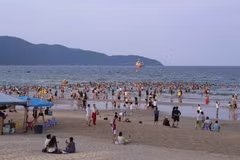
Da Nang beach attracts a large number of visitors (Photo: VNA)

Da Nang draws visitors with vibrant lineup of beach festivals, cultural events

Since mid-April, the city has rolled out a series of cultural and artistic programmes across various venues. Among the highlights are the exhibitions “Sac mau Dat Quang,” held from April 15 to May 5 at the Da Nang Fine Arts Museum, and “Giao diem Viet Nam,” running from April 17 to May 17 at the Da Nang Museum. These exhibitions offer multi-dimensional perspectives on culture, people and contemporary life.

A beach in Co To (Photo: VNA)

Quang Ninh gears up for peak summer tourism surge

Quang Ninh has already hosted a string of large-scale concerts this year, attracting hundreds of thousands of attendees. It is set to stage the Summer Culture, Sports and Tourism Week from April 25-May 3, featuring music, sports, and food events. The centerpiece Ha Long Carnaval 2026, themed “Wonders Shining in a New Era”, is expected to pull in more than 80,000 visitors.

At Noi Bai International Airport in Hanoi (Photo: VNA)

Air travel demand holds steady during Hung Kings, April 30-May 1 holidays

Despite volatility in aviation fuel prices triggered by tensions in the Middle East, flexible Government policies, particularly measures by the Ministry of Construction to cut fuel-related taxes, fees and infrastructure costs, helped maintain stable operations across the sector. As a result, no broad ticket shortages emerged.

A representative of Anex Tour Vietnam presents a conical hat to the first passengers arriving in Da Nang from Vladivostok. (Photo: VNA)

Da Nang welcomes first flight from Vladivostok

According to the plan, the programme will run from April 16 to October 23, connecting eight cities across Russia, the CIS, and Belarus with Da Nang. The total number of visitors is expected to reach approximately 25,500, with a maximum frequency of 36 flights per month, equivalent to around 4,800 passengers monthly.