Vietnam, China step up cooperation in AI training, applications for cross-border tourism

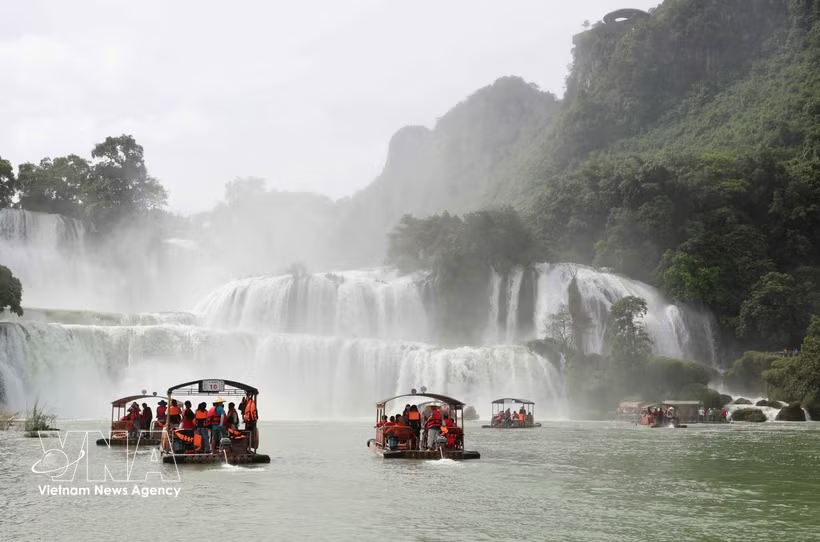
In recent years, cross-border tourism cooperation between the two countries has continued to expand. Products such as the cross-border tourism area Ban Gioc (Vietnam) – Detian (China) Waterfalls have been put into regular operation, providing fresh momentum for bilateral exchanges.

The cross-border tourism area Ban Gioc (Vietnam) – Detian (China) Waterfalls attracts thousands of visitors each day. (Photo: VNA)

Beijing (VNA) – A programme on exchange and cooperation in artificial intelligence (AI) for cross-border tourism between China and Vietnam concluded on April 19 in Nanning, China's Guangxi, with nearly 30 representatives from Vietnamese tourism authorities and enterprises.

The initiative was jointly organised by the Guangxi Department of Culture and Tourism and the Departments of Culture, Sports and Tourism of Vietnam's Quang Ninh, Lang Son, Cao Bang, and Tuyen Quang provinces.

Experts from both sides delivered training on tourism policies, smart tourism operations, and the application of AI in sector management, helping participants enhance their capacity to optimise operations, develop tourism products, build brands, and improve service quality. Delegates also undertook field visits to explore Guangxi’s digital tourism service systems.

In recent years, cross-border tourism cooperation between the two countries has continued to expand. Products such as the cross-border tourism area Ban Gioc (Vietnam) – Detian (China) Waterfalls have been put into regular operation, providing fresh momentum for bilateral exchanges.

According to data from Guangxi’s border management authorities, in the first quarter of this year, total cross-border movements through local checkpoints reached 4.347 million, up 19.7% year-on-year. Notably, the Dongxing border gate alone received more than 3,200 Vietnamese tourist groups, reflecting strong growth in cross-border travel.

The training programme provided a valuable platform for Vietnamese tourism professionals to gain practical knowledge of AI and cross-border tourism development, while laying the groundwork for enhanced information-sharing platforms, smart tourism products, and strengthened data connectivity between the two sides./.


VNA

See more

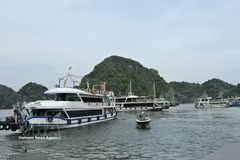
Tour boats await visitors to explore Lan Ha Bay at the Cai Beo tourist boat pier. (Photo: VNA)

New cruise route linking Ha Long and Lan Ha Bays launched

The launch of a new cruise service connecting Ha Long Bay in Quang Ninh province and Lan Ha Bay in neighbouring Hai Phong city marks a significant step in enhancing regional connectivity and promoting the conservation and value of the UNESCO-recogniaed Ha Long Bay – Cat Ba Archipelago.

A visitor poses for check-in photos while touring the World Heritage Site of the Thang Long Imperial Citadel. (Photo: VNA)

Hanoi launches holiday tourism drive for April 30–May 1 holiday

According to the Hanoi Department of Tourism, this year’s strategy focuses on expanding travel beyond the urban core to destinations such as Ba Vi, Soc Son, Huong Son and Son Tay, offering eco-tourism, wellness getaways, community-based travel and farm experiences rooted in local culture.

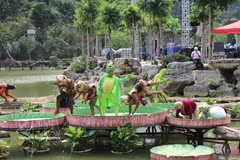
"Cricket" is the first stop of the show in Ninh Binh (Photo: VNA)

Ninh Binh turns heritage into live-action spectacles to draw tourists

These massive outdoor productions, staged right in the middle of historic sites, are acting like a powerful magnet, transforming Ninh Binh into a hotspot for deeper, more meaningful cultural experiences. They're becoming the main draw, convincing travellers to stick around longer and shell out more cash for one-of-a-kind cultural thrills.

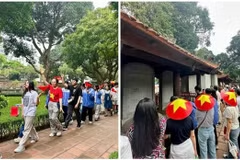
Visitors at Van Mieu - Quoc Tu Giam (The Temple of Literature) in central Hanoi. (Photo: hanoi.gov.vn)

Hanoi gears up for tourism boom during national holidays

For Hanoi tourism sector, the national holidays to commemorate Hung Kings (April 25-27), along with the national reunification celebration (April 30) and the Labour Day (May 1) are not only a peak time for welcoming visitors but also a test of its operational capacity, service organisation, and destination quality in the context of a volatile market.

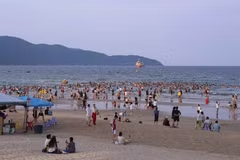
Da Nang beach attracts a large number of visitors (Photo: VNA)

Da Nang draws visitors with vibrant lineup of beach festivals, cultural events

Since mid-April, the city has rolled out a series of cultural and artistic programmes across various venues. Among the highlights are the exhibitions “Sac mau Dat Quang,” held from April 15 to May 5 at the Da Nang Fine Arts Museum, and “Giao diem Viet Nam,” running from April 17 to May 17 at the Da Nang Museum. These exhibitions offer multi-dimensional perspectives on culture, people and contemporary life.

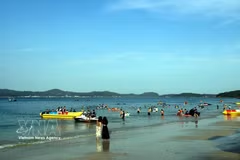
A beach in Co To (Photo: VNA)

Quang Ninh gears up for peak summer tourism surge

Quang Ninh has already hosted a string of large-scale concerts this year, attracting hundreds of thousands of attendees. It is set to stage the Summer Culture, Sports and Tourism Week from April 25-May 3, featuring music, sports, and food events. The centerpiece Ha Long Carnaval 2026, themed “Wonders Shining in a New Era”, is expected to pull in more than 80,000 visitors.

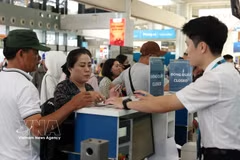
At Noi Bai International Airport in Hanoi (Photo: VNA)

Air travel demand holds steady during Hung Kings, April 30-May 1 holidays

Despite volatility in aviation fuel prices triggered by tensions in the Middle East, flexible Government policies, particularly measures by the Ministry of Construction to cut fuel-related taxes, fees and infrastructure costs, helped maintain stable operations across the sector. As a result, no broad ticket shortages emerged.

A representative of Anex Tour Vietnam presents a conical hat to the first passengers arriving in Da Nang from Vladivostok. (Photo: VNA)

Da Nang welcomes first flight from Vladivostok

According to the plan, the programme will run from April 16 to October 23, connecting eight cities across Russia, the CIS, and Belarus with Da Nang. The total number of visitors is expected to reach approximately 25,500, with a maximum frequency of 36 flights per month, equivalent to around 4,800 passengers monthly.

Visitors explore and experience the cultural space of Lo Lo Chai village in Lung Cu commune, Tuyen Quang province. (Photo: qdnd.vn)

Administrative expansion unlocks new momentum for tourism development

Nguyen Thi Hoai, Deputy Director of the Department of Culture, Sports and Tourism of Tuyen Quang, said the expansion of administrative boundaries has opened up new development space for the province, with key tourism products including cultural-historical tourism, ethnic cultural experiences, community-based tourism linked to scenic sites, spiritual tourism, and other distinctive experiential offerings.

At Thung Nham ecological tourism site in Ninh Binh province. (Photo: VNA)

Vietnam’s tourism defies fuel price shock with record Q1 “hat-trick”

According to data released by the National Statistics Office, foreign arrivals in March reached nearly 2.1 million, up 1.3% year-on-year. In total, Vietnam welcomed an estimated 6.76 million foreign tourists in the first quarter, a more than 12% jump from the same period in 2025 and the highest Q1 figure ever recorded.

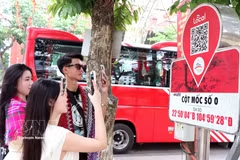
Visitors scan QR codes at Km0 Ha Giang to access tourism information. (Photo: VNA)

Technology powers tourism growth in mountainous province

Last year, Tuyen Quang welcomed over 3.9 million visitors, and is aiming to attract around 4.1 million arrivals, including around 600,000 foreigners, this year. Tourism continues to be identified as a key economic sector, with development oriented toward sustainability, green growth, and enhanced competitiveness through digitalisation.

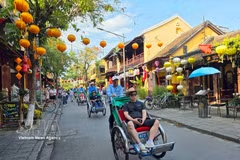
Tourists enjoy a rickshaw tour of Hoi An Ancient Town, Da Nang city. (Photo: VNA)

ITE HCMC 2026 to promote Vietnam’s tourism on global map

With its large scale, the ITE HCMC 2026 aims to promote tourism cooperation between Vietnam and priority markets such as Northeast Asia, Western Europe, North America, Southeast Asia, and Oceania while also boosting visitor arrivals from the Indian market