Vietnam’s tourism defies fuel price shock with record Q1 “hat-trick”

According to data released by the National Statistics Office, foreign arrivals in March reached nearly 2.1 million, up 1.3% year-on-year. In total, Vietnam welcomed an estimated 6.76 million foreign tourists in the first quarter, a more than 12% jump from the same period in 2025 and the highest Q1 figure ever recorded.

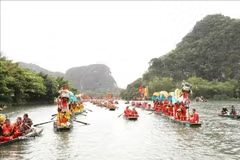
At Thung Nham ecological tourism site in Ninh Binh province. (Photo: VNA)

Hanoi (VNA) - Despite global headwinds stemming from tensions in the Middle East, Vietnam’s tourism sector posted a record-breaking first quarter, pulling in more than 2 million foreigners per month and achieving its strongest Q1 performance on record.

Record “hat-trick” of 2 million visitors per month

According to data released by the National Statistics Office, foreign arrivals in March reached nearly 2.1 million, up 1.3% year-on-year.

In total, Vietnam welcomed an estimated 6.76 million foreign tourists in the first quarter, a more than 12% jump from the same period in 2025 and the highest Q1 figure ever recorded.

Notably, this marks the first time the domestic tourism industry has sustained three consecutive months with over 2 million foreign arrivals each.

The Vietnam National Authority of Tourism (VNAT) said the results underscore the sector’s growing appeal, resilience, and solid footing amid global uncertainties.

Optimising visitor experience and spending

Lecturer Tang Thong Nhan from the Ho Chi Minh City University of Technology called the three straight months above 2 million arrivals a strongly positive signal, especially against a backdrop of global volatility.
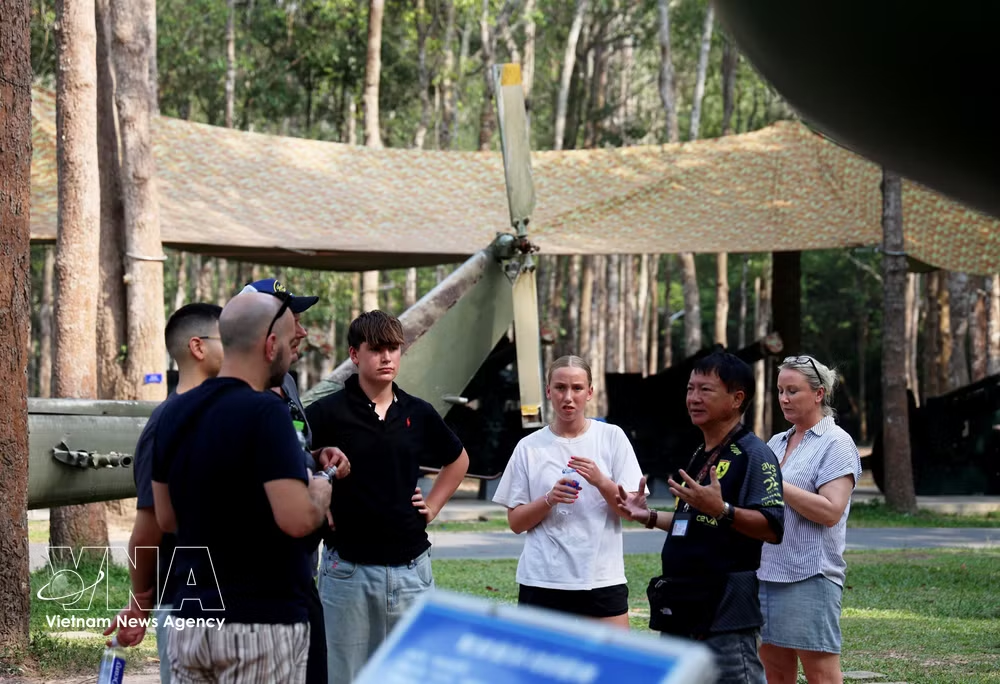
vnanet-f.jpg
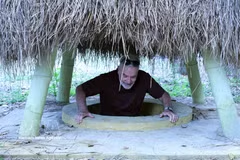
Foreigners explore Cu Chi tunnels in Ho Chi Minh City. (Photo: VNA)

The first quarter is traditionally peak season for Vietnam, driven by major festivals, Lunar New Year, and favourable weather across key destinations. Geopolitical tensions and rising fuel prices only intensified in the latter half of March, leaving travel demand relatively stable through the first 2.5 months of the year, he noted.

However, the second quarter is shaping up to be far more challenging. Surging fuel costs have already driven airfares up 10–25%, with some routes spiking as much as 40%, threatening to curb demand, particularly from price-sensitive markets.

To maintain momentum, Nhan urged a sharper focus on high-end tourism segments with stronger spending power, as these travellers are less deterred by higher travel costs and deliver considerably higher revenue per visitor. Vietnam should also capitalise on shifting travel patterns triggered by geopolitical instability, especially by drawing high-spending tourists from the Middle East seeking safer alternatives.

Sustaining growth in emerging markets such as Russia and India through expanded flight routes, easier visas, and tailored products will be critical. At the same time, traditional powerhouses like China and the Republic of Korea demand targeted strategies to retain and win back visitors, given their scale and stability, he added.

From a longer-term perspective, Dr. Duong Duc Minh from the VNAT’s Institute for Tourism Development Research argued that Vietnam’s tourism strategy must move decisively beyond chasing raw visitor numbers toward optimising the entire end-to-end consumer journey.

He pointed to a broader global economic shift, from supply chains in 1950–2000, to value chains in 2000–2010, and now to optimisation in the post-2019 era where maximising the full visitor experience is the new battleground.

A key bottleneck in Vietnam remains the “final stage” of consumption, particularly shopping and taking products home. Many local souvenirs and specialty goods are still too bulky or expensive to transport, discouraging purchases and leaving money on the table.

Encouragingly, some progress is visible at the local level. The northern province of Quang Ninh, for instance, has rolled out coordinated solutions, ranging from transport infrastructure upgrades to targeted demand stimulation at Van Don International Airport, including travel incentives and bundled services for visitors./.
VNA

See more

Con Co “steel island”: a green gem in the open sea. (Photo: VNA)

Con Co “steel island”: a green gem in the open sea

Unlike well-established destinations, this small island quietly preserves its layered heritage: tens-of-thousands-year-old basalt formations, pristine tropical forests and enduring wartime memories. Together, they create a distinctive “green gem” in the open sea, subtle yet captivating enough to hold any visitor.

The Hue–Da Nang “Central Heritage Connection” train takes passengers along one of Vietnam’s most spectacular coastal railway routes. (Photo: nhandan.vn)

Heritage rail journey brings new identity to central Vietnam tourism

The heritage train offers passengers not only a means of transport, but also a sense of connection linking destinations across central Vietnam, tourism with transport, and nostalgic memories with contemporary experiences. While older travellers are reminded of journeys from decades ago, younger passengers and international visitors are discovering a greener, culture-rich way to explore the region.

Many Vietnamese travellers love to plan the trip by themselves even when it requires a lot of time. (Photo courtesy of Booking.com)

Vietnamese travellers enjoy planning for trips

The Booking.com’s Travel Trends 2026 data revealed that a growing number of Vietnamese travellers, about 74% of respondents, are channelling “Main Character Planning Energy”, where planning and booking is just as enjoyable as the trip itself.

Hai Tac Island in An Giang province is increasingly attractive to visitors. (Photo: VNA)

Slow travel increases connections, reshapes tourism trends

Rather than rushing to “check in” at as many attractions as possible, slow travel allows visitors to immerse themselves in local life. Travellers may spend time wandering through a highland market, learning to cook a traditional dish, cycling around a coastal fishing village, or simply enjoying the tranquil rhythm of life in the countryside.

Sunlight streams into the Dinosaur Eye while visitors join the Son Doong adventure tour (Photo: VNA published)

Quang Tri province boosts tourism promotion through international television, films

A special documentary on Son Doong Cave, the world’s largest cave, was aired on March 29 in the renowned “60 Minutes” programme of CBS News. The report retraced the discovery of Son Doong Cave and years of expeditions conducted by the British Cave Research Association, offering global audiences a comprehensive look at the cave through scientific, historical and human perspectives.

The Dien Bien Phu campaign headquarters has become a popular tourist attraction in Dien Bien province. (Photo: VNA)

Dien Bien Phu tourism cable car project receives in-principle approval

The project aims to effectively tap the area’s natural landscapes, geographical advantages and distinctive historical value, while creating a high-quality tourism product with strong competitiveness. It is also intended to preserve, honour and promote the value of the Dien Bien Phu Victory special national historical relic site.

Da Lat station is the hub of the roughly 84-km Phan Rang–Da Lat railway (Photo: VNA)

Da Lat city's century-old railway station doubles as tourist draw

It now functions as both a transport hub and a sought-after photo spot. In the early morning, with mist still threaded through the pines, the station radiates an old-world calm. Visitors arrive at dawn to breathe the mountain air and capture iconic images of the highland city.

Ha Long Bay in Quang Ninh province. (Photo: VNA)

Quang Ninh - magnet for affluent Indian travellers

Alongside wedding tourism, Quang Ninh is also seeing robust growth in arrivals of Indian MICE travellers. Delegations of hundreds, and sometimes thousands, of visitors have been coming to the province for conferences, seminars and incentive travel programmes combined with leisure stays.