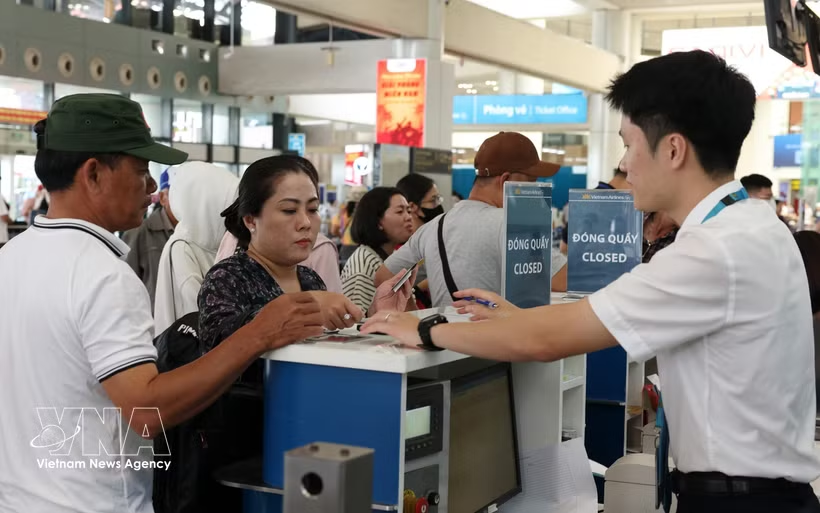
Hanoi (VNA) – Vietnam’s air transport market showed positive signals during the upcoming Hung Kings Commemoration Day and the April 30–May 1 holiday, with booking demand distributed relatively evenly and no widespread localised congestion reported.
Despite volatility in aviation fuel prices triggered by tensions in the Middle East, flexible Government policies, particularly measures by the Ministry of Construction to cut fuel-related taxes, fees and infrastructure costs, helped maintain stable operations across the sector. As a result, no broad ticket shortages emerged.
Airlines kept flight supply at reasonable levels, meeting travel demand while giving passengers wider choices on schedules and pricing.
The proximity of the two holidays created an extended break, allowing travellers to better plan their itineraries. That helped spread demand more evenly and eased peak-day pressure compared with previous years.
In the early days of the holiday period (April 25, 26, 29 and 30), booking rates on tourism routes from Hanoi and Ho Chi Minh City stayed generally low, leaving a relatively large number of available seats.
On the key route between Ho Chi Minh City and Hanoi, load factors ranged from just 20%-40%, showing that capacity largely matched market demand.
Certain routes to niche tourist destinations, however, posted high occupancy exceeding 90%. Those included Ho Chi Minh City - Tuy Hoa, Ho Chi Minh City - Con Dao, Hanoi - Tuy Hoa, Hanoi - Chu Lai and Hanoi - Dong Hoi.
Return travel demand picked up toward the end of the holiday as passengers headed back to major cities, especially Ho Chi Minh City. Even so, overall booking rates on routes into Hanoi and Ho Chi Minh City remained moderate. Only a few routes, such as Con Dao–Ho Chi Minh City and Dong Hoi–Hanoi, exceeded 80% occupancy during the period.
Airfares in the early phase (April 25–29) for economy-class tickets on the Hanoi–Ho Chi Minh City route typically ranged between 3.6 - 4.2 million VND (137–159 USD). Vietnam Airlines and Bamboo Airways quoted the highest fares at 3.9-4.2 million dong VND, followed by Vietjet Air at 3.2-3.9 million VND and Vietravel Airlines at 3.3-3.8 million VND.
Those prices were comparable to those seen during the 2026 Lunar New Year period and reflected a modest 8–10% year-on-year increase, driven by higher operational costs but still within regulated limits.
Fares also stayed high in the days leading up to the holiday. On April 29, Ho Chi Minh City–Da Nang economy tickets were priced at 2.7-3.2 million VND on Vietnam Airlines, while Vietjet Air and Bamboo Airways offered 1.8 - 2.6 million VND. Hanoi–Da Nang fares ranged from 2.6-3.8 million VND on Vietnam Airlines and 2.1-2.9 million VND on other carriers.
On longer-haul leisure routes, Hanoi–Phu Quoc fares peaked near 4.8 million VND on Vietnam Airlines and 3-4.6 million VND on Vietjet Air. Ho Chi Minh City–Phu Quoc tickets ranged from 1.8-3 million VND, and Hanoi–Cam Ranh from 3.5-4.2 million VND.
On return legs, ticket prices rose sharply toward the end of the holiday. A survey on May 3 showed Cam Ranh - Hanoi fares reaching 3.9–4.2 million VND on Vietjet Air, while many economy-class seats on other airlines were already sold out.
Similarly, Cam Ranh - Ho Chi Minh City fares stood at 2-2.3 million VND on Vietjet Air and 2.6-3.1 million VND on Vietnam Airlines. Most economy seats on Phu Quoc - Hanoi flights for May 3 were sold out, while Phu Quoc - Ho Chi Minh City fares ranged from 2.1-3 million VND on Vietnam Airlines and about 1.9-2.3 million VND on other carriers./.