Beyond spotlight: Vietnam tourism builds lasting value

Mui Ne’s appearance in global trend reports signals a new movement, where destinations can no longer rely solely on scenery but must tell their own stories and craft distinctive and personalised experiences.

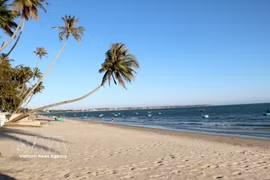
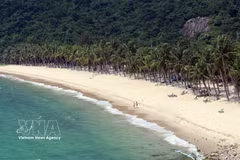
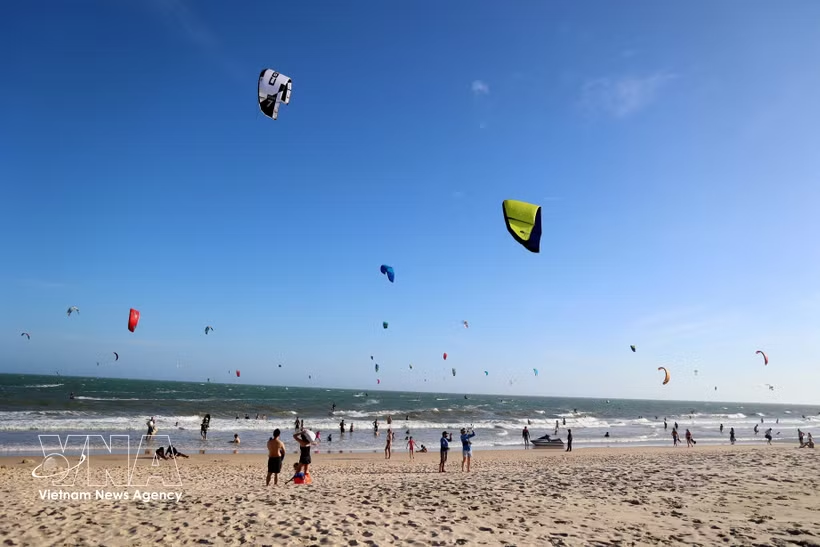
Mui Ne in Lam Dong province is becoming a popular destination for those who love water sports. (Photo: VNA)

Hanoi (VNA) - The recognition of Mui Ne among Booking.com’s top global trending destinations for 2026, alongside Bilbao (Spain), Barranquilla (Colombia), Philadelphia (the US) and Guangzhou (China), underscores a shift in Vietnam’s tourism toward greater distinctiveness and depth.

For years, Vietnam’s tourism advantages have largely rested on natural resources and competitive costs. This model enabled rapid growth but also created a familiar cycle of heavy exploitation followed by a gradual loss of differentiation.

Mui Ne’s appearance in global trend reports signals a new movement, where destinations can no longer rely solely on scenery but must tell their own stories and craft distinctive and personalised experiences.

This shift is taking shape across the country. Da Nang is positioning itself as a hub for events and high-end resorts; Phu Quoc is developing integrated resort complexes; while Hanoi and Ho Chi Minh City are tapping into cultural depth and urban lifestyles. The common thread is a growing awareness among tourism stakeholders to move from a passive “use what’s available” approach to proactively designing products and curating experiences.

Change is also being driven by travelers. The desire to “travel to feel” is replacing the urge to “travel to check in.” This trend opens up opportunities for community-based tourism. As authenticity becomes a core value, fishing villages, neighborhoods and cultural spaces can all become integral parts of the tourism offering.

Opportunities abound, but challenges are equally evident. As destinations gain popularity, risks of overcrowding and over-commercialisation rise. The key question is no longer how many visitors to attract, but how to maintain the quality of experience as numbers grow - requiring coordinated planning, effective management and strong community awareness.

The recognition may provide an initial boost, but long-term value lies in preserving identity, refreshing offerings and adapting to evolving trends. As more destinations move in this direction, Vietnam’s tourism sector can build a more diverse and sustainable ecosystem./.
VNA

See more

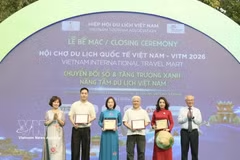
The organisers of VITM 2026 honour sponsors. ( Photo: VNA)

VITM 2026 boosts tourism demand ahead of peak season

According to the organisers, around 4,500 representatives from Vietnamese and international tourism enterprises attended the event, generating more than 25,000 business meetings and partnership exchanges. Approximately 15,000 discounted tours and travel products were offered to visitors.

Traditional dragon procession held on the river in Ninh Binh. (Photo: VNA)

Cultural heritage drives sustainable tourism growth in Ninh Binh

In the first two months of 2026, Ninh Binh welcomed over 5.4 million visitors, up 9.9% year-on-year, generating nearly 5.84 trillion VND (221 million USD) in tourism revenue, up 15.9%. During the 2026 Lunar New Year holiday alone, the province received 2.38 million visitors, an 81.4% increase from the previous year, ranking second nationwide.

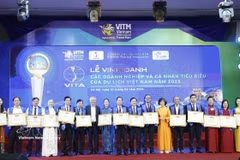
Outstanding individuals and firms honoured at VITM 2026 (Photo: VNA)

Outstanding individuals, firms honoured at Vietnam International Travel Mart 2026

In 2025, Vietnam’s tourism sector recorded its highest-ever number of visitors, welcoming more than 21.5 million international arrivals, up more than 20% from 2024, and serving over 135.5 million domestic travellers. Tourism revenue also surpassed 1 quadrillion VND (nearly 38 billion USD). The sector has become a bright spot of the economy, with Vietnam ranking among the world’s fastest-growing tourism destinations.

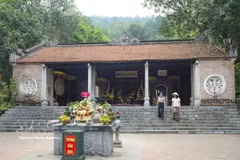
The Ba Trieu Temple in Thanh Hoa province (Photo: VNA)

Thanh Hoa taps digital transformation to boost heritage tourism

With 28 nationally-recognised intangible cultural heritage elements, Thanh Hoa province has prioritised integrating conservation with tourism development. Digital transformation, in particular, is seen as a crucial bridge connecting tradition with innovation, helping heritage sites become more accessible and engaging.

Pristine white-sand beach on Cu Lao Cham Island, Da Nang city, is a magnet for visitors. (Photo: VNA)

Vietnam – a safe destination amid global uncertainties

Despite global tourism headwinds linked to geopolitical conflicts, transport disruptions and surging travel expenses, Vietnam’s tourism sector has sustained strong growth, underscoring the destination’s resilience and rising international profile.

A border guard at the Mong Cai International Border Gate processes exit procedures for passengers at the Bac Luan 1 border gate in Quang Ninh province. (Photo: VNA)

Vietnam, China promote AI application in cross-border tourism cooperation

During the programme, participants will attend intensive courses delivered by AI technology experts, China–ASEAN policy researchers, and tourism specialists. The curriculum focuses on the application of big data in tourism policy planning, the development of cross-border tourism products, and the building of joint tourism brands.

The sea area off the southern coast of Phu Quoc Island. (Photo: VNA)

UK newspaper praises Phu Quoc’s unspoilt charm amid tourism boom

Phu Quoc is positioned as a compelling alternative – even a potential rival to Phuket – for travellers seeking authenticity in Southeast Asia. Its appeal lies not only in scenic beauty and fresh seafood, but also in the harmonious coexistence of modern tourism and enduring local culture.

At an elevation of 1,700 metres above sea level, the summit of Pu Luong is increasingly emerging as an ideal destination for trekking - a form of adventure tourism that combines hiking with nature exploration and physical as well as mental endurance. (Photo: VNA)

Vietnam eyes becoming region’s leading tourism destination

Vietnam has in recent years undergone a notable transformation in its tourism development strategy, placing a strong emphasis on nature-based and eco-tourism. This shift is not merely aligned with global trends, but represents a necessary step towards safeguarding valuable natural resources, while appealing to a growing segment of environmentally conscious travellers.

Foreign tourists in a photo with local residents. (Photo: VNA)

Vietnam serves 6.76 million foreign arrivals in Q1

China and the Republic of Korea (RoK) continued to lead as Vietnam’s largest source markets in the quarter, with 1.4 million and 1.3 million visitors respectively, accounting for around 40% of total arrivals.

Cua Viet beach is a magnet for both locals and visitors during holidays. (Photo: VNA)

Quang Tri seeks to unlock potential of marine tourism’s “golden triangle”

Cua Tung, Cua Viet and Con Co special zone are identified as three key destinations of marine tourism, and to transform this “tourism triangle” into premium and peaceful resorts, a new strategy is needed to enhance attractiveness to high-end travellers seeking private spaces as the strength of these places lies in their pristine and tranquil beauty.

A corner of the Phu Quy special zone in Lam Dong province (Photo: VNA)

Phu Quy moves to unlock potential as premier marine tourism hotspot

Under a resolution of the provincial Party Congress for the 2025–2030 term, the locality prioritises spatial planning of the marine economy, focusing on emerging sea-based industries linked with environmental protection and national defence. Located 56 nautical miles offshore, Phu Quy is a central pillar of this vision.