Ho Chi Minh City steps up to connect, steer Vietnam’s tourism flows

Sales of tours, services and tourism products at the 22nd Ho Chi Minh City Tourism Festival 2026, held in early this month by the municipal Department of Tourism and the city’s Tourism Association, generated around 120 billion VND in revenue.

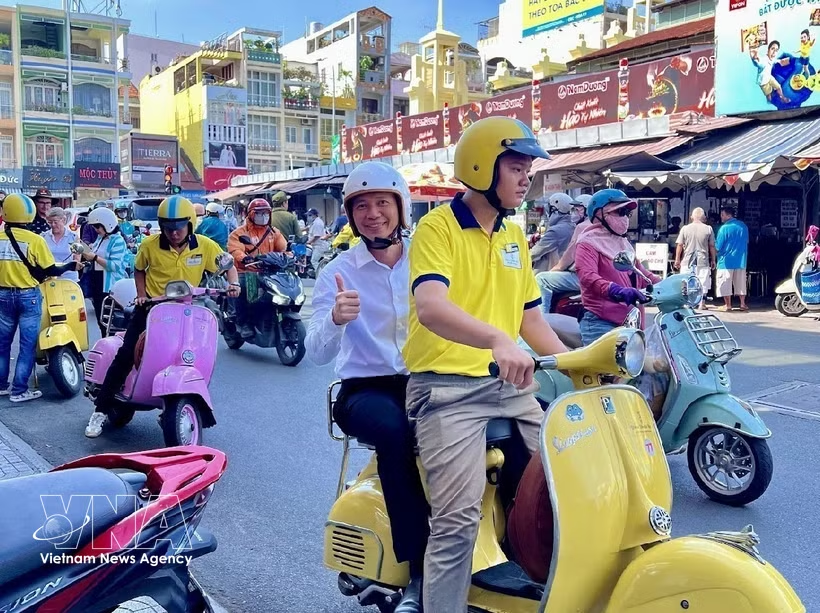
Tourists experience exploring Ho Chi Minh City by Vespa scooter. (Photo: VNA)

Ho Chi Minh City (VNA) – Tourism in Ho Chi Minh City is not only expanding in scale but also shifting strongly toward improving visitor experience, strengthening connectivity and enhancing its spillover effects.

Boosting local tours

Sales of tours, services and tourism products at the 22nd Ho Chi Minh City Tourism Festival 2026, held in early this month by the municipal Department of Tourism and the city’s Tourism Association, generated around 120 billion VND in revenue.

The event showcased about 1,000 distinctive tourism products from across the country, offered with flexible discounts, promotions and giveaways. Designed as an open experiential space, the festival blended trade promotion with cultural, entertainment and community engagement activities, enabling visitors to access quality travel programmes at reasonable prices while helping businesses promote and distribute their offerings.

Pham Huy Binh, Director of the municipal Department of Tourism, said the festival not only achieved strong results in scale but also created clear market stimulus. Partnerships formed at the event are expected to evolve into concrete cooperation programmes, while products introduced will continue to be refined for the market. The inspiration generated is also expected to shape new travel journeys in the near future.

Travel firms have simultaneously rolled out new products ahead of the April holiday season. Notably, helicopter sightseeing tours over Ho Chi Minh City departing from Vung Tau offer four options ranging from 15 to 60 minutes, catering to diverse budgets and preferences. The product is expected to become a signature experience attracting more visitors.

Meanwhile, Cu Chi Tunnels are promoting a range of new offerings, including the night tour themed “Moonlight over the War Zone,” a mini zoo, sports shooting activities, and Khmer cultural experiences during the April 30–May 1 holiday.

Other distinctive tours include “Binh Tay Market – Touching the Past,” “Tan Dinh Imprints,” “Saigon Greets the Morning,” “Saigon by Night,” and “Xuan Hoa – Old Charm in a New Urban Area.” In culinary tourism, the city has launched a series of 15 themed programmes connecting travel with local flavours across different districts.

According to Chairwoman of Saigontourist Group Nguyen Thi Anh Hoa, as the city expands its tourism space and diversifies products linked to nature, ecology and community-based experiences, businesses are conducting field surveys in various localities. These efforts aim to assess tourism resources, infrastructure and development potential to better serve visitors.

Data from Agoda also show that travellers are increasingly prioritising sustainable options that benefit the environment and local communities, especially in Asia and among Vietnamese tourists.

Restructuring products amid rising costs

Since early March, domestic fuel prices have continued to rise due to geopolitical tensions in the Middle East disrupting global energy supply chains. This has directly impacted the tourism sector, where transport costs account for a large share of tour prices, especially for air and cruise travel.

Rather than adjusting base fares, many airlines and transport service providers have introduced fuel surcharges to offset rising input costs. This creates significant pressure on travel companies to maintain competitive pricing while ensuring service quality.

In response, tourism firms in Ho Chi Minh City are adopting flexible strategies. Instead of across-the-board discounts, businesses are restructuring products by optimising services, itineraries and bundled experiences to create differentiated value.

Many companies are separating fuel surcharges, particularly for outbound tours, to improve pricing transparency, while prioritising early flight bookings to mitigate cost fluctuations. There is also a shift toward domestic road tours and nearby destinations, combined with diverse experiences such as free walking tours, cycling and metro-based travel.

A representative example is Vietravel, which is striving to stabilise service costs while maintaining quality. The company separates transportation costs, adjusted according to airlines and transport partners, while keeping land service costs such as hotels, meals, guides and experiences stable. This approach helps protect customer benefits and ensure consistent service standards.

Tran Doan The Duy, CEO of Vietravel, said the company clearly communicates transport cost adjustments to customers instead of bundling them into overall tour prices. In the context of rising global operating costs, reasonable adjustments are made without compromising service quality, ensuring safe, fulfilling and worthwhile journeys.

To maintain a healthy, safe and professional tourism environment, the city has stepped up inspections of tourism establishments, ensuring compliance with regulations and transparent pricing. Authorities are closely monitoring fuel and service prices to prevent unreasonable hikes or customer exploitation during the upcoming April 30–May 1 holiday.

The sector’s long-term strategy, officials say, is to compete through unique, high-value experiences that encourage repeat visits, laying a sustainable foundation for future growth./.
VNA

See more

At Noi Bai International Airport in Hanoi (Photo: VNA)

Air travel demand holds steady during Hung Kings, April 30-May 1 holidays

Despite volatility in aviation fuel prices triggered by tensions in the Middle East, flexible Government policies, particularly measures by the Ministry of Construction to cut fuel-related taxes, fees and infrastructure costs, helped maintain stable operations across the sector. As a result, no broad ticket shortages emerged.

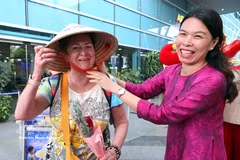
A representative of Anex Tour Vietnam presents a conical hat to the first passengers arriving in Da Nang from Vladivostok. (Photo: VNA)

Da Nang welcomes first flight from Vladivostok

According to the plan, the programme will run from April 16 to October 23, connecting eight cities across Russia, the CIS, and Belarus with Da Nang. The total number of visitors is expected to reach approximately 25,500, with a maximum frequency of 36 flights per month, equivalent to around 4,800 passengers monthly.

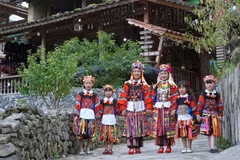
Visitors explore and experience the cultural space of Lo Lo Chai village in Lung Cu commune, Tuyen Quang province. (Photo: qdnd.vn)

Administrative expansion unlocks new momentum for tourism development

Nguyen Thi Hoai, Deputy Director of the Department of Culture, Sports and Tourism of Tuyen Quang, said the expansion of administrative boundaries has opened up new development space for the province, with key tourism products including cultural-historical tourism, ethnic cultural experiences, community-based tourism linked to scenic sites, spiritual tourism, and other distinctive experiential offerings.

At Thung Nham ecological tourism site in Ninh Binh province. (Photo: VNA)

Vietnam’s tourism defies fuel price shock with record Q1 “hat-trick”

According to data released by the National Statistics Office, foreign arrivals in March reached nearly 2.1 million, up 1.3% year-on-year. In total, Vietnam welcomed an estimated 6.76 million foreign tourists in the first quarter, a more than 12% jump from the same period in 2025 and the highest Q1 figure ever recorded.

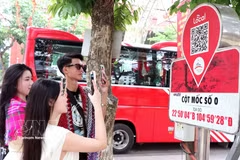
Visitors scan QR codes at Km0 Ha Giang to access tourism information. (Photo: VNA)

Technology powers tourism growth in mountainous province

Last year, Tuyen Quang welcomed over 3.9 million visitors, and is aiming to attract around 4.1 million arrivals, including around 600,000 foreigners, this year. Tourism continues to be identified as a key economic sector, with development oriented toward sustainability, green growth, and enhanced competitiveness through digitalisation.

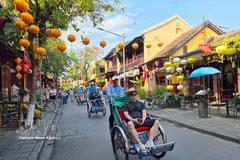
Tourists enjoy a rickshaw tour of Hoi An Ancient Town, Da Nang city. (Photo: VNA)

ITE HCMC 2026 to promote Vietnam’s tourism on global map

With its large scale, the ITE HCMC 2026 aims to promote tourism cooperation between Vietnam and priority markets such as Northeast Asia, Western Europe, North America, Southeast Asia, and Oceania while also boosting visitor arrivals from the Indian market

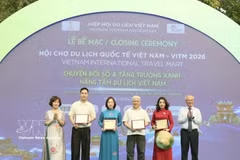
The organisers of VITM 2026 honour sponsors. ( Photo: VNA)

VITM 2026 boosts tourism demand ahead of peak season

According to the organisers, around 4,500 representatives from Vietnamese and international tourism enterprises attended the event, generating more than 25,000 business meetings and partnership exchanges. Approximately 15,000 discounted tours and travel products were offered to visitors.

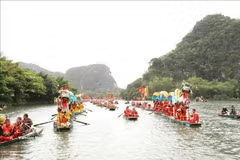
Traditional dragon procession held on the river in Ninh Binh. (Photo: VNA)

Cultural heritage drives sustainable tourism growth in Ninh Binh

In the first two months of 2026, Ninh Binh welcomed over 5.4 million visitors, up 9.9% year-on-year, generating nearly 5.84 trillion VND (221 million USD) in tourism revenue, up 15.9%. During the 2026 Lunar New Year holiday alone, the province received 2.38 million visitors, an 81.4% increase from the previous year, ranking second nationwide.

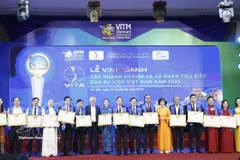
Outstanding individuals and firms honoured at VITM 2026 (Photo: VNA)

Outstanding individuals, firms honoured at Vietnam International Travel Mart 2026

In 2025, Vietnam’s tourism sector recorded its highest-ever number of visitors, welcoming more than 21.5 million international arrivals, up more than 20% from 2024, and serving over 135.5 million domestic travellers. Tourism revenue also surpassed 1 quadrillion VND (nearly 38 billion USD). The sector has become a bright spot of the economy, with Vietnam ranking among the world’s fastest-growing tourism destinations.

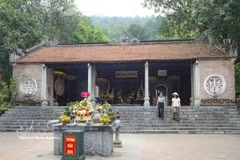
The Ba Trieu Temple in Thanh Hoa province (Photo: VNA)

Thanh Hoa taps digital transformation to boost heritage tourism

With 28 nationally-recognised intangible cultural heritage elements, Thanh Hoa province has prioritised integrating conservation with tourism development. Digital transformation, in particular, is seen as a crucial bridge connecting tradition with innovation, helping heritage sites become more accessible and engaging.