Ho Chi Minh City targets modern, inclusive healthcare system

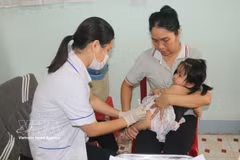
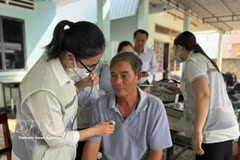
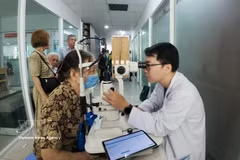
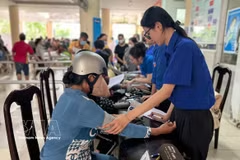
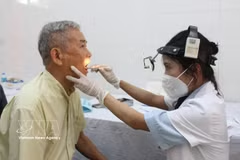
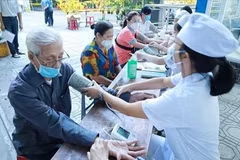
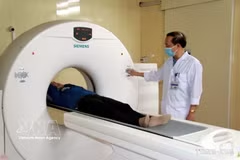
On April 5 alone, 58 hospitals and health centres conducted screening programmes across 64 wards and communes, with a focus on outlying areas. Beyond early detection, residents receive consultations, long-term health monitoring guidance, and access to specialised services locally.

Health workers and residents perform mass wellness exercises, promoting healthy lifestyles in the community. (Photo: VNA)

Ho Chi Minh City (VNA) - The Ho Chi Minh City People’s Committee on April 5 held a meeting themed “Proactive disease prevention – For a healthier Vietnam,” kicking off a series of activities to ensure all residents have equitable, timely and sustainable access to quality healthcare services, with no one left behind.

The event, held in response to All People's Health Day (April 7) and World Health Day 2026, underscores the city’s shift toward a more proactive and community-based healthcare model amid mounting public health challenges.

As a dynamic mega-city of nearly 15 million people, Ho Chi Minh City faces rapid urbanisation and significant demographic changes. It is also grappling with a dual burden of disease—continuing to control infectious diseases while confronting a sharp rise in non-communicable illnesses such as cardiovascular diseases, diabetes, cancer, mental health conditions, and age-related health issues. In this context, building a preventive, continuous and data-driven healthcare system that is accessible at the grassroots level has become both an urgent requirement and a long-term development direction.

According to Nguyen Van Vinh Chau, Deputy Director of the municipal Department of Health, the city has officially rolled out “community-based continuous healthcare teams” as part of this year’s campaign. The initiative marks a breakthrough approach to bringing healthcare closer to residents, with teams proactively going door to door to provide care and manage health across the life cycle based on family medicine principles.

vnanet-4.jpg
Vice Chairman of the municipal People’s Committee Nguyen Manh Cuong speaks at the event (Photo: VNA)

The rollout is expected to improve the quality of primary healthcare, strengthen grassroots health services as the “gatekeeper” of the system, reduce pressure on higher-level hospitals, and enhance the efficiency of healthcare resource use.

In parallel, the department is mobilising its entire healthcare network to provide free specialised health screenings for residents.

On April 5 alone, 58 hospitals and health centres conducted screening programmes across 64 wards and communes, with a focus on outlying areas. Beyond early detection, residents receive consultations, long-term health monitoring guidance, and access to specialised services locally. Medical data from these activities are also being integrated into the city’s electronic health records system, contributing to the gradual development of a comprehensive population health database.

The department is also working on a proposal to provide health check-ups for all residents as early as 2026. While the scale poses a major challenge, it also presents an opportunity for the health sector to build a modern population health management model.

Addressing the meeting, Vice Chairman of the municipal People’s Committee Nguyen Manh Cuong called on the health sector to further strengthen its core role, accelerate innovation in grassroots healthcare, and effectively implement community-based continuous care models.

He also stressed the importance of applying digital technology, data systems and electronic health records in health management and service delivery.

Other departments, agencies, local authorities, schools and organisations were urged to work closely with the health sector to promote healthier living environments; expand public sports movements; improve environmental hygiene; and encourage green, scientific and healthy lifestyles across communities, workplaces and households./.


VNA

See more

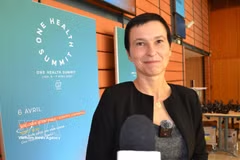
A workshop at the One Health Summit, held in Lyon, France, from April 5 to 7, 2026. (Photo: VNA)

Vietnam backs global One Health commitments at Lyon summit

The MAE welcomed the French Government’s organisation of the One Health Summit, describing it as an important forum to advance global political commitments and strengthen international cooperation in preventing zoonotic diseases.

Ilustrative image (Photo: pngtree.com)

Vietnamese scientists unlock genetic insights into rare diseases

Prof. Dr. Nguyen Huy Hoang, Deputy Director of the Institute of Biology under the Vietnam Academy of Science and Technology, and his research team conducted a project titled “Genetic mutation analysis in Vietnamese patients with selected rare diseases using whole-exome sequencing technology.” The project, implemented from 2022 to 2024, aims to clarify the genetic causes of these diseases within the Vietnamese population.

Vice Chairwoman of the National Assembly Nguyen Thi Thanh, Minister of Health Dao Hong Lan, and delegates attend the programme. (Photo: nhandan.vn)

Healthy lifestyles, disease prevention highlighted on national health day

Vice Chairwoman of the National Assembly Nguyen Thi Thanh emphasised the need for consistent and effective implementation of the resolution across the political system, with priorities including refining healthcare policies and institutions, strengthening preventive and grassroots healthcare networks, expanding population health management, promoting early detection, and improving school-based physical education and nutrition.

Politburo member, Secretary of the Party Central Committee and Chairman of the Commission for Information, Education and Mass Mobilisation Trinh Van Quyet (front row, fifth from left), together with delegates, participate in a walk after the launch of All People’s Health Day in Hanoi on April 5. (Photo: VNA)

All People’s Health Day promotes early disease prevention

The launch marked the first year the activity has been implemented in a coordinated manner nationwide. Members of the public were able to visit free screening areas, receive nutritional advice, participate in mass exercise performances, enjoy artistic programmes, and join a walk in response following the ceremony.

Volunteer young doctors are expected to provide free health screenings for around 10,000 residents (Photo: VNA)

Free cancer screening, health checks to benefit 10,000 people in Hanoi

Participants will receive comprehensive health checks through a streamlined one-stop process, including blood pressure measurement, height and weight assessment, BMI and cardiovascular risk evaluation, blood tests, general examinations and specialist consultations in internal medicine, paediatrics, obstetrics, ophthalmology, ENT, dentistry and oncology. Rapid blood glucose testing and biochemical screening will also be conducted to detect diabetes and metabolic disorders.

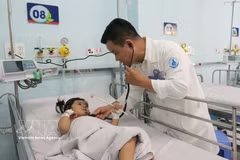
Dr Du Tuan Quy from the Children’s Hospital 1 in Ho Chi Minh City examines a patient with hand, foot and mouth disease. (Photo: VNA)

Over 25,000 hand, foot and mouth disease cases posted in 3 months

In the first three months, more than 25,000 cases of hand, foot and mouth disease have been recorded nationwide. Of the total cases, around 18,000, or nearly 72%, were concentrated in southern provinces. The disease has primarily affected children aged between one and five.

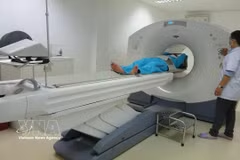
Early cancer screening at Da Nang Hospital. (Photo: VNA)

AI boosts early detection of non-communicable diseases

Deputy Minister of Health Nguyen Thi Lien Huong said NCDs pose a growing global challenge, accounting for over 70% of deaths worldwide, mainly from cardiovascular diseases, cancer, diabetes and chronic respiratory diseases. In Vietnam, the burden is rising rapidly, requiring urgent and sustained preventive strategies.

Most infections were reported among children under 10 years old, making up 99.3%, with those aged 1–5 accounting for the highest proportion (92.7%). (Illustrative photo: VNA)

Hand, foot and mouth cases increase five-fold in Q1

Most infections were reported among children under 10 years old, making up 99.3%, with those aged 1–5 accounting for the highest proportion (92.7%) due to close contact in kindergartens and limited hygiene practices.

From 2026, all residents in Ho Chi Minh City will receive periodic health check-ups or screening at least once a year under a roadmap. Illustrative image. (Photo: VNA)

Ho Chi Minh City to offer annual health check-ups for residents

In the initial phase in 2026, priority will be given to children under 24 months old, students, out-of-school minors, contracted employees, probationary workers, apprentices, public officials, members of the armed forces, social protection beneficiaries and people aged 60 and above.