Maternal, child healthcare remains cornerstone of Vietnam’s sustainable development

Child healthcare is both a humanitarian priority and a long-term investment in population quality and human resources. Early interventions in maternal care, nutrition, immunisation, and neonatal services play a decisive role in shaping physical and intellectual development.

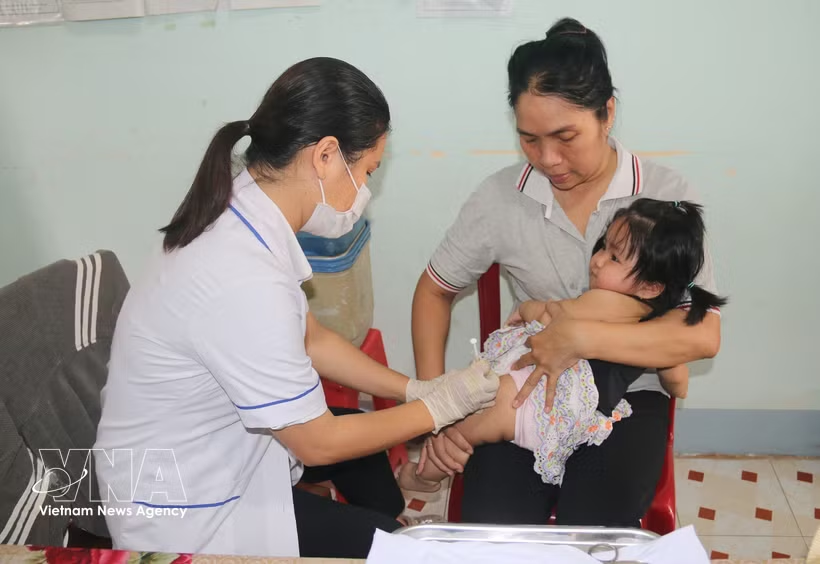
A medical worker administer the IPV polio vaccine to children in An Thạnh Thủy commune, Dong Thap province. (Photo: VNA)

Hanoi (VNA) – In response to All People’s Health Day (April 7) themed “Proactive disease prevention - For a healthy Vietnam,” the health sector and the society are stepping up efforts to improve public health, with maternal and child healthcare identified as a key pillar of sustainable development.

Child healthcare is both a humanitarian priority and a long-term investment in population quality and human resources. Early interventions in maternal care, nutrition, immunisation, and neonatal services play a decisive role in shaping physical and intellectual development.

Vietnam was the first in Asia and the second in the world to ratify the UN Convention on the Rights of the Child (CRC) in 1990, affirming its commitment to ensuring comprehensive child development. The legal framework has since been strengthened, notably with the 2016 Law on Children recognising children as rights holders.

Indicators on child care and protection in Vietnam have shown marked improvements over time. The under-five mortality rate dropped more than threefold, from 58 per 1,000 live births in 1990 to 16.9 in 2024 while infant mortality declined nearly fourfold, from 44.4 to 11.3. Particularly, neonatal mortality also decreased nearly fivefold, from 44 to 9 per 1,000 live births in the reviewed period..

Immunisation coverage remains above 90% among children under one year old, and underweight malnutrition among children under five decreased to 10.4% in 2024. School attendance rates remain high, supported by an expanded child protection system.

Sophie Kiladze, Chair of the UN Committee on the Rights of the Child, noted that Vietnam’s progress is reflected in both legal reforms and practical outcomes, including reduced mortality and poverty, expanded access to education, and improved child protection systems.

June Kunugi, UNICEF Regional Director for East Asia and the Pacific, highlighted opportunities for Vietnam to further invest in human resources and build a generation of healthy, educated, and empowered children.

Bridging gaps in maternal healthcare in disadvantaged areas

Despite these gains, narrowing disparities in maternal healthcare, particularly in mountainous and ethnic minority areas, remains a priority.

A project titled “Leaving no one behind: Innovative interventions to reduce maternal mortality in ethnic minority regions in Vietnam,” implemented from 2021 to 2026 by the Ministry of Health and the United Nations Population Fund (UNFPA), has delivered encouraging results across 60 disadvantaged communes in six provinces.

The proportion of ethnic minority women receiving at least four antenatal check-ups rose from 11.3% in 2021 to 36% in 2025, while facility-based births increased from 29.9% to 57.1%. Notably, no maternal deaths were recorded in project areas during its implementation, thanks to improved capacity in detecting and handling obstetric complications. Postnatal care coverage within seven days also rose significantly to 73.2%, supporting early detection of complications and better breastfeeding practices.

Deputy Minister of Health Nguyen Tri Thuc said Vietnam is among the leading countries in implementing sustainable development goals, elaborating that Vietnam was among six countries that achieved the Millennium Development Goal-5 (MDG5) on reducing maternal mortality in 2015. However, disparities persist, with maternal mortality in remote and ethnic minority areas still two to three times higher than the national average.

To address this, the health sector is implementing comprehensive measures, including prioritising maternal healthcare and family planning in disadvantaged areas under the National Target Programme for 2026–2035, he state.

As Vietnam enters a new development phase, continued investment in maternal and child healthcare, especially at the grassroots level, alongside broader social engagement, will be crucial to ensuring a healthier and more sustainable future for the country./.

VNA

See more

The caregivers’ club in Coc village, Pu Luong commune, the north-central province of Thanh Hoa, has established a livelihood support fund, helping households develop their economies through models such as rice cultivation, vegetable growing, fish farming and poultry raising. (Photo: VNA)

Community-based child nutrition care model benefits Thanh Hoa’s locality

After more than one year of implementation with the support of World Vision, the model has delivered positive outcomes in improving nutrition and enhancing the quality of childcare. Household livelihoods have improved, mothers’ awareness and caregiving skills have been strengthened, and notably, the rate of child malnutrition in Coc has declined markedly.

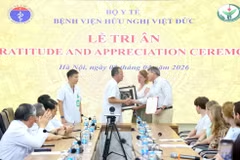
Assoc. Prof. Dr. Duong Duc Hung, Director of Viet Duc University Hospital, presents a token of appreciation in recognition of the noble gesture of the organ donor’s family. (Photo: baochinhphu.vn)

British teen’s organ donation saves three Vietnamese lives

A 19-year-old British tourist who died during a trip to Vietnam has saved the lives of three Vietnamese patients with end-stage organ failure, in a deeply moving act of compassion. The young woman is the first foreign national to donate organs in Vietnam.

A workshop at the One Health Summit, held in Lyon, France, from April 5 to 7, 2026. (Photo: VNA)

Vietnam backs global One Health commitments at Lyon summit

The MAE welcomed the French Government’s organisation of the One Health Summit, describing it as an important forum to advance global political commitments and strengthen international cooperation in preventing zoonotic diseases.

Ilustrative image (Photo: pngtree.com)

Vietnamese scientists unlock genetic insights into rare diseases

Prof. Dr. Nguyen Huy Hoang, Deputy Director of the Institute of Biology under the Vietnam Academy of Science and Technology, and his research team conducted a project titled “Genetic mutation analysis in Vietnamese patients with selected rare diseases using whole-exome sequencing technology.” The project, implemented from 2022 to 2024, aims to clarify the genetic causes of these diseases within the Vietnamese population.

Vice Chairwoman of the National Assembly Nguyen Thi Thanh, Minister of Health Dao Hong Lan, and delegates attend the programme. (Photo: nhandan.vn)

Healthy lifestyles, disease prevention highlighted on national health day

Vice Chairwoman of the National Assembly Nguyen Thi Thanh emphasised the need for consistent and effective implementation of the resolution across the political system, with priorities including refining healthcare policies and institutions, strengthening preventive and grassroots healthcare networks, expanding population health management, promoting early detection, and improving school-based physical education and nutrition.

Politburo member, Secretary of the Party Central Committee and Chairman of the Commission for Information, Education and Mass Mobilisation Trinh Van Quyet (front row, fifth from left), together with delegates, participate in a walk after the launch of All People’s Health Day in Hanoi on April 5. (Photo: VNA)

All People’s Health Day promotes early disease prevention

The launch marked the first year the activity has been implemented in a coordinated manner nationwide. Members of the public were able to visit free screening areas, receive nutritional advice, participate in mass exercise performances, enjoy artistic programmes, and join a walk in response following the ceremony.

Volunteer young doctors are expected to provide free health screenings for around 10,000 residents (Photo: VNA)

Free cancer screening, health checks to benefit 10,000 people in Hanoi

Participants will receive comprehensive health checks through a streamlined one-stop process, including blood pressure measurement, height and weight assessment, BMI and cardiovascular risk evaluation, blood tests, general examinations and specialist consultations in internal medicine, paediatrics, obstetrics, ophthalmology, ENT, dentistry and oncology. Rapid blood glucose testing and biochemical screening will also be conducted to detect diabetes and metabolic disorders.

Dr Du Tuan Quy from the Children’s Hospital 1 in Ho Chi Minh City examines a patient with hand, foot and mouth disease. (Photo: VNA)

Over 25,000 hand, foot and mouth disease cases posted in 3 months

In the first three months, more than 25,000 cases of hand, foot and mouth disease have been recorded nationwide. Of the total cases, around 18,000, or nearly 72%, were concentrated in southern provinces. The disease has primarily affected children aged between one and five.

Early cancer screening at Da Nang Hospital. (Photo: VNA)

AI boosts early detection of non-communicable diseases

Deputy Minister of Health Nguyen Thi Lien Huong said NCDs pose a growing global challenge, accounting for over 70% of deaths worldwide, mainly from cardiovascular diseases, cancer, diabetes and chronic respiratory diseases. In Vietnam, the burden is rising rapidly, requiring urgent and sustained preventive strategies.