Ho Chi Minh City ready to provide mass health checkups for over 15 million residents

The initiative is designed to bring multi-specialty healthcare closer to communities, with an emphasis on vulnerable and high-risk groups, including the elderly, those with chronic conditions, and disadvantaged populations, enabling early detection and sustained health management.

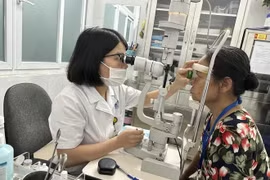
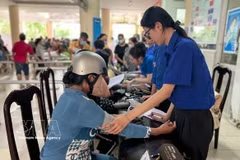
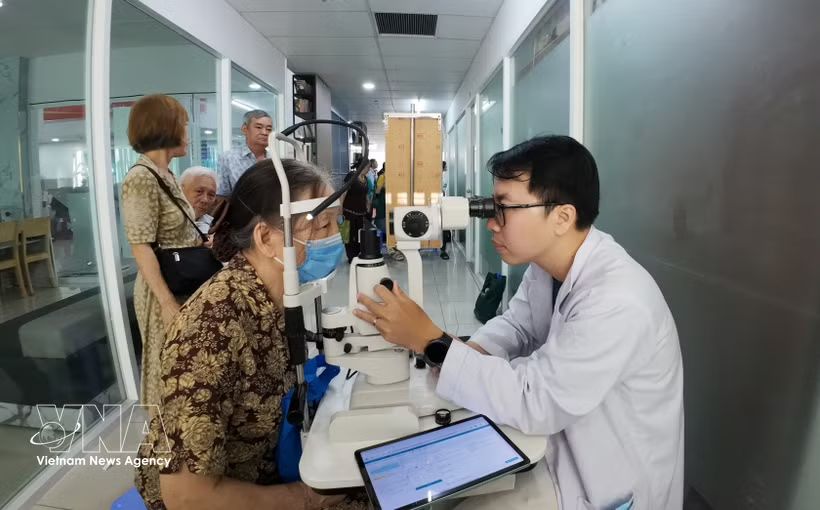
Doctors from Sai Gon Eye Hospital examine residents in Xuan Hoa ward, Ho Chi Minh City. (Photo: VNA)

Ho Chi Minh City (VNA) – Ho Chi Minh City is set to launch a sweeping health checkup programme covering more than 15 million residents in 2026, part of a long-term plan through 2030 that highlights its transition from treatment to proactive health care.

According to Assoc. Prof. Dr Tang Chi Thuong, Director of the municipal Department of Health, a citywide health checkup drive will kick off on April 17 at 168 commune-level health stations, building on recent activities held for All People’s Health Day.

The campaign will draw on medical staff from 101 public and private hospitals, including central-level, ministerial, municipal, and private facilities. Central hospitals will lead screenings for major conditions such as cardiovascular, endocrine, cancer, musculoskeletal, dental, and occupational diseases. Specialised hospitals will handle discipline-specific checks, while general hospitals will focus on detecting and managing chronic non-communicable and common internal illnesses.

Private providers and regional health centres will also join the effort, broadening access to services. Cervical cancer screening for female workers, particularly those in informal sectors, will be prioritised in 16 localities.

The initiative is designed to bring multi-specialty healthcare closer to communities, with an emphasis on vulnerable and high-risk groups, including the elderly, those with chronic conditions, and disadvantaged populations, enabling early detection and sustained health management.

Screening outcomes will be integrated into electronic health records to ensure accurate and up-to-date data for long-term monitoring. Local health stations will classify residents by risk levels, manage follow-ups, and arrange referrals as needed, adhering to the principle of early detection, timely intervention, and continuous care.

Deputy Director of the Department of Health Assoc. Prof. Dr Nguyen Anh Dung said the programme will prioritise cost-effective interventions targeting high-burden diseases that can be scaled at the grassroots level.

In the near term, particularly in 2026, the city will finalise technical guidelines, funding mechanisms, basic screening packages, and electronic health records. By 2027, a flexible, non-boundary-based network of healthcare providers will be established, covering densely populated areas, industrial zones, schools, and social welfare facilities.

From 2028, the programme will expand evidence-based screenings for hypertension, diabetes, cardiovascular risks, cervical, breast and colorectal cancers, viral hepatitis, and tuberculosis. By 2030, the city aims to deploy an automated digital system capable of proactively inviting residents for screenings.

The health sector also plans to develop a unified population health database under the “one citizen – one ID – one health record – one service history” model. This integrated public–private system will enable residents to access services across multiple facilities while ensuring consistent data and benefits management, improving transparency and optimising healthcare resources./.

VNA

See more

The caregivers’ club in Coc village, Pu Luong commune, the north-central province of Thanh Hoa, has established a livelihood support fund, helping households develop their economies through models such as rice cultivation, vegetable growing, fish farming and poultry raising. (Photo: VNA)

Community-based child nutrition care model benefits Thanh Hoa’s locality

After more than one year of implementation with the support of World Vision, the model has delivered positive outcomes in improving nutrition and enhancing the quality of childcare. Household livelihoods have improved, mothers’ awareness and caregiving skills have been strengthened, and notably, the rate of child malnutrition in Coc has declined markedly.

Assoc. Prof. Dr. Duong Duc Hung, Director of Viet Duc University Hospital, presents a token of appreciation in recognition of the noble gesture of the organ donor’s family. (Photo: baochinhphu.vn)

British teen’s organ donation saves three Vietnamese lives

A 19-year-old British tourist who died during a trip to Vietnam has saved the lives of three Vietnamese patients with end-stage organ failure, in a deeply moving act of compassion. The young woman is the first foreign national to donate organs in Vietnam.

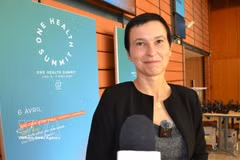
A workshop at the One Health Summit, held in Lyon, France, from April 5 to 7, 2026. (Photo: VNA)

Vietnam backs global One Health commitments at Lyon summit

The MAE welcomed the French Government’s organisation of the One Health Summit, describing it as an important forum to advance global political commitments and strengthen international cooperation in preventing zoonotic diseases.

Ilustrative image (Photo: pngtree.com)

Vietnamese scientists unlock genetic insights into rare diseases

Prof. Dr. Nguyen Huy Hoang, Deputy Director of the Institute of Biology under the Vietnam Academy of Science and Technology, and his research team conducted a project titled “Genetic mutation analysis in Vietnamese patients with selected rare diseases using whole-exome sequencing technology.” The project, implemented from 2022 to 2024, aims to clarify the genetic causes of these diseases within the Vietnamese population.

Health workers and residents perform mass wellness exercises, promoting healthy lifestyles in the community. (Photo: VNA)

Ho Chi Minh City targets modern, inclusive healthcare system

On April 5 alone, 58 hospitals and health centres conducted screening programmes across 64 wards and communes, with a focus on outlying areas. Beyond early detection, residents receive consultations, long-term health monitoring guidance, and access to specialised services locally.

Vice Chairwoman of the National Assembly Nguyen Thi Thanh, Minister of Health Dao Hong Lan, and delegates attend the programme. (Photo: nhandan.vn)

Healthy lifestyles, disease prevention highlighted on national health day

Vice Chairwoman of the National Assembly Nguyen Thi Thanh emphasised the need for consistent and effective implementation of the resolution across the political system, with priorities including refining healthcare policies and institutions, strengthening preventive and grassroots healthcare networks, expanding population health management, promoting early detection, and improving school-based physical education and nutrition.

Politburo member, Secretary of the Party Central Committee and Chairman of the Commission for Information, Education and Mass Mobilisation Trinh Van Quyet (front row, fifth from left), together with delegates, participate in a walk after the launch of All People’s Health Day in Hanoi on April 5. (Photo: VNA)

All People’s Health Day promotes early disease prevention

The launch marked the first year the activity has been implemented in a coordinated manner nationwide. Members of the public were able to visit free screening areas, receive nutritional advice, participate in mass exercise performances, enjoy artistic programmes, and join a walk in response following the ceremony.

Volunteer young doctors are expected to provide free health screenings for around 10,000 residents (Photo: VNA)

Free cancer screening, health checks to benefit 10,000 people in Hanoi

Participants will receive comprehensive health checks through a streamlined one-stop process, including blood pressure measurement, height and weight assessment, BMI and cardiovascular risk evaluation, blood tests, general examinations and specialist consultations in internal medicine, paediatrics, obstetrics, ophthalmology, ENT, dentistry and oncology. Rapid blood glucose testing and biochemical screening will also be conducted to detect diabetes and metabolic disorders.

Dr Du Tuan Quy from the Children’s Hospital 1 in Ho Chi Minh City examines a patient with hand, foot and mouth disease. (Photo: VNA)

Over 25,000 hand, foot and mouth disease cases posted in 3 months

In the first three months, more than 25,000 cases of hand, foot and mouth disease have been recorded nationwide. Of the total cases, around 18,000, or nearly 72%, were concentrated in southern provinces. The disease has primarily affected children aged between one and five.

Early cancer screening at Da Nang Hospital. (Photo: VNA)

AI boosts early detection of non-communicable diseases

Deputy Minister of Health Nguyen Thi Lien Huong said NCDs pose a growing global challenge, accounting for over 70% of deaths worldwide, mainly from cardiovascular diseases, cancer, diabetes and chronic respiratory diseases. In Vietnam, the burden is rising rapidly, requiring urgent and sustained preventive strategies.