Hanoi (VNA) – Politburo Resolution No. 79-NQ/TW, dated January 6, 2026, on developing the state economic sector not only reaffirms its leading role but also calls for strong reforms in governance, efficiency and competitiveness of state-owned enterprises (SOEs). Experts say its core is a shift from administrative control to modern corporate governance, creating new momentum for growth in the next development phase.
From administrative control to modern governance
Dr Pham Si An, deputy head of the Finance and Scientific Management Department at the Vietnam Academy of Social Sciences, said the target of having all state economic groups and corporations adopt governance standards aligned with the Organisation for Economic Co-operation and Development (OECD) by 2030 represents a foundational step to enhance efficiency and strengthen the economy’s competitiveness.
According to the expert, the key issue does not lie in technical provisions but a requirement for a shift in management mindset. For years, governance has relied heavily on input control, procedures and administrative processes, limiting proactiveness and adaptability. Meanwhile, rapidly changing domestic and global conditions require enterprises to be more flexible and accountable for results.
To address these bottlenecks, it is essential to clearly separate the State’s ownership role from its regulatory function. Overlapping roles risk administrative interference, impacting operational efficiency. A clearer division would allow enterprises to operate under market principles while maintaining macro-level monitoring.
At the same time, boards of directors need to be granted substantive authority, particularly in executive appointments and investment strategy. When authority is matched with accountability, governance bodies can play a genuine leadership role rather than merely executing administrative directives.
Transparency is another crucial element. Applying international financial reporting standards, alongside disclosure of non-financial information, would improve governance quality and strengthen trust among investors and partners. Wage mechanisms also need greater flexibility. Rigid administrative pay frameworks make it difficult for SOEs to attract high-quality talent. Allowing market-based recruitment and performance-linked evaluation would help boost productivity and management quality.
In governance methods, shifting from “input control” to “management by objectives” is seen as a fundamental change. With clearly defined targets set by the State, enterprises should be given autonomy in implementation and held accountable for outcomes, thereby fostering innovation and creativity.
Enterprises take proactive steps
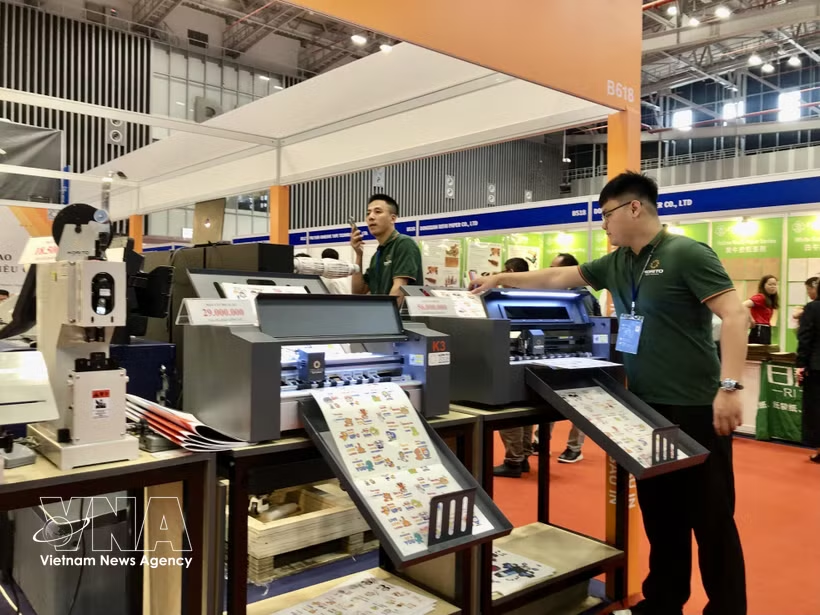
From a business perspective, Doan Dac Truong, Deputy Director of Tien Bo Printing Company Limited, said Resolution 79 provides clear direction for adaptation in a more competitive environment, particularly as traditional printing demand declines.
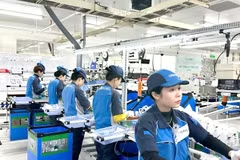
As a wholly Party-owned enterprise, the company has streamlined its structure, reduced indirect labour, strengthened decentralisation and cut unnecessary procedures to improve efficiency. It has also accelerated the application of technology in management and production, while gradually modernising its equipment.
These efforts delivered positive results in 2025, with revenue rising 16% to 147 billion VND and profit up 8% to 27 billion VND (1.02 million USD). Budget contributions exceeded 50 billion VND, and average monthly income reached about 13 million VND per worker.
From its experience, the company highlighted the importance of linking technological modernisation with transparency and adoption of market-based governance thinking. It also stressed the need to clearly separate management from production to allow greater operational autonomy.
Truong noted that allowing enterprises to retain part of their profits for reinvestment, as stipulated in Resolution 79, is a critical factor in enabling technological upgrades. Provisions on medium- and long-term investment strategies also help reduce dependence on project-by-project approvals, shortening implementation time and improving investment efficiency.
Going forward, the company will focus on modernising production, upgrading governance, expanding IT use and improving workforce quality. Effective implementation of Resolution 79 is expected to help SOEs enhance performance, improve employee incomes and contribute more sustainably to economic growth./.
VNA