Policy push enhances private sector’s role in economic growth

An official has highlighted improved conditions enabling private enterprises to take on a greater role in major national projects as a central outcome of Resolution No. 68.

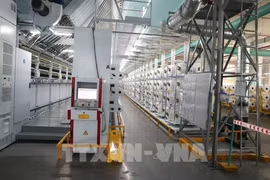
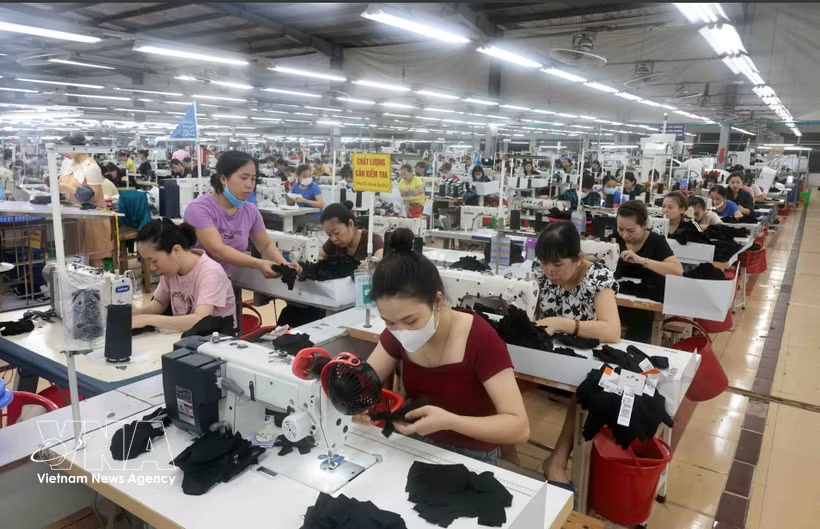
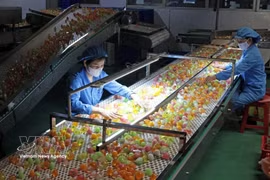
TNG Garment Company in Thai Nguyen generates annual revenue of trillions of VND and provides jobs for more than 20,000 workers. (Photo: VNA)

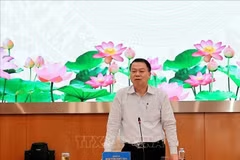
Hanoi (VNA) – Despite considerable challenges in implementing the Politburo’s Resolution No. 68 on private sector development, key measures have largely been institutionalised and are beginning to deliver results, driven by strong commitment from ministries and agencies and the active participation from the business community, said Trinh Thi Huong, Deputy Director of the Department of Private Enterprise and Collective Economy Development under the Ministry of Finance (MoF).

Speaking at MoF’s regular press briefing for the first quarter of 2026, Huong highlighted improved conditions enabling private enterprises to take on a greater role in major national projects as a central outcome of the policy.

Over the past year, three waves of simultaneous groundbreakings and inaugurations saw 564 projects launched nationwide, with total investment exceeding 5.15 quadrillion VND (195.6 billion USD), around 75% of which comes from the private sector. The Government is continuing to refine mechanisms to better support private firms in asserting their role as a key engine of economic growth.

Nearly a year into implementation, the resolution has been quickly translating the Politburo's viewpoints and orientations into actionable policies. In particular, the Government has reviewed and proposed revisions to a range of major laws, including those on taxation, pricing, investment, enterprises and bankruptcy, aiming to remove bottlenecks, streamline administrative procedures and foster a more conducive business environment while unlocking private sector resources.

The National Assembly adopted Resolution No. 198/2025/QH on special mechanisms for private sector development. Besides, the Government recently issued Decree No. 20/2026/ND-CP to guide implementation and fast-track policy rollout.

Several measures have already taken effect, delivering initial gains. These include scrapping business licence fees to lower market entry costs, granting three-year corporate income tax exemptions for newly established small and medium-sized enterprises (SMEs), and introducing strong incentives to promote investment in science, technology and innovation.

A notable provision allows businesses to deduct up to 200% of their actual spending on research and development (R&D) when calculating taxable income, thus encouraging greater investment in innovation and competitiveness enhancement.

Localities are also accelerating support in land access and production space. Industrial parks, clusters and incubators are prioritising land allocation for innovative start-ups, high-tech firms and SMEs, which may also benefit from at least a 30% reduction in land rental fees, depending on local conditions and budget capacity.

In parallel, several large-scale programmes have been approved by the Prime Minister, including initiatives to train 10,000 CEOs, develop 1,000 leading enterprises and support businesses in expanding into global markets. The MoF has been assigned to lead two of these programmes and is expediting the issuance of implementation guidelines.

Meanwhile, other ministries and agencies are stepping up coordination to deliver additional support schemes, including digital transformation assistance for SMEs, helping strengthen governance capacity and adaptability in the fast-evolving digital economy.

The MoF will continue working with relevant sides to perfect programmes and policies, and review the one-year implementation of Resolution No. 68, Huong noted, adding that comprehensive assessment will help clarify effects on the business community to make adjustments necessary for ensuring more effective and reality-matching policies./.

VNA

See more

VinFast EV sales jump 127% in March 2026. (Photo: Vinfast)

VinFast EV sales jump 127%, cementing market dominance

According to its report, all models in VinFast’s EV lineup recorded strong growth in March. Notably, on March 28 alone, the company completed 3,520 orders, the highest number ever recorded in a single day by an automotive brand in Vietnam.

Illustrative image (Photo: VNA)

Australia announces import conditions for Vietnamese pomelos

Australia’s formal publication provides an important legal basis, marking the completion of the review, assessment and agreement on technical requirements for fresh Vietnamese pomelos. This represents a significant step forward in market access, creating favourable conditions for relevant agencies, localities and businesses to prepare for export activities in the coming time.

Containers of fresh Vietnamese durian for export are subject to a full-chain traceability system. (Photo: VNA)

First “green lane” durian shipment exported to China

​Under the “green lane” process, quality control begins at the cultivation stage, including soil sampling and monitoring, and continues through harvesting and processing, with traceability labels attached to trees and applied to fruit at the time of picking. It also allows plant quarantine procedures and the issuance of certificates of origin (C/O) directly in the localities where the orchards are located.

Delegates at the Vietnam Expo 2026 (Photo: VNA)

Vietnam pushes for deeper auto supply chain ties with RoK

The RoK stood as Vietnam’s largest foreign investor with more than 95.2 billion USD in registered capital as of February 2026, or about 18% of all foreign cash flowing in, with thousands of active projects. In January-February alone, the RoK led the pack with nearly 2 billion USD in pledges, grabbing a whopping 32.7% of total registered capital and showing no signs of slowing down.

More than 600 tourism firms, 15 countries and territories, and 34 provinces and cities are promoting destinations and introducing tourism products at the fair (Photo: VNA)

Digital transformation key to elevating Vietnam’s tourism: official

Speaking at the opening of the Vietnam International Travel Mart (VITM) 2026 in Hanoi on April 10, Deputy Minister of Culture, Sports and Tourism Ho An Phong noted that despite challenges in 2025, Vietnam largely fulfilled its socio-economic development goals. Tourism remained a bright spot, recording 21.5 million foreign arrivals and 135.5 million domestic visitors, with total revenue exceeding 1 quadrillion VND (37.9 billion USD).

A drone sprays fertiliser over rice fields. (Photo: VNA)

Low-altitude economy emerges as new growth driver for Vietnam

The UAV technology is particularly effective in addressing challenges faced by ground infrastructure, especially in densely populated urban areas and remote regions. Smart aerial devices also enable real-time data collection, improving governance, decision-making and digital transformation across industries.

Passengers at Cat Bi Airport in Hai Phong city (Photo: VNA)

Aviation sector ensures fuel supply for April 30–May 1 peak

Aviation fuel suppliers are actively negotiating and diversifying supply sources both domestically and internationally, while strengthening coordination, storage and distribution capacity to meet immediate demand. These efforts aim to support airlines in optimising operations and maintaining stable flight schedules.