Ho Chi Minh City (VNA) – Vietnam is well-positioned to benefit from ongoing global trade realignments, leveraging its solid footing in electronics and semiconductors to move further up the value chain, according to Suan Teck Kin, Executive Director for Global Economics and Markets Research at United Overseas Bank (UOB).
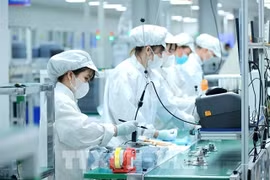
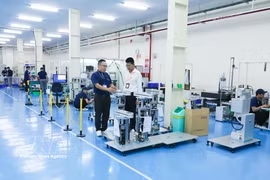
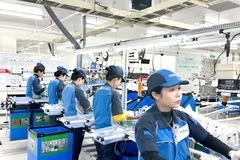
Speaking at the “The Year Ahead 2026” forum organised by Bloomberg Businessweek Vietnam in Ho Chi Minh City on April 10, he highlighted that Vietnam ranks eighth worldwide in electronics exports and hosts more than 170 foreign-invested semiconductor projects, primarily in chip design, assembly, testing and packaging.
These advantages are expected to propel the country into higher-value segments, including advanced OSAT (outsourced semiconductor assembly and testing), precision components, production inputs and equipment, as well as industrial AI and automation across manufacturing and logistics.
For 2026, UOB maintains a cautiously upbeat outlook on Vietnam. Although GDP growth may ease, the economy is still underpinned by robust manufacturing, construction and services, along with strong exports and continued foreign investment driven by supply chain diversification. He said rising inflationary pressure, largely due to elevated energy costs, has led the bank to revise down its growth forecast, while anticipating that the State Bank of Vietnam will keep monetary policy steady.
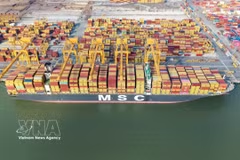
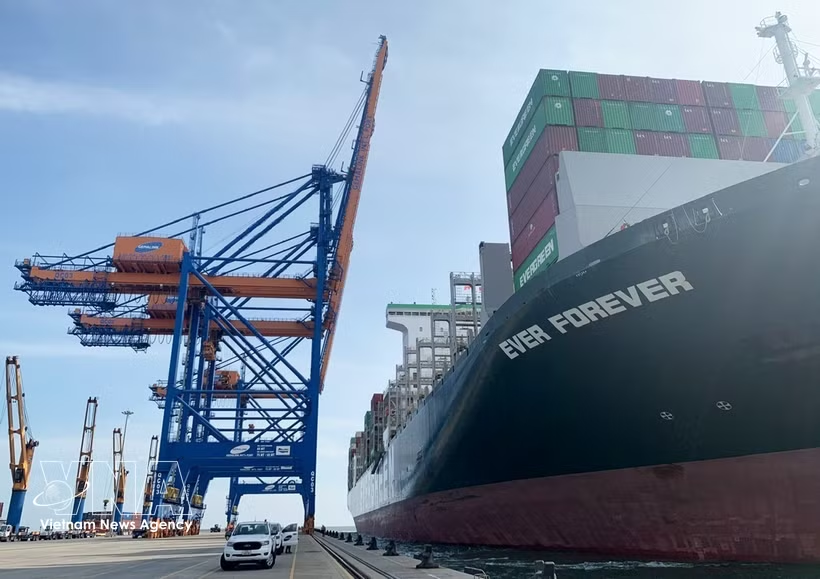
According to projections from the World Trade Organisation, global trade growth is expected to reach about 1.9%, in line with long-term trends but below 2025 levels. Ongoing geopolitical tensions in the Middle East and persistently high energy prices could trim up to 0.5 percentage points from global trade growth by raising transport costs, disrupting logistics and weighing on tourism and demand. Meanwhile, sustained AI-driven demand is likely to act as a key support.
Suan also pointed to a significant structural shift in US import patterns since 2018, reflecting deeper supply chain diversification. Data from the US Census Bureau shows Mexico has become the largest exporter to the US, accounting for 16.9% of total imports, followed by ASEAN at 15.7%, ahead of the EU and Canada. In contrast, China’s share has dropped to about 7.8%, down sharply from over 20% before 2018.
While these shifts open up opportunities for ASEAN economies, including Vietnam, they also demand higher competitiveness, productivity and value-added output.
At the same time, China’s trade structure is undergoing a notable recalibration. By 2025, ASEAN had emerged as China’s largest trading partner, accounting for around 16.6% of total trade, surpassing both the EU and the US as the US's role continues to diminish compared to pre-2018 levels.
With intra-Asian trade gaining prominence, Vietnam now makes up about 4.7% of China’s total trade, highlighting its deepening integration into regional supply chains. Suan noted that China is increasingly repositioning itself as a central hub within Asia’s manufacturing and trade ecosystem, rather than solely a final export base.
Against the backdrop of ongoing tariff pressures, he emphasised that export market diversification is now a strategic necessity. Vietnam, he said, should maximise the benefits of its 16 free trade agreements while expanding into fast-growing markets in the Middle East, Africa, Latin America and parts of Europe./.
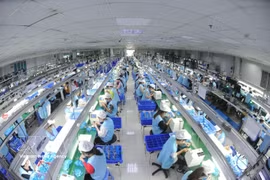
Vietnam reinforces role as key regional electronics manufacturing hub
Korean technology corporations are intensifying investment in Southeast Asia to diversify supply chains and leverage cost advantages, with Vietnam remaining a focal destination thanks to its strategic location and abundant labour force.