
Hanoi (VNS/VNA) - Vietnam has officially met all requirements to be reclassified from a frontier market to a secondary emerging market, with the upgrade set to take effect starting with the FTSE Russell semi-annual review in September, marking a significant milestone in the country's capital market development.
After the review results were announced, Vice Chairman of the State Securities Commission (SSC) Bui Hoang Hai said Vietnamese stocks would be added to FTSE indices in four phases, starting in September 2026 and concluding in September 2027.
The weighting of Vietnam in the index is estimated at around 0.04%, equivalent to approximately 1.6 billion USD in investable capital from passive funds, he said, noting that passive flows represent only part of the picture.
Data compiled by Bloomberg shows that most markets historically recorded strong growth in foreign capital inflows following an upgrade, regardless of whether the classification was based on FTSE or MSCI criteria. Statistics indicate that capital inflows typically increase five to seven times compared to the pre-upgrade average.
China provides a notable case. Its A-shares were officially included in the MSCI Emerging Markets Index in 2018, coinciding with one of the country's slowest growth periods in nearly a decade amid the US-China trade war.
Foreign investors withdrew more than 11 billion USD that year, before returning with net inflows exceeding 132 billion USD the following year.
For Vietnam, projections have also pointed to substantial inflow potential.
The World Bank estimated in 2024 that a successful upgrade could attract up to 25 billion USD in new capital.
Meanwhile, international experience suggests liquidity improvements can be significant. Saudi Arabia, for instance, saw trading value surge more than 20-fold around the time of its upgrade to emerging market status, with activity continuing to rise thereafter.
However, post-upgrade market performance remains contingent on broader conditions. According to analysts at BIDV Securities Company, the sustainability of growth will depend on macroeconomic factors, such as monetary and fiscal policy, earnings per share expansion and the pace of domestic reforms.
Vietnam's market liquidity is projected to improve markedly if the upgrade roadmap is completed, with average trading value expected to reach between 1.3 billion USD and 2.1 billion USD per session during the 2026-2030 period.
The reclassification is also expected to trigger a structural shift in capital allocation.
As markets move between index categories, capital rebalancing often creates buying pressure for remaining constituents in the old index and selling pressure for stocks newly added to the upgraded index.
For example, when a country exits a frontier index, its former weight leaves room for other constituents to grow, while stocks entering emerging market indices may initially face portfolio adjustment-related selling.
Historical data, however, does not guarantee a uniform upward trajectory.
Analysts at VPBank Securities noted that inclusion in the FTSE Emerging Markets Index does not necessarily ensure sustained growth, as market trends are more heavily influenced by macroeconomic dynamics.
"The upgrade should be viewed as a supportive factor and an important catalyst for capital inflows, while macro fundamentals will remain the decisive driver of market direction," the firm said.
Similarly, KB Securities Vietnam expects the reclassification to activate large-scale capital rotation from both passive index-tracking funds and active global investors into Vietnam.
Based on scenario analyses aligned with FTSE Russell, potential inflows could range from 3-9 billion USD, corresponding to an estimated weighting of 0.3% to 1.1% in the FTSE Emerging All Cap Index.
On the other hand, Vietnam could face outflows of up to around 1 billion USD from frontier-focused funds.
Nevertheless, this selling pressure is considered modest relative to the expected demand from emerging market allocations, contributing to asset revaluation and reinforcing investor confidence ahead of the formal upgrade timeline.
Short-term market dynamics, however, remain subject to cyclical patterns.
According to SSI Research, investor sentiment may soften in the latter half of April, reflecting seasonal trends.
Historically, April has been one of the more cautious months for equities, with the average proportion of advancing stocks at around 47.7%, the second lowest of the year after October.
This seasonal dip is often linked to the market having already priced in business plans following annual general meetings, alongside profit-taking during the first quarter earnings season.
Additional pressures may emerge from expectations of slower earnings growth in the second quarter, as elevated fuel prices and interest rates weigh on profitability, coupled with a high comparison base from the same period in 2025, when net profit after tax attributable to parent company shareholders rose by 33.5%.
Extended public holidays toward the end of the month may further dampen investor participation and narrow liquidity, potentially leading to short-term volatility./.
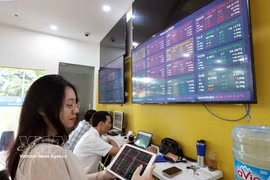
Positive FTSE Russell assessments spotlight Vietnam’s stock market reforms
With a strengthened foundation and continued reform commitment, Vietnam’s stock market has a solid basis to develop in a more stable, transparent, and internationally aligned direction.