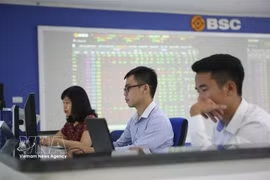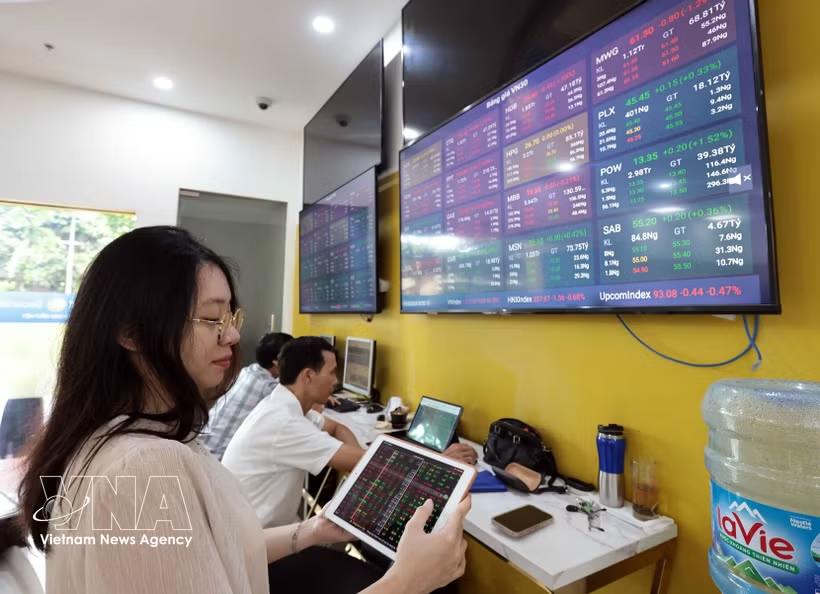
London (VNA) – The release by FTSE Russell, one of the world’s leading financial index providers, of its mid-year review results with positive assessments of the Vietnamese stock market, is not merely a technical update but also reflects substantial progress in the Vietnamese Government’s economic reforms and macroeconomic management, said insiders.
According to David Sol, Global Head of Policy at FTSE Russell, the March review confirmed that key improvements supporting the path toward upgrading Vietnam to emerging market status from frontier market in September are on track.
In its decision in October 2025, FTSE Russell affirmed that Vietnam had met the criteria to be classified as a secondary emerging market. While the upgrade was broadly welcomed by the financial community, several technical factors were still seen as constraints to large-scale international capital inflows.
The latest review therefore represents not only a continuation of the 2025 decision but also signals tangible improvements in market accessibility and real-world trading operations – key concerns for global investors. This is widely viewed as an important step in Vietnam’s stock market upgrade roadmap, helping strengthen confidence in its operational efficiency and its ability to attract more sustainable foreign capital flows.
Talking to Vietnam News Agency correspondents in London, Christine Le, President of the Vietnam Finance and Investment Association in the UK, described the development as a clear demonstration of the effectiveness and consistency of recent reforms, as well as a substantive improvement in market accessibility and investability. From this perspective, she said that Vietnam’s market is shifting from a paper-compliant status to one that meets operational standards in practice – a critical factor in attracting institutional capital.
Recent reforms, including the implementation of a non-pre-funding mechanism, the establishment of a failed trade handling framework, and especially the allowance of trading via global brokers, have addressed long-standing concerns of foreign investors. These measures help reduce transaction risks and reinforce investors’ confidence, particularly as they are implemented in a context of macroeconomic stability and consistent governance.
She noted that one of the most significant impacts of the review is the repositioning of Vietnam within the global capital allocation framework. Vietnam had previously been viewed mainly as a frontier market with strong growth potential but not yet within the mandatory allocation universe of most institutional funds.
With the progress recognised by FTSE Russell in the March 2026 review, Vietnam is gradually moving toward a position where it can be integrated into the strategic asset allocation structures of global investors. This shift is expected not only to increase capital inflows but also to improve their quality, making them more stable and long-term rather than speculative.
Despite the positive outlook, the upgrade process also places higher demands on the market, she stated, adding in the time to come, policy priorities should move from meeting upgrade criteria to maintaining and enhancing the quality of an emerging market, both in standards and in actual investment experience. This includes effective and consistent legal enforcement, improved market access for foreign investors, higher asset quality and corporate governance standards, modernised market infrastructure, and stronger risk management capacity.
She stressed that maintaining macroeconomic stability and policy consistency is a fundamental factor determining the long-term attractiveness and credibility of the market.
FTSE Russell not only develops key benchmark standards but also serves as a “compass” for global institutional investors. From index-tracking funds to banks and asset managers, its indices are widely used as strategic tools for guiding investment decisions and capital allocation. Alongside MSCI and S&P Dow Jones, FTSE Russell is part of the “big three” that shape global market standards, country classifications, and capital flows.
The latest positive assessments from FTSE Russell are therefore a milestone in Vietnam’s stock market upgrade roadmap and a test of the depth of its reform process. With a strengthened foundation and continued reform commitment, Vietnam’s stock market has a solid basis to develop in a more stable, transparent, and internationally aligned direction./.
VNA