Hanoi (VNA) – Vietnam’s real estate market in the first quarter of 2026 showed diverging trends, with the supply of commercial apartments continuing to fall sharply while the social housing segment gained momentum on the back of supportive policies.
Data from the Ministry of Construction (MoC) indicate a market entering a period of clear segmentation. On one side is a prolonged shortage of new supply, and on the other, growing expectations of rebalancing through affordable housing programmes.
Supply tightens, prices remain high
Since the beginning of the year, new project supply has narrowed significantly. Nationwide, only 51 projects covering commercial housing, land plots and resort real estate received investment approval, including 39 commercial housing projects – equivalent to 49.4% of the level recorded in the fourth quarter of 2025.
The decline reflects persistent legal and procedural bottlenecks despite recent policy efforts to remove obstacles. The resort property segment also slowed, with just eight projects approved, or 88.9% of the previous quarter.
Meanwhile, completed projects showed more positive signals. In the first quarter, 31 commercial housing projects were finished. Although this was lower than in the fourth quarter of 2025, it marked a year-on-year surge of 221.4%, suggesting developers are prioritising the completion of ongoing projects as legal hurdles are gradually addressed.
However, Deputy Director of the Department for Housing and Real Estate Market Management Hoang Thu Hang said the increase in completed projects is insufficient to offset the drop in new projects. The market therefore remains in a state of primary supply shortage, especially in major urban centres.
As a result, property prices have stayed high. The MoC reported that prices in many localities stayed stable but showed no sign of declining. In key markets such as Hanoi, Ho Chi Minh City and Khanh Hoa, prices rose by about 2% compared to the previous quarter while Da Nang and Dong Nai saw increases of over 1%.
Notably, price growth has persisted despite weakening liquidity. Total successful real estate transactions nationwide reached approximately 115,650, or 76.4% of the fourth quarter of 2025. Apartment and individual housing transactions totalled 25,663, equivalent to 67.8% of the previous quarter. Land plots continued to dominate with 89,987 transactions though this segment also declined overall.
Nguyen Van Dinh, Chairman of the Vietnam Association of Realtors (VARS), said the combination of high prices and falling transactions reflects a serious mismatch between supply and demand. The prolonged shortage of commercial apartments, particularly in the affordable segment, has limited the market’s ability to correct prices in the short term despite weakening demand.
Le Hoang Chau, Chairman of the Ho Chi Minh City Real Estate Association (HoREA), also pointed to legal constraints as the core bottleneck, noting that newly issued laws will take time to be fully implemented while developers continue to face pressure from costs and cash flow.
Social housing gains speed, market rebalancing expected
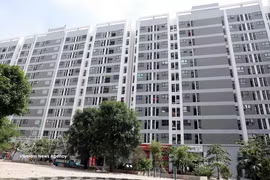
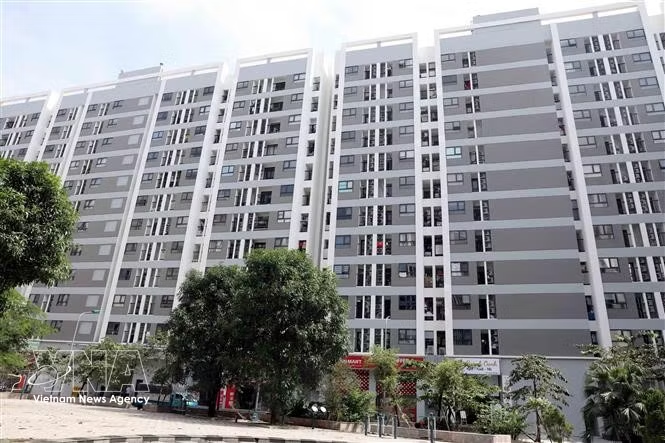
Against this backdrop, social housing has emerged as a bright spot. Since early 2026, the Government and relevant ministries have rolled out a series of policies to boost this segment, including decrees and resolutions aimed at resolving land, land-use fee and development mechanism issues.
Initial results are encouraging. To date, 737 social housing projects are under development nationwide, with a total scale of 701,247 units, fulfilling 70.1% of the target set under the scheme to build at least one million social housing units for low-income earners and industrial park workers during 2021–2030.
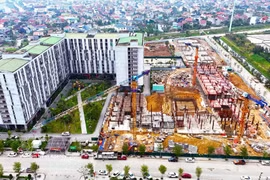
In first quarter of 2026 alone, work started on 33 projects with 28,856 units. Meanwhile, 18 projects became eligible for sale of off-plan housing, adding around 7,031 units to the market.
The Government has also set a target of 158,723 social housing units for 2026, creating both pressure and momentum for localities to accelerate implementation.
The contraction in commercial apartment supply and the rise of social housing signal a restructuring process underway. If policies are implemented consistently and effectively, social housing could evolve from a short-term remedy into a major driver for a more stable and sustainable property market in the years ahead./.