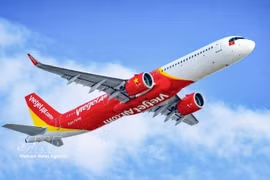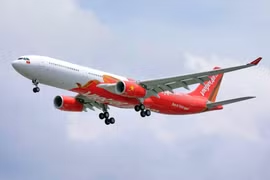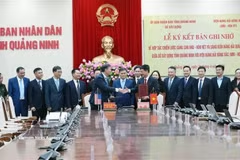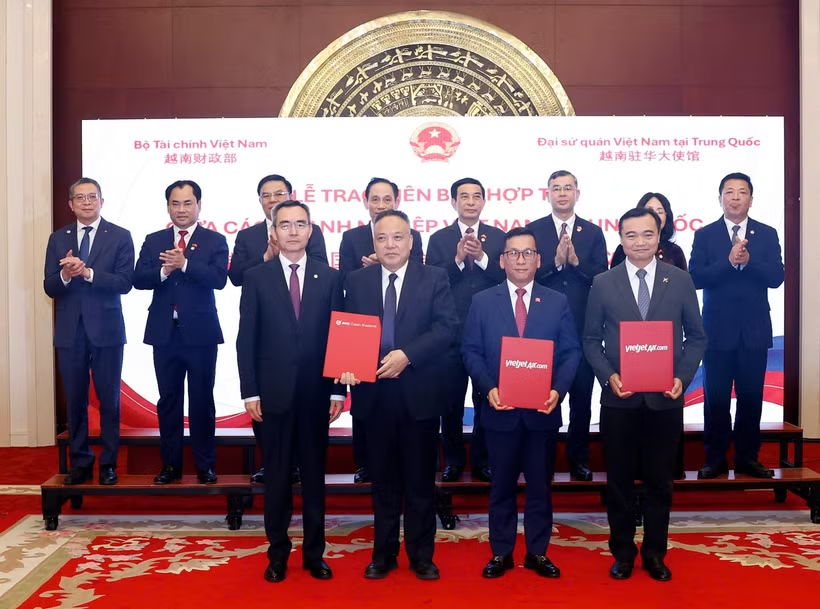
Beijing (VNA) – Vietjet and SPDB Financial Leasing (SPDBFL), a subsidiary of Shanghai Pudong Development Bank, have exchanged an agreement for the finance lease of 10 COMAC C909 aircraft, expanding financial and aviation cooperation between Vietnam and China.
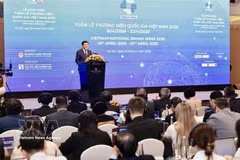
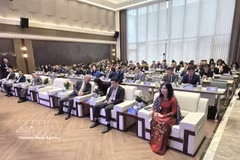
The event took place at the Embassy of Vietnam in Beijing, in the presence of Vietnam’s Deputy Prime Minister Phan Van Giang, along with senior government officials and representatives of leading enterprises from both countries. The event was held during the state visit of Vietnam’s Party General Secretary and State President To Lam to China, at the invitation of Party General Secretary and President of China Xi Jinping.
Driven by its vision to become a multinational aviation group, Vietjet is expanding its international flight network and investing in a modern fleet. Supporting this strategy, SPDB - one of China’s leading financial institutions - brings strong financial capacity and extensive experience in financing large-scale projects. Through SPDBFL, the bank plays an important role in structuring aircraft leasing and financing solutions, helping airlines optimise capital and execute long-term growth strategies.
The two parties agreed to finance aircraft through operating leases, with a larger scale and deeper level of cooperation, covering up to 10 COMAC C909 aircraft. This step contributes to optimising the operational efficiency of Vietjet’s fleet, while diversifying financial resources and enhancing access to international capital markets.
The agreement also lays the foundation for Vietjet to gradually introduce COMAC aircraft into operations on routes connecting Vietnam and China, thereby expanding the regional network and promoting bilateral air connectivity. At the same time, the cooperation contributes to strengthening regional and global aviation value chain linkages.
During Party General Secretary and President Lam’s visit, Vietjet also announced five new routes between Vietnam and China, including: Hanoi–Hangzhou, Hanoi–Enshi, Hanoi–Huangshan, Ho Chi Minh City–Guilin, and Ho Chi Minh City–Huangshan. Among these, the Hanoi–Enshi and Ho Chi Minh City–Guilin routes have been in operation since early April 2026. The new services connect key economic, cultural, and tourism centers, promoting trade, investment, and people-to-people exchanges between the two countries, while supporting the Vietnam–China Tourism Cooperation Year.
Cooperation between Vietnamese and Chinese enterprises reflects a growing trend of deeper linkages between financial institutions and airlines. These partnerships are fostering more flexible and effective cooperation models, contributing positively to the continued development of the Vietnam–China Comprehensive Strategic Cooperative Partnership in a new phase of growth.
On this occasion, Vietjet and AVIC Cabin Systems have exchanged a comprehensive cooperation agreement in the field of aircraft interiors and aviation supporting industries. The partnership marks a new strategic chapter between the two parties, amid increasingly strengthened industrial and technological cooperation between Vietnam and China.
Under the agreement, the two sides will collaborate to develop advanced aircraft interior solutions, gradually enhance manufacturing capabilities, promote supply chain localisation, and facilitate technology transfer. With Jiatai – a member of AVIC Cabin Systems – the cooperation also aims to develop a sustainable aviation supporting industry ecosystem in Vietnam, with the capability to integrate more deeply into the global supply chain.
Representing AVIC Cabin Systems, He Caifu, CEO of Jiatai, stated that the company is committed to delivering innovative solutions and international-standard services, while working alongside Vietjet to effectively implement projects and build a long-term partnership based on trust and quality.
Beyond manufacturing cooperation, the agreement is expected to serve as a platform to promote technology transfer, enhance Vietnam’s aviation industrial capabilities, and strengthen regional value chain connectivity. Together, the two sides aim to shape new links within the rapidly evolving aviation ecosystem in the Asia-Pacific region.
With its ambition to become a multinational aviation group, Vietjet continues to expand its international network, invest in a modern fleet, and proactively deepen its participation in the aviation value chain. The airline remains at the forefront of integrating advanced and innovative aviation technologies.
The rapid expansion of its international network is also driving corresponding demand for stronger aviation industrial capabilities and supply chain development. In this context, cooperation with AVIC Cabin Systems enables Vietjet to enhance its industrial capacity, expand its operational scale, and progressively integrate more deeply into the global aviation value chain. AVIC Cabin Systems is a member of the Aviation Industry Corporation of China (AVIC) – one of the world’s leading aviation industrial groups, with a comprehensive ecosystem spanning research, design, manufacturing, and supply. With total assets of hundreds of billions of US dollars, AVIC has over 100 subsidiaries, 26 listed companies, and a global workforce of more than 400,000 employees.
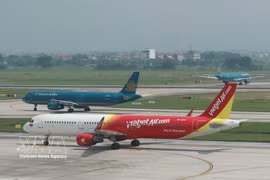
The new-age carrier Vietjet has not only revolutionised the aviation industry in Vietnam but also been a pioneering airline across the region and around the world. The airline currently operates 135 aircraft and has nearly 600 additional aircraft on order, including both wide-body and narrow-body aircraft. With a focus on cost management ability, effective operations, and performance, applying the latest technology to all activities and leading the trend, Vietjet offers flying opportunities with cost-saving and flexible fares as well as diversified services to meet customers' demands.
Vietjet is a fully-fledged member of International Air Transport Association (IATA) with the IATA Operational Safety Audit (IOSA) certificate. As Vietnam's largest private carrier, the airline has been awarded the highest ranking for safety with 7 stars by the world's only safety and product rating website airlineratings.com and listed as one of the world's 50 best airlines for healthy financing and operations by Airfinance Journal in many consecutive years. The airline has also been named as Best Low-Cost Carrier by renowned organisations such as Skytrax, CAPA, Airline Ratings, and many others./.