Ho Chi Minh City (VNA) – Southern Vietnam’s industrial real estate market is entering a more strategic phase of growth, shifting its focus from rapid expansion to quality, efficiency and long-term value creation, according to a report by Cushman & Wakefield Vietnam.
The report, reviewing a decade of Vietnam’s real estate market, highlighted strong growth in industrial land, ready-built warehouses and factories, along with rising rental prices, as the market increasingly prioritises infrastructure, operational efficiency and higher-quality supply.
Key industrial hubs in the south, including Ho Chi Minh City, Dong Nai and Tay Ninh, are transitioning from a period driven largely by supply expansion and rising land prices to a more refined growth model. This new phase is shaped by infrastructure upgrades, supply chain restructuring, product improvement and greater emphasis on operational performance.
Over the past 10 years, the supply of industrial land in the southern region rose by 80.21%, while average primary prices surged by 120.5%, equivalent to a compound annual growth rate (CAGR) of 9.18%. In the ready-built segment, warehouse supply expanded by 141%, with rents increasing by 43.8% (CAGR 5.3%). Meanwhile, ready-built factory supply grew by 134%, while rental rates rose by 16.7% (CAGR 2.2%).
According to Cushman & Wakefield Vietnam, the market has moved from a phase of “strong expansion” to one of “adjustment to increase value,” reflecting growing attention to modern standards, sustainability factors and higher-quality solutions for tenants.
This transformation has been supported by Vietnam’s strong manufacturing base, expanding trade connections and its continued appeal as a production hub for international investors.
Structural drivers have sustained demand for industrial land and ready-built assets across the southern region, particularly as tenants increasingly prioritise supply chain resilience, operational efficiency and strategic locations.
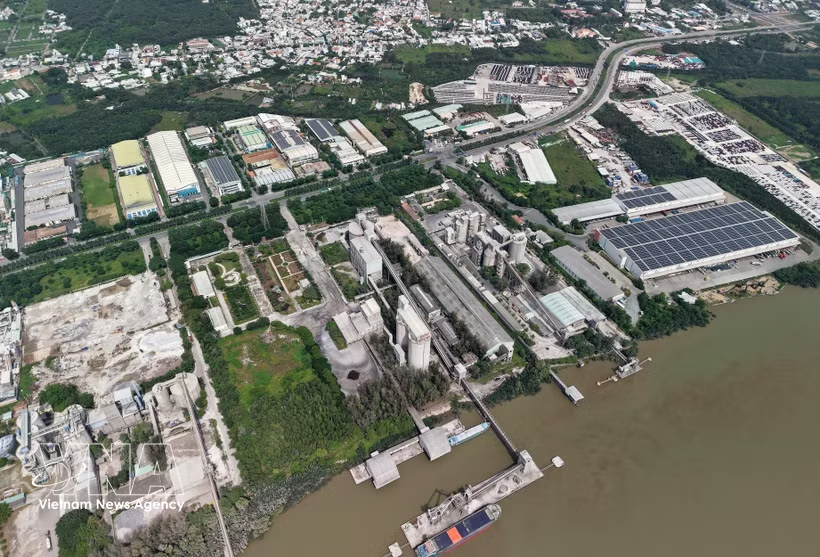
The rising demand has also fostered deeper industrial clusters and a more defined regional growth structure. Total industrial land supply in the south has reached approximately 36,400 hectares across 161 projects. The region also has about 6.6 million square metres of ready-built factories across 205 projects and 6.65 million square metres of ready-built warehouses across 189 projects.
Looking ahead, the report projects that by 2036, industrial land supply in the region will expand to at least 58,557 hectares across around 250 projects. Ready-built factory supply is expected to reach 7.76 million square metres, while warehouse supply is forecast to increase to 7.31 million square metres.
This future pipeline is set to reinforce the region’s role as a key manufacturing, logistics and industrial investment corridor in Vietnam, with growth increasingly shaped by quality, strategic positioning and integration into broader supply chains.
Chuong Quoc Doan, Associate Director of Leasing Agency - Industrial and Office at Cushman & Wakefield Vietnam, said the southern industrial market has grown strongly over the past decade, with its next phase focusing more on quality than quantity.
She noted that infrastructure connectivity, product quality, operational efficiency and sustainability will play a greater role in driving long-term value. For both investors and tenants, the market is becoming more specialised and increasingly competitive.
The southern key economic region continues to benefit from a deep manufacturing base, established logistics networks and robust future supply, while tenant demand is shifting toward better-planned industrial assets, modern ready-built facilities and locations that support both production efficiency and supply chain resilience./.