Stock market enters new cycle as reforms, foreign inflows converge

Despite record net foreign outflows in 2025, many experts view those withdrawals as cyclical rather than structural, while medium- and long-term fundamentals remain supportive.

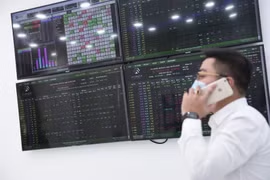
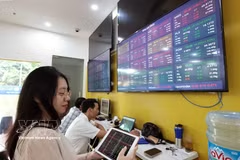
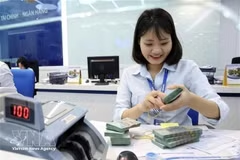
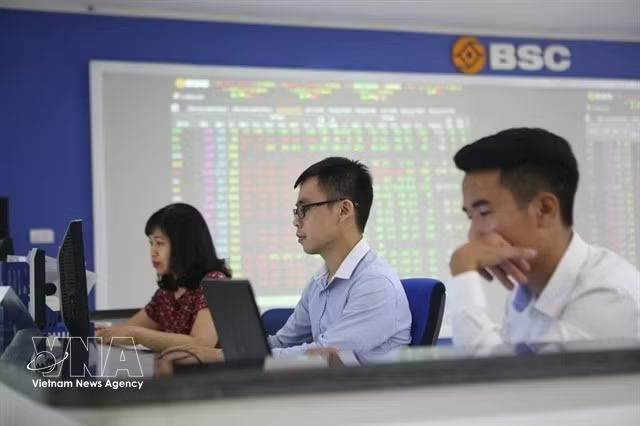
Traders work on a trading floor of a securities firm. (Photo: VNA)

Hanoi (VNS/VNA) - Vietnam's stock market is poised to enter a new development cycle, underpinned by structural reforms, market infrastructure upgrades and prospective foreign capital flows, insiders said.

Despite record net foreign outflows in 2025, many experts view those withdrawals as cyclical rather than structural, while medium- and long-term fundamentals remain supportive.

A recent report by SSI Securities Corporation (SSI) showed that the market entered 2026 with strong growth momentum, with the benchmark VN-Index approaching its base-case target of 1,920 points earlier in the year before correcting in March. The pullback was largely attributed to profit-taking, interest rate concerns and geopolitical uncertainties and was viewed as tactical rather than indicative of a reversal in the long-term trend.

Underlying fundamentals continue to support the market outlook. Analysts pointed to robust economic growth, large-scale infrastructure investment and a shift of domestic capital back into equities as other asset classes such as real estate and gold cool down. In addition, a pipeline of initial public offerings (IPOs) is expected to expand market depth and improve liquidity.

Market classification upgrades remain a central theme shaping investor expectations.

According to SSI, Vietnam could attract approximately 1.67 billion USD in passive inflows from global exchange-traded funds if it is upgraded by FTSE Russell, with disbursements likely to be phased over three to five quarters to mitigate volatility.

Beyond FTSE, MSCI is seen as the next milestone over the medium to long term.

Ongoing reforms, including the removal of pre-funding requirements, the introduction of a central counterparty clearing mechanism (CCP), enhanced English-language disclosure and foreign ownership limit adjustments, are expected to bring Vietnam closer to meeting international criteria.

SSI estimates the market could satisfy 17 out of 18 MSCI requirements once these improvements are completed.

Bui Hoang Hai, Vice Chairman of the State Securities Commission (SSC), said that although the country remains a regional growth bright spot with a stable macroeconomic foundation and strong market expansion, foreign investors still recorded net withdrawals of more than 5 billion USD in 2025.

He attributed the outflows largely to global capital cycle dynamics, noting that many leading financial institutions and corporations have continued to engage with Vietnam, reflecting sustained interest in the market. At the same time, progress in upgrade efforts, technological infrastructure and the legal framework has improved investment conditions.

Market participants stressed that foreign outflows do not signify a decline in investor confidence.

Nguyen Ngoc Anh, CEO of SSI Asset Management (SSIAM), said the trend has been in place since 2024 and extended into 2025, yet the market still posted strong gains of around 12% in 2024 and approximately 41% in 2025.

The fact that the market continued to grow strongly shows that investors who exited may have missed significant opportunities, she said.

According to Anh, market liquidity has been improving while the composition of foreign investors is undergoing a transition. Previously concentrated among a few large funds in East Asia, capital flows are now increasingly coming from the US and other developed markets.

This is a period of structural transition in capital flows, where withdrawals by some large funds could be misunderstood as a broader global trend, she noted./.

VNA

See more

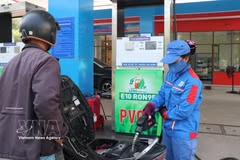
Tran Phu petrol station in Nghia Lo ward, Quang Ngai province, sells E10 petrol to local residents. (Photo: VNA)

Vietnam advised to build sustainable linkages for bioethanol production

According to the Vietnam Biofuels Association, the country currently operates six fuel ethanol plants with a combined designed capacity of approximately 600,000 cubic metres per year. At full capacity, these facilities could meet around 40% of the demand for E10 RON95 blending. However, securing sufficient feedstock to operate at full capacity continues to face considerable difficulties.

Delegates at the forum (Photo: VNA)

Vietnam–Russia Economic Forum highlights internal strength in new context

The Vietnam–Russia Economic Forum 2026 (VREF 2026), themed “Unleashing internal strength in the new era,” took place in Hanoi on April 8 in a hybrid format, bringing together scholars, policymakers, experts and business representatives to discuss economic development and strengthen bilateral cooperation in the evolving global landscape.

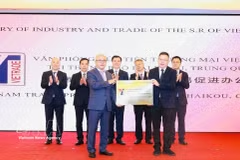
Representatives from Vietnam and China's Hainan province pose for a group photo at the inauguration ceremony (Photo: VNA)

Vietnam Trade Promotion Office inaugurated in China’s Haikou city

Leaders of the Vietnamese Ministry of Industry and Trade described the office as a concrete outcome of cooperation with the People’s Government of Hainan Province, following the Memoranda of Understanding signed a year earlier, enhancing economic and trade ties and establishing the Haikou office.

Product showcase area at AI Day 2026. (Photo: VNA)

Vietnam sees ample opportunities in AI-powered economy

The “Vietnam AI Economy 2025” report, released by the National Innovation Centre, Japan International Cooperation Agency (JICA), and Boston Consulting Group, puts hard numbers on the opportunity for the first time. It forecasts that AI could add up to 130 billion USD to Vietnam’s GDP by 2040, equivalent to roughly 25% of the country’s current economy.

USABC President and CEO Brian McFeeters (Photo: VNA)

US businesses look to advance long-term investment in Vietnam

Despite ongoing global economic uncertainties, the size of the coming delegation reflects strong US business interest in expanding trade, investment, and long-term partnerships in Vietnam, as well as confidence in the country’s economic growth prospects.

The access road leading to the bridge on the Thieu Quang commune side under the Xuan Quang Bridge sub-project, part of the road project linking National Highway 1 with National Highway 45. (Photo: VNA)

Faster public investment disbursement crucial to growth targets

Public investment was a major contributor to the economy’s 7.83% GDP growth in the first quarter, achieved despite global uncertainties and rising input costs. Nonetheless, the figure fell short of the 9.1% growth scenario outlined in the Government’s Resolution No. 01/NQ-CP.

Thuan Thanh Eco-Smart IP is Viglacera’s first green, smart industrial park. (Photo: Viglacera)

Green industrial parks drive next-generation FDI

Ho Chi Minh City needs to strengthen investment in supply chain data systems, smart warehouses, regional logistics centres and inland container depots, while promoting stronger linkages between FDI firms, large domestic companies and small and medium-sized enterprises to support technology transfer and workforce development.

AMRO Chief Economist Dong He said Vietnam handles last year’s tariff shock relatively well. (Photo: Screenshot)

Vietnam weathers economic shocks effectively: AMRO

The report highlights that Vietnam continues to benefit from strong domestic demand, robust export performance and sustained foreign investment inflows, particularly in high-tech manufacturing and electronics.

Aircraft of Vietnam Airlines (Illustrative photo: VNA)

Vietnam waives transport fees to support businesses

The Ministry of Finance has announced the waiver of several fees and charges to support production and business activities in the transport sector. The policy takes effect from April 7, 2026 to June 30, 2026.

Fishing boats anchor at Vam Lang Fishing Port in Gia Thuan commune, Dong Thap province. (Photo: VNA)

Dong Thap intensifies action to tackle IUU fishing

Local officials have been assigned to work closely with fishing communities, supporting compliance with regulations while reinforcing coordination mechanisms to monitor vessel movements at sea and prevent potential violations at an early stage.