Hanoi's growth holds firm despite fuel price pressures

In Hanoi, the decisive implementation of socio-economic development programmes from the start of the year helped sustain growth, with GRDP rising 7.87% year-on-year in the first quarter.

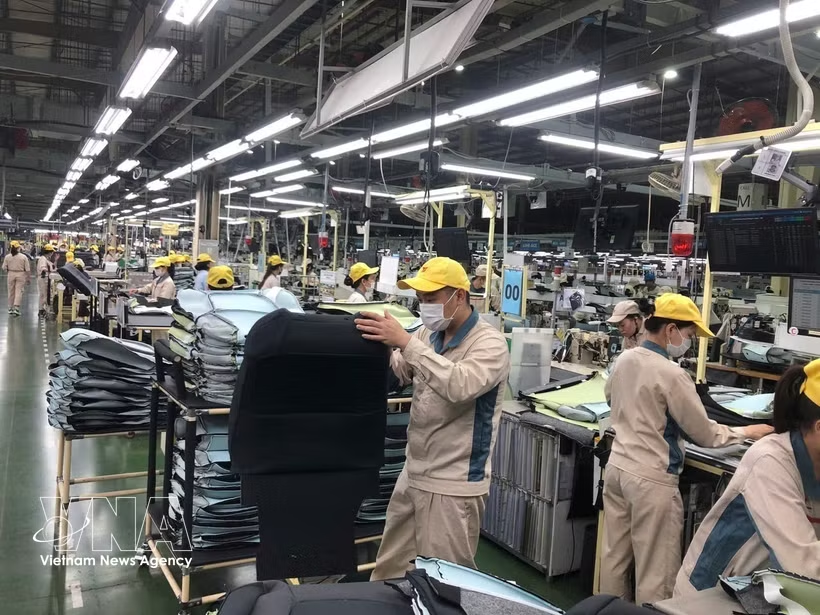
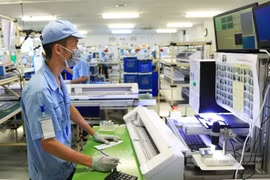
Workers in a production shift at Toyota Boshoku Hanoi (Photo: VNA)

Hanoi (VNA) – Hanoi’s economy expanded 7.87% in the first quarter of 2026, one of the strongest growth rates in recent years, despite mounting pressures from rising global fuel prices and trade uncertainties.

The figures were announced at a press conference held by the municipal People’s Committee on April 6 to review the city’s socio-economic performance in the first quarter.

Speaking at the event, Do Thu Hang, Deputy Director of the Hanoi Department of Finance, said the global environment remained volatile, particularly as the conflict in the Middle East since late February has disrupted maritime trade routes, pushed up energy prices and heightened inflation risks.

Despite these headwinds, Vietnam’s economy has maintained a positive recovery momentum, supported by industrial production, exports and public investment, she said.

In Hanoi, the decisive implementation of socio-economic development programmes from the start of the year helped sustain growth, with GRDP rising 7.87% year-on-year in the first quarter.

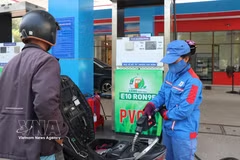
However, soaring fuel prices have added significant pressures. In March 2026, petrol prices jumped 28.09% month-on-month, while diesel rose 56.62%. Compared with March 2025, petrol prices increased 21.44% and diesel 58.67%, driving up transport and production costs and weighing on consumption.

Industrial production remained resilient, with the industrial index of production (IIP) rising 8.5% year-on-year, including 8.7% growth in manufacturing and 6.4% in electricity production and distribution.

Business activity also gained momentum. The city recorded 9,033 newly established enterprises, up 33.4%, with registered capital totaling 168.5 trillion VND (about 6.4 billion USD). Meanwhile, 5,147 businesses resumed operations, an increase of 36.1% year-on-year, though dissolutions and temporary suspensions also rose.

Foreign direct investment (FDI) reached 478.9 million USD, down 66.2% year-on-year. In contrast, total investment capital in the city rose 10.1% to 102.3 trillion VND, while public investment from the local budget surged 47.4% to 20.9 trillion VND, the highest level nationwide.

Trade and services remained bright spots, Hang said. Retail sales and consumer service revenue reached 252 trillion VND, up 11.2%, while tourism rebounded strongly with over 2.43 million visitors, including 1.78 million international arrivals.

In the coming time, the city will prioritise major infrastructure projects, accelerate public investment disbursement and stimulate consumption, including piloting the night-time economy in Hoan Kiem and Tay Ho.

Hanoi will also shift towards selective investment attraction, targeting strategic investors in high-tech industries, supporting industries and research and development, while promoting digital transformation across public services and commerce.

Officials said the first quarter has laid an important foundation, but achieving double-digit growth will require faster public investment, stronger mobilisation of social resources and new momentum from science, technology, the digital economy, culture and tourism./.

VNA

See more

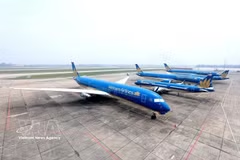
Illustrative image (Photo: VNA)

Australia announces import conditions for Vietnamese pomelos

Australia’s formal publication provides an important legal basis, marking the completion of the review, assessment and agreement on technical requirements for fresh Vietnamese pomelos. This represents a significant step forward in market access, creating favourable conditions for relevant agencies, localities and businesses to prepare for export activities in the coming time.

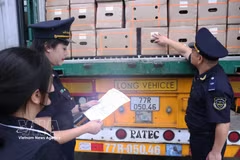
Containers of fresh Vietnamese durian for export are subject to a full-chain traceability system. (Photo: VNA)

First “green lane” durian shipment exported to China

​Under the “green lane” process, quality control begins at the cultivation stage, including soil sampling and monitoring, and continues through harvesting and processing, with traceability labels attached to trees and applied to fruit at the time of picking. It also allows plant quarantine procedures and the issuance of certificates of origin (C/O) directly in the localities where the orchards are located.

Delegates at the Vietnam Expo 2026 (Photo: VNA)

Vietnam pushes for deeper auto supply chain ties with RoK

The RoK stood as Vietnam’s largest foreign investor with more than 95.2 billion USD in registered capital as of February 2026, or about 18% of all foreign cash flowing in, with thousands of active projects. In January-February alone, the RoK led the pack with nearly 2 billion USD in pledges, grabbing a whopping 32.7% of total registered capital and showing no signs of slowing down.

More than 600 tourism firms, 15 countries and territories, and 34 provinces and cities are promoting destinations and introducing tourism products at the fair (Photo: VNA)

Digital transformation key to elevating Vietnam’s tourism: official

Speaking at the opening of the Vietnam International Travel Mart (VITM) 2026 in Hanoi on April 10, Deputy Minister of Culture, Sports and Tourism Ho An Phong noted that despite challenges in 2025, Vietnam largely fulfilled its socio-economic development goals. Tourism remained a bright spot, recording 21.5 million foreign arrivals and 135.5 million domestic visitors, with total revenue exceeding 1 quadrillion VND (37.9 billion USD).

A drone sprays fertiliser over rice fields. (Photo: VNA)

Low-altitude economy emerges as new growth driver for Vietnam

The UAV technology is particularly effective in addressing challenges faced by ground infrastructure, especially in densely populated urban areas and remote regions. Smart aerial devices also enable real-time data collection, improving governance, decision-making and digital transformation across industries.

Passengers at Cat Bi Airport in Hai Phong city (Photo: VNA)

Aviation sector ensures fuel supply for April 30–May 1 peak

Aviation fuel suppliers are actively negotiating and diversifying supply sources both domestically and internationally, while strengthening coordination, storage and distribution capacity to meet immediate demand. These efforts aim to support airlines in optimising operations and maintaining stable flight schedules.