Hanoi (VNA) – Public investment is set to remain a central pillar supporting Vietnam’s economic expansion through the rest of 2026, though experts say removing structural bottlenecks and strengthening support for construction enterprises will be critical to promote its role as a growth driver.
Under the 2026 plan, the Prime Minister has allocated nearly 995.35 trillion VND (37.7 billion USD) in state-budget public investment capital, roughly 93 trillion VND higher than in 2025. The total includes 345.12 trillion VND from the central budget and 650.23 trillion VND from local budgets.
Local authorities have also added over 12.93 trillion VND from their own balanced budgets, while 42 billion VND in previously approved capital has been extended into 2026. This brings the overall public investment plan to more than 1 quadrillion VND, underscoring the Government’s determination to leverage public spending as a key engine for economic growth, with a target of over 10% expansion this year.
Data from the Ministry of Finance show that public investment disbursement reached 110.3 trillion VND in the first quarter, equivalent to 11% of the annual plan, up 1.2 percentage points and about 30 trillion VND year-on-year.
Nguyen Thi Huong, Director General of the National Statistics Office (NSO), said public investment was a major contributor to the economy’s 7.83% GDP growth in the first quarter, achieved despite global uncertainties and rising input costs. Nonetheless, the figure fell short of the 9.1% growth scenario outlined in the Government’s Resolution No. 01/NQ-CP.
According to the NSO, achieving double-digit growth for the full year remains a formidable challenge, requiring stronger momentum in the remaining quarters, with projected growth rates of 10.5% in the second quarter, 10.6% in the third, and 10.74% in the fourth.
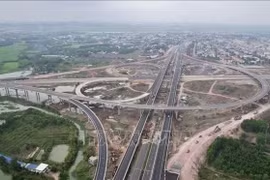
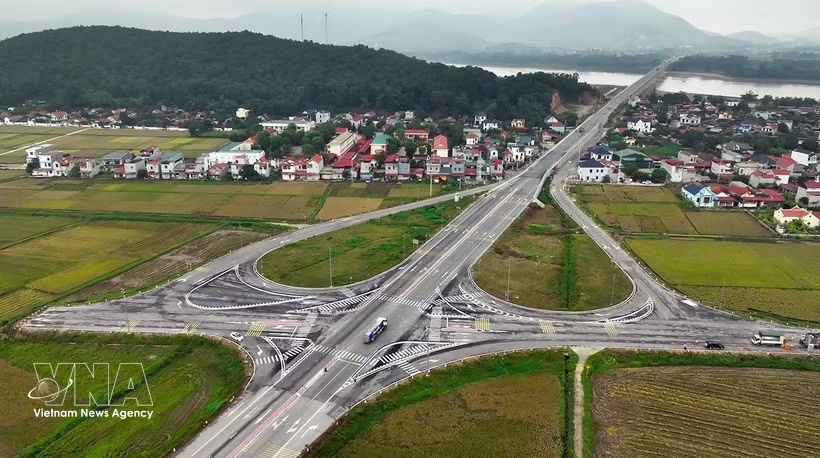
Huong noted that public investment will continue to act as a vital growth engine and “seed capital” to expand long-term productive capacity, particularly through major infrastructure projects such as Long Thanh International Airport, high-speed railways, ring roads, expressways, and the Olympic sports urban complex, which are expected to generate strong spillover effects across the economy.
Since early 2026, the Government and relevant ministries and localities have issued a series of directives aimed at accelerating disbursement. Most recently, Resolution No. 89/NQ-CP, adopted at the Government’s regular March meeting and its conference with local authorities on April 5, called for closer monitoring of global developments, more flexible policy responses, enhanced resource mobilisation, and determined efforts to achieve full disbursement of the 2026 capital plan.
The resolution also requires strict adherence to monthly disbursement schedules, particularly for nationally significant projects, major energy and transport works, inter-regional connectivity initiatives, and national target programmes identified as key growth drivers this year.
However, weakening financial health among construction firms is emerging as a major obstacle to faster disbursement. Up to 44.4% of enterprises reported more challenging business conditions in the first quarter compared with the previous period.
Rising material costs, supply chain disruptions, and escalating logistics expenses have significantly eroded contractors’ profit margins as contract values remain unchanged. Meanwhile, outstanding construction debts and cash-flow constraints continue to weigh heavily on the sector, with 25.2% of firms facing severe financial pressure due to delayed payments and 21.2% lacking sufficient operating capital.
Project implementation has also been slowed by delayed site clearance (16.2%), cumbersome administrative procedures (19.9%), and shortages of skilled workers (18.7%) following the Lunar New Year holiday.
Huong stressed that accelerating disbursement alone will not be enough for the construction sector to achieve a breakthrough. Authorities need to stabilise construction material prices, decisively address payment backlogs to restore contractors’ cash flow, and speed up land clearance so that enterprises have sufficient capacity to drive economic growth forward./.