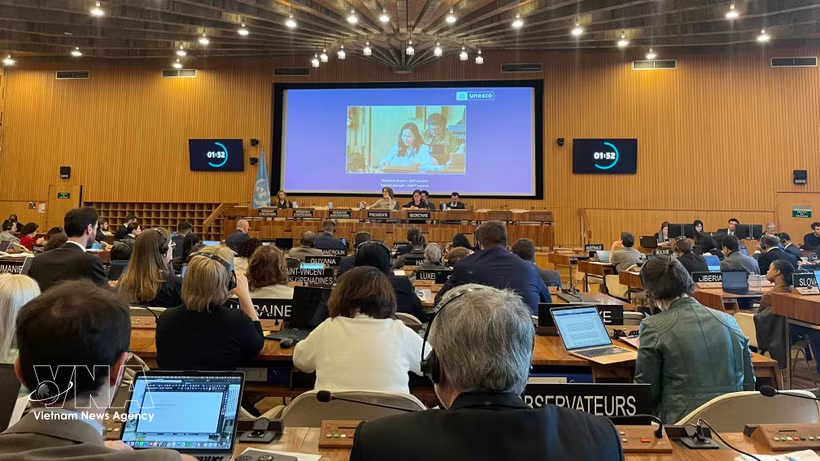
Paris (VNA) – The UNESCO Executive Board on April 15 approved decisions to extend the status of two Vietnamese Category II centres under UNESCO’s auspices for a further eight years during its 224th session in Paris.
These include the International Centre of Research and Postgraduate Training in Mathematics (ICRTM) and the International Centre for Physics (ICP), both operating under the Vietnam Academy of Science and Technology (VAST). Under the adopted decisions, the Executive Board authorised the Director-General of UNESCO to sign bilateral agreements with the Government of Vietnam, along with memoranda of understanding with VAST. This represents a key activity for the Ministry of Science and Technology in 2026, as it coordinates with VAST and the Vietnam National Commission for UNESCO to submit proposals to the Government for the signing of the agreements for the 2026–2034 period, in line with the 2026 Law on International Treaties.
Earlier independent evaluations conducted by UNESCO in September 2025 for ICRTM and October 2025 for ICP yielded positive results. International experts recognised the significant progress made by both centres in fulfilling their missions, including conducting high-level research, providing postgraduate training, strengthening partnerships at national, regional and international levels, and establishing robust governance, financial and operational frameworks. The assessments confirmed that the legal and operational frameworks of the two centres in Vietnam are aligned with UNESCO’s current standards. With the next eight-year extension cycle, Vietnam aims to expand cooperation with international scientific centres, as well as with ASEAN countries and African partners, positioning ICRTM and ICP as regional centres of excellence in fundamental sciences. These efforts are expected to contribute meaningfully to national development and to the implementation of the United Nations’ International Decade of Sciences for Sustainable Development (2024–2033), led by UNESCO.
According to Deputy Minister of Foreign Affairs Ngo Le Van, Chairman of the Vietnam National Commission for UNESCO, the extension demonstrates the country’s governance capacity and strong commitment to the development of fundamental sciences.
In line with the Politburo’s Resolution No. 57-NQ/TW on breakthroughs in science, technology, innovation and national digital transformation, and Resolution No. 59-NQ/TW on international integration in the new situation, the two centres are not only serving national interests but are also emerging as knowledge hubs, promoting South–South cooperation within ASEAN and the Asia-Pacific region, thereby positioning Vietnam as an active node in the global scientific network. Professor Tran Hong Thai, President of VAST, affirmed that the academy will continue to prioritise mathematics and physics, including ensuring staffing for scientists, attracting young talent, expanding international cooperation and inviting foreign experts for long-term engagement in Vietnam. The goal is to develop ICRTM and ICP into core institutions driving Vietnam’s scientific advancement, contributing not only to fundamental research but also to practical applications such as data modelling, weather forecasting and emerging technological systems.
Ambassador Nguyen Thi Van Anh, Permanent Representative of Vietnam to UNESCO, described the development as a significant milestone, reaffirming the reputation, standing and substantive contributions of Vietnam’s fundamental sciences on the international stage. It also forms part of the commemorations marking 50 years of cooperation between Vietnam and UNESCO (1976–2026).
The continued operation and enhancement of these centres reflect Vietnam’s policy of positioning science, technology and innovation as key drivers of development, while closely linking scientific advancement with deeper and more substantive international integration in the current context, she said./.
See more
China–ASEAN AI cooperation centre drives regional tech cooperation
With strong policy support and growing participation from businesses and research institutions, the China–ASEAN Artificial Intelligence (AI) Application Cooperation Centre is expected to act as a digital bridge, promoting technological integration and opening new avenues for Vietnam–China cooperation in the digital era.
Vietnam, China step up cooperation in science, technology, innovation
Politburo member and Chairman of the Party Central Committee’s Organisation Commission Nguyen Duy Ngoc, who also serves as Standing Deputy Head of the Central Steering Committee for the Development of Science, Technology, Innovation and Digital Transformation, toured the park’s exhibition area and was briefed on the formation and development of Zhongguancun, along with Beijing’s achievements in science, technology and innovation.
Vietnam launches talks to join expanded Information Technology Agreement
Vietnam considers the expanded Information Technology Agreement an important mechanism for promoting trade liberalisation in IT products, reducing costs and improving access to technology, while supporting global innovation.
Vietnam ramps up push for self-reliant semiconductor industry
Building on this foundation, Vietnam aims to capitalise on the global supply chain shift by focusing on specialised chips and science-technology human resources, gradually mastering stages from research, design to packaging and testing.
Swiss–Vietnam dialogue advances cooperation in AI, fintech
Most financial institutions in Vietnam have adopted AI, with investment accelerating amid strong demand for digital banking and high smartphone penetration.
Bac Ninh accelerates development of 5G, data infrastructure
In the first quarter, Bac Ninh’s telecommunications infrastructure continued to develop in a synchronous manner. All communes have been connected to dedicated data transmission networks, and 100% of the population is covered by mobile services.
An Giang identifies key tasks in science-technology development
The priorities focus on four pillars: science and technology, innovation, digital transformation, and real-world applications to boost socio-economic development. These are expected to create breakthroughs in governance, production, and daily life.
Vietnam Research Excellence Fellowship for 2026-2030 approved
Under the Vietnam Research Excellence Fellowship (VREF) for the 2026–2030 period, PhD students are identified as a core research force directly contributing to breakthroughs in sci-tech and innovation. Investing in top-tier doctoral candidates is more than workforce development, but a high-stakes strategic bet to forge a cohort of world-class scientists and technologists who can power Vietnam’s long-term economic ambitions.
Resolution 57 unlocks people’s creative potential
Resolution 57 is emerging as a powerful driver for building a modern administration, enhancing public service delivery, and offering increasingly convenient experiences for citizens.
Vietnam becomes test bed for AI-driven commerce tools
A 2025 study by Kantar found that 89% of online adults in Vietnam message businesses at least once a week, while 78% say responses from AI-powered chatbots are helpful.
Biometric verification required for mobile device changes from April 15
The policy is designed to enhance security, particularly in cases where users lose their SIM cards but fail to promptly deactivate them, creating opportunities for fraud or illegal activities.
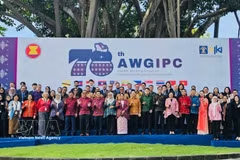
Vietnam reports 2025 strides at ASEAN working group’s meeting on IP
Vietnam recorded positive results, clearing nearly 250,000 backlogged applications and lifting the rights establishment efficiency rate to 74% from a year earlier, even as new filings jumped roughly 20%.
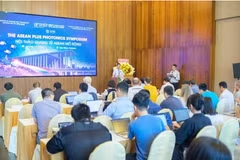
Gia Lai province hosts ASEAN Plus Photonics Symposium
Participants presented and discussed a wide range of advanced topics shaping the future of photonics, including nanophotonics and metasurfaces; topological and non-Hermitian photonics; photonic crystals and optical lattices; light–matter interactions and polariton systems.
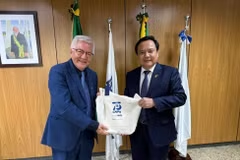
Vietnam, Brazil to strengthen cooperation in science, technology
Ambassador Bui Van Nghi expressed Vietnam’s interest in strengthening cooperation with Brazil in areas such as renewable energy and environmental technologies, as well as high-tech sectors including artificial intelligence (AI), quantum technology, and the semiconductor industry.
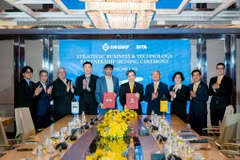
Sun Group partners with SITA to build digital foundations for integrated aviation - tourism ecosystem
Under the agreement, SITA will work alongside Sun Group to deploy technology platforms across its aviation ecosystem, including Phu Quoc and Van Don International Airports, as well as Sun PhuQuoc Airways. The focus will be on digitising passenger processes, optimising operations, and building an integrated data platform that connects all touchpoints across the travel journey.
National strategy on innovative start-ups unveiled
By 2030, the strategy targets a total of 5 million business entities, including at least 10,000 innovative start-ups.
Cybersecurity needs heightened attention in the age of AI
While boosting efficiency in the banking sector, the application of artificial intelligence (AI) also changes the nature of cyber risks and poses great challenges to cybersecurity in Vietnam.
AI powers sweeping overhaul of Vietnam’s education system
Nguyen Son Hai, Deputy Director General of the Department of Information and Communication Technology under the Ministry of Education and Training (MoET), said the sector has made rapid strides in digital transformation, from online classes during the COVID-19 pandemic to nationwide platforms covering the national education database, registration for high school graduation exam, and online university admissions.
Digital transformation gathers pace nationwide
Adopted by the Politburo in late 2024, Resolution 57 positions science – technology development, innovation, and digital transformation as a top important breakthrough and strategic pillar for Vietnam’s development in the new era. Early implementation shows a clear shift toward data-driven governance and technology-enabled public services.
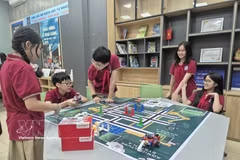
Drone Soccer 2026 debuts as innovative tech playground for Tay Ninh students
The Zone 1 competition, part of the 2026 Science, Technology, Innovation and Digital Transformation Week, drew the strong participation from students, contributing to the promotion of STEM education and sparking interest in technology among local youths.