Cybersecurity needs heightened attention in the age of AI

While boosting efficiency in the banking sector, the application of artificial intelligence (AI) also changes the nature of cyber risks and poses great challenges to cybersecurity in Vietnam.

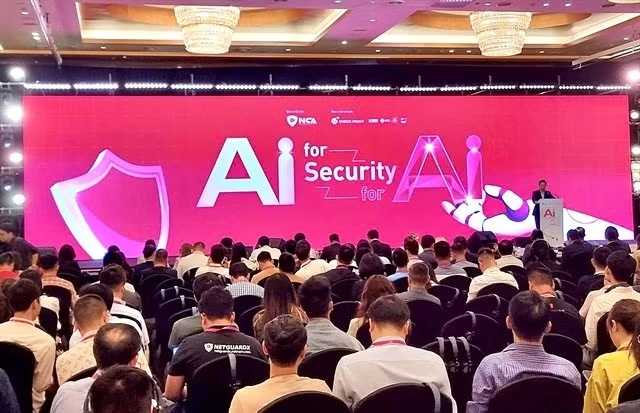
A view of a cross-industry conference held by the National Cybersecurity Association in Hanoi on April 7. (Photo: baotintuc.vn)

Hanoi (VNS/VNA) – Using artificial intelligence (AI) to process data-heavy tasks such as banking increases efficiency and service quality, but it also poses new cybersecurity threats that need to be assessed and managed carefully.

That was a key message at a cross-industry conference held by the National Cybersecurity Association in Hanoi on April 7, which aims to boost collaboration between the banking sector and technology companies in walking the thin line between using AI to identify AI-enabled cyber threats and preventing cyber threats caused by AI.

In Vietnam’s financial and banking sector, AI tools are being applied in several activities such as credit assessment and scoring, fraud detection and customer support, improving efficiency and service accessibility for customers, according to Pham Tien Dung, Deputy Governor of the State Bank of Vietnam.

However, these tools are also changing the nature of cyber risks and pose significant challenges to cybersecurity.

“Attackers exploiting AI to automate processes, scale up and increase the sophistication of their attacks have made the cybersecurity environment more complex and posed greater challenges to traditional security methods,” he said.

This calls for a dual approach in the sector that, on one hand, deploys AI in a reliable and controlled manner for necessary tasks, and on the other, establishes a defence mechanism to protect these AI-powered systems from being exposed to cyber attacks, according to Dung.

“Building an AI ecosystem goes beyond just technology. It also requires data governance, risk management and cybersecurity assurance, from the initial design phase and throughout the entire operation process,” he said.

Not only the banking system, but ordinary citizens were also being exposed to more sophisticated cyber threats involving AI, said Colonel Nguyen Hong Quan, Deputy Director of the Department of Cyber Security and High-Tech Crime Prevention under the Ministry of Public Security.

“While cybercriminals previously relied primarily on traditional techniques and tools, today, with the support of AI, they are able to automate large-scale attacks with unprecedented sophistication,” he said. “Personalised scams and counterfeit products using deepfake technology are becoming increasingly difficult to identify, and malware can adapt to evade defence systems."

Another notable point is that cybercriminals are shifting from individual operations to a professional, systematic and industrialised model, significantly shortening preparation time and expanding the scope of attacks, Quan added.

“This leads to a new reality, which is that cyberspace is no longer a static environment but a dynamic battlefield, where offensive and defensive activities occur continuously and at an ever-increasing pace,” he said.

From a national security perspective, Quan said AI would present numerous strategic challenges, including the protection of data sovereignty, dependence on foreign platforms and technologies, and the need to protect AI systems themselves, which have become new targets of attack.

“In this context, enhanced cooperation among government agencies, businesses and international organisations is essential,” he said.

Speaking from the perspective of tech companies that provide AI-integrated cybersecurity solutions, Ruma Balasubramanian, President in Asia Pacific & Japan of Check Point Software, said it was of utmost importance for industry players, in both the private and public sectors, to understand that they would need to re-establish what they know about cybersecurity.

It starts with understanding exactly what system or data they are protecting, who the attackers are and what they are capable of, according to Balasubramanian.

They will also have to modernise existing security tools and reassess everything from the ground up to ensure that their organisation is not vulnerable to AI-based attacks, she added.

The final step is to adopt and leverage AI in a safe and secure way to increase cybersecurity capabilities, which industry partners such as Check Point can help with.

“Understanding what cybersecurity tools are out there that really leverage this technology is critically important as you build out your capabilities,” Ruma said.

According to research data from Check Point, in any given week in Vietnam, government databases are being attacked more than 14,000 times on average, while any given organisation faces around 5,300 attacks in the same timeframe, nearly three times the global average./.

VNA
See more

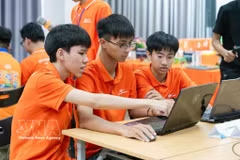
Students experience robotic products (Photo: VNA)

AI powers sweeping overhaul of Vietnam’s education system

Nguyen Son Hai, Deputy Director General of the Department of Information and Communication Technology under the Ministry of Education and Training (MoET), said the sector has made rapid strides in digital transformation, from online classes during the COVID-19 pandemic to nationwide platforms covering the national education database, registration for high school graduation exam, and online university admissions.

Voters can access essential information about candidates on the VNeID app, enabling them to proactively learn and enhance their awareness when participating in elections. (Photo: VNA)

Digital transformation gathers pace nationwide

Adopted by the Politburo in late 2024, Resolution 57 positions science – technology development, innovation, and digital transformation as a top important breakthrough and strategic pillar for Vietnam’s development in the new era. Early implementation shows a clear shift toward data-driven governance and technology-enabled public services.

Can Tho city pledges to allocate at least 1% of total budget spending to science, technology and innovation (Illustrative image. Source: VNA)

Plan issued to implement Vietnam–France agreement on science-technology cooperation

Under the plan, the Ministry of Science and Technology will take the lead, in coordination with relevant ministries and agencies, in directing, guiding, monitoring and inspecting the implementation of the agreement. The ministry will also prepare reports on the signing and implementation progress for submission to the Ministry of Foreign Affairs for consolidation and reporting to competent authorities as required.

An overview of the provincial steering committee of Tay Ninh on implementing Resolution 57 on April 2 (Photo: VNA)

Tay Ninh moves to accelerate digital transformation

In science, technology and innovation, Tay Ninh has identified six major priorities: development of the digital economy, a carbon credit market, a Halal ecosystem, renewable energy, enterprise innovation support, and applications of artificial intelligence and big data.

Vietnam successfully held its first auction of national “.vn” domain names from March 18 to 20. (Photo: VNA)

Sci-tech revenue up 17% in March

The sci-tech sector contributed 133.5 trillion VND to the country’s gross domestic product (GDP) in March, a 28% increase from the same period last year.

Delegates at the meeting (Photo: VNA)

Da Nang boosts hi-tech partnership with Germany’s Chemnitz City

Authorities in Da Nang hope Chemnitz and German partners will continue to accompany and support the city in accessing advanced technologies, connecting experts, integrating into innovation ecosystems, and attracting high-tech enterprises and supporting industries to explore investment and long-term cooperation opportunities.

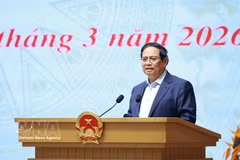
Prime Minister Pham Minh Chinh speaks at the meeting of the Government’s Steering Committee for science and technology, innovation, digital transformation, and Project 06 (Photo: VNA)

Strategic tech must address practical challenges: PM

Prime Minister Pham Minh Chinh called for the rollout of a strategic technology development programme, alongside the completion of incentive policies to attract tech giants and develop key tech products, particularly in semiconductors and AI.

Experience virtual reality technology at Nha Trang Center shopping mall (Khanh Hoa). (Photo: VNA)

Experts give ideas to build AI economy from data

Vietnam’s economic growth over past decades has largely relied on labour expansion, capital accumulation, export promotion and deep global trade integration, but as the country enters a higher development stage, this model is showing limitations.

VINASA Vice Chairwoman and Secretary General Nguyen Thi Thu Giang (right) and SEPC General Director Abhay Sinha sign the MoU on cooperation in New Delhi on March 25. (Photo: VNA)

Vietnam, India ink deal to step up IT cooperation

Under the terms of the MoU, the two sides will jointly push trade and investment in IT and services, arrange business delegations and business-to-business meetings, share market and policy information, and help companies access partnership opportunities and expand into new markets.

The Ninh Thuan 1 Nuclear Power Plant project is planned to be built in Khanh Hoa province (Photo: VNA)

Vietnam approves atomic energy development strategy, targeting civil applications

Tran Chi Thanh, Director of the Vietnam Atomic Energy Institute under the Ministry of Science and Technology, underscored that in the coming period, the institute and its affiliated units will continue promoting their strengths to promote the safe and secure application of atomic energy, contributing effectively to socio-economic development goals.

Students at FPT Ha Nam Inter-level High School practice their lessons directly by applying digital technology software (Photo: VNA)

FPT joins top 35 global AI application development service providers

The recognition reflects FPT’s end-to-end AI capabilities, spanning strategic consulting, solution design, application development, and the integration and deployment of AI systems in real-world operations. Notably, the company has developed IvyHub, an integrated agentic AI platform that enables enterprises to design, deploy and manage AI agents at scale.

The High-Frequency Systems and Microchip Laboratory at Ho Chi Minh City University of Technology, Vietnam National University, Ho Chi Minh City. (Photo: VNA)

Ho Chi Minh City sets sights on becoming semiconductor hub

A central component of the plan is expanding cooperation with global technology leaders such as AMD, NVIDIA and Qualcomm. These partnerships are expected to support technology transfer, strengthen chip design capabilities and help the city move further up global semiconductor value chains.