Hanoi (VNA) - Artificial intelligence (AI) is emerging as a potent force reshaping governance, teaching and research in Vietnam’s education sector, unlocking a more flexible and adaptive system aligned with the Politburo’s Resolution 71-NQ/TW on breakthroughs in education and training.
From “digitalisation” to full-scale restructuring
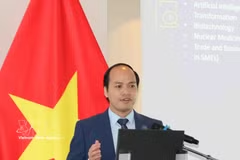
Nguyen Son Hai, Deputy Director General of the Department of Information and Communication Technology under the Ministry of Education and Training (MoET), said the sector has made rapid strides in digital transformation, from online classes during the COVID-19 pandemic to nationwide platforms covering the national education database, registration for high school graduation exam, and online university admissions.
According to him, while earlier digital efforts centred on simply digitising activities, AI now signals a sharper shift toward comprehensive restructuring of teaching and education governance. In school management, unified governance platforms and databases, built on data that is accurate, sufficient, clean, live, unified and shared, are enabling educational establishments to move from manual, fragmented processes to data-driven, smart governance. The result is faster, more precise and effective decision-making.
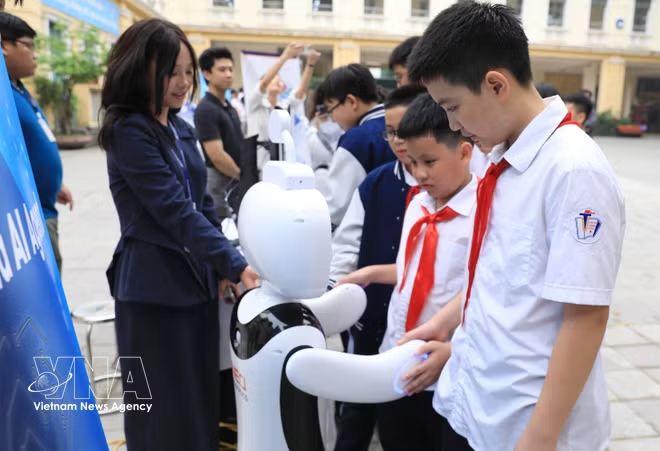
On personalised learning, AI and digital tools allow teachers to dissect individual student abilities and progress, recommend tailored content and pathways, and flag those needing extra support. This is making truly personalised education more practical and effective, advancing the resolution’s goals of equitable access and better quality.
Yet, AI also brings thorny challenges around management and academic integrity. Hai stressed that the ministry advocates neither imposing extreme restrictions nor allowing uncontrolled use, but creating an appropriate legal framework to ensure AI is applied effectively, safely, and under proper oversight.
The ministry is also preparing to enforce the Artificial Intelligence Law in education and developing a national strategy for AI deployment in education and training. Regulations on safety, risk management and deployment conditions, including strict rules on academic integrity when using AI, are in the works.
Schools and universities are being urged to take the lead in governing AI use in teaching, assessment and research. The goal is to establish and enforce codes of conduct that foster innovation without compromising academic standards.
Hai highlighted three key tasks, including building digital and AI competencies among learners, creating shared digital platforms and data systems, and upgrading infrastructure and access.
Specifically, the MoET already issued a circular embedding AI competency content into curricula. An AI education curriculum for general education students is under pilot and slated for rollout in the 2026–2027 academic year.
Efforts are accelerating the development of digital learning repositories, electronic learning systems, online public services and a national education governance platform, all tightly integrated with the national education database.
Local authorities and institutions continue pouring resources into IT infrastructure and learning devices, while rolling out support policies for internet and digital access, especially in disadvantaged regions, to ensure no learner is left behind.
Forging an innovative education ecosystem
Assoc. Prof. Nguyen Phong Dien, Vice President of the Hanoi University of Science and Technology (HUST), said HUST sees AI as far more than a subject to teach or study. It is a strategic driver for comprehensive university transformation, spanning curricula, teaching methods, research, governance, and broader academic and innovation ecosystem.
HUST is pursuing five core directions in the AI era, including overhauling curricula, teaching, learning and evaluation methods; building a fully digital university ecosystem and vibrant innovation environment, and developing human capital while safeguarding core educational values, he said.
Separately, the Posts and Telecommunications Institute of Technology (PTIT) has launched DeepEduBench, a toolkit designed to evaluate AI models’ teaching and learning capabilities in Vietnamese.
PTIT, together with Sotatek, DopikAI and AI for Vietnam, is now planning a major Vietnamese educational dataset of up to 150 billion tokens.
Experts said AI is fast becoming indispensable in education. Developing homegrown Vietnamese-language AI models and rigorous evaluation standards will be critical to scaling practical apps, lifting workforce quality and bolstering technological self-reliance.
At the University of Economics and Business Administration (TUEBA) under Thai Nguyen University, its Vice Rector Assoc. Prof. Do Thi Thuy Phuong highlighted a fundamental shift in research mindset. TUEBA has moved away from purely academic, publication-focused work toward studies that tackles concrete challenges facing local communities and businesses.
Projects must now clearly define beneficiaries, application contexts and pathways to become actionable models, policies or management solutions. Priority fields include enterprise digital transformation, value chain development, circular economy and sustainable development.
Students are pushed to join scientific research as early as their second or third year, backed by funding, competitions and startup iniatitivess. Research is deliberately tied to real business needs, fostering a creative academic ecosystem in which lecturers and students alike function as knowledge creators and innovators.
TUEBA is also advancing plans for applied research centres and collaborative laboratories to bridge academic insight with practical business environments, she added./.