National strategy on innovative start-ups unveiled

By 2030, the strategy targets a total of 5 million business entities, including at least 10,000 innovative start-ups.

The Da Nang software park No. 2 is designed with modern infrastructure, well suited to enterprises in the fields of information technology and innovation. (Photo: VNA)

Hanoi (VNA) – The Government has issued Resolution No. 86/NQ-CP promulgating the national strategy on innovative start-ups, aiming to foster a wave of innovation-driven entrepreneurship across society, grounded in science, technology and digital transformation.

The strategy also seeks to position start-ups as a key driver of socio-economic growth, improve living standards, advance industrialisation and modernisation, strengthen national self-reliance, and promote rapid and sustainable development. Ultimately, Vietnam aspires to become a leading hub for innovative start-ups in the region.

By 2030, the strategy targets a total of 5 million business entities, including at least 10,000 innovative start-ups.

It also sets out that 100% of higher education and vocational training institutions will incorporate innovation and entrepreneurship into their curricula. All essential administrative procedures for business registration are to be conducted digitally, while 60% of business entities are expected to utilise digital tools and platforms, and 40% to adopt shared digital services. A nationwide network of at least 300 innovation hubs, centres and clusters is to be established.

Vietnam aims to rank among the world’s top 40 countries in the Global Innovation Index (GII) and within the top 45 globally in start-up ecosystem rankings. At least five start-ups are expected to achieve valuations of 1 billion USD or more, while the venture capital market is projected to reach a value of 1.5 billion USD.

By 2045, the country aims to rank among the world’s top 30 countries in innovation and start-up development.

Over the same period, the strategy envisions one in every ten citizens engaging in entrepreneurial activity, one enterprise for every 35 citizens, and approximately one innovative start-up for every 5,000 people. At least 100 start-ups are expected to reach valuations exceeding 100 million USD, with the venture capital market expanding to 10 billion USD.
vnanet-2.jpg
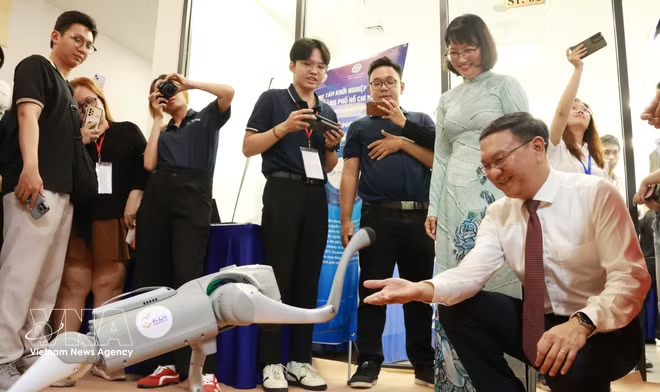
At the opening ceremony of the Startup & Innovation Hub of Ho Chi Minh City (SIHUB) on August 25, 2025. (Photo: VNA)

To achieve these objectives, the strategy outlines a range of key tasks and solutions, including raising public awareness, developing shared infrastructure and facilities to support technology-driven and innovation-led start-ups, and establishing community-based innovation spaces tailored to local conditions. It also calls for the selection and development of several national and regional innovation clusters.

In addition, pilot mechanisms will be introduced for controlled testing environments for new products, services and technologies, with priority given to promising sectors such as digital assets, artificial intelligence, financial technology and logistics, in order to attract entrepreneurial talents and international venture capital.

The strategy also emphasises the need to refine the legal framework, enhance human resource development, and expand capital markets and venture investment for innovative start-ups.

Greater international integration and cooperation will be promoted to mobilise external resources while strengthening domestic entrepreneurial capacity. This includes partnerships with at least five reputable international partners to deliver incubation and acceleration programmes meeting global standards in Vietnam, expanding overseas Vietnamese start-up networks, supporting foreign start-ups entering the Vietnamese market, and assisting domestic start-ups in exporting products and services abroad, among other initiatives.

Another key task is to develop infrastructure, tools and institutional frameworks to advance a digital nation grounded in science, technology and innovation. This includes piloting a digital start-up visa policy to attract technology talents to work in Vietnam, as well as piloting visa exemptions and multiple-entry arrangements for foreign experts and advisers invited by national and provincial innovation centres and start-up support centres to work in the country, among other measures./.


VNA

See more

Students experience robotic products (Photo: VNA)

AI powers sweeping overhaul of Vietnam’s education system

Nguyen Son Hai, Deputy Director General of the Department of Information and Communication Technology under the Ministry of Education and Training (MoET), said the sector has made rapid strides in digital transformation, from online classes during the COVID-19 pandemic to nationwide platforms covering the national education database, registration for high school graduation exam, and online university admissions.

Voters can access essential information about candidates on the VNeID app, enabling them to proactively learn and enhance their awareness when participating in elections. (Photo: VNA)

Digital transformation gathers pace nationwide

Adopted by the Politburo in late 2024, Resolution 57 positions science – technology development, innovation, and digital transformation as a top important breakthrough and strategic pillar for Vietnam’s development in the new era. Early implementation shows a clear shift toward data-driven governance and technology-enabled public services.

Can Tho city pledges to allocate at least 1% of total budget spending to science, technology and innovation (Illustrative image. Source: VNA)

Plan issued to implement Vietnam–France agreement on science-technology cooperation

Under the plan, the Ministry of Science and Technology will take the lead, in coordination with relevant ministries and agencies, in directing, guiding, monitoring and inspecting the implementation of the agreement. The ministry will also prepare reports on the signing and implementation progress for submission to the Ministry of Foreign Affairs for consolidation and reporting to competent authorities as required.

An overview of the provincial steering committee of Tay Ninh on implementing Resolution 57 on April 2 (Photo: VNA)

Tay Ninh moves to accelerate digital transformation

In science, technology and innovation, Tay Ninh has identified six major priorities: development of the digital economy, a carbon credit market, a Halal ecosystem, renewable energy, enterprise innovation support, and applications of artificial intelligence and big data.

Vietnam successfully held its first auction of national “.vn” domain names from March 18 to 20. (Photo: VNA)

Sci-tech revenue up 17% in March

The sci-tech sector contributed 133.5 trillion VND to the country’s gross domestic product (GDP) in March, a 28% increase from the same period last year.

By 2030, Vietnam targets ranking among the world’s top 15 countries in the Global Cybersecurity Index (Source: baochinhphu.vn)

Project aims to enhance capacity of national cybersecurity protection force

The project aims to strengthen overall capabilities and develop an elite and modern cybersecurity force able to proactively prevent and effectively respond to all cyber risks and threats, safeguarding national security, social order and safety, and the rights and lawful interests of organisations and individuals in cyberspace.

Delegates at the meeting (Photo: VNA)

Da Nang boosts hi-tech partnership with Germany’s Chemnitz City

Authorities in Da Nang hope Chemnitz and German partners will continue to accompany and support the city in accessing advanced technologies, connecting experts, integrating into innovation ecosystems, and attracting high-tech enterprises and supporting industries to explore investment and long-term cooperation opportunities.

Prime Minister Pham Minh Chinh speaks at the meeting of the Government’s Steering Committee for science and technology, innovation, digital transformation, and Project 06 (Photo: VNA)

Strategic tech must address practical challenges: PM

Prime Minister Pham Minh Chinh called for the rollout of a strategic technology development programme, alongside the completion of incentive policies to attract tech giants and develop key tech products, particularly in semiconductors and AI.

Experience virtual reality technology at Nha Trang Center shopping mall (Khanh Hoa). (Photo: VNA)

Experts give ideas to build AI economy from data

Vietnam’s economic growth over past decades has largely relied on labour expansion, capital accumulation, export promotion and deep global trade integration, but as the country enters a higher development stage, this model is showing limitations.

VINASA Vice Chairwoman and Secretary General Nguyen Thi Thu Giang (right) and SEPC General Director Abhay Sinha sign the MoU on cooperation in New Delhi on March 25. (Photo: VNA)

Vietnam, India ink deal to step up IT cooperation

Under the terms of the MoU, the two sides will jointly push trade and investment in IT and services, arrange business delegations and business-to-business meetings, share market and policy information, and help companies access partnership opportunities and expand into new markets.