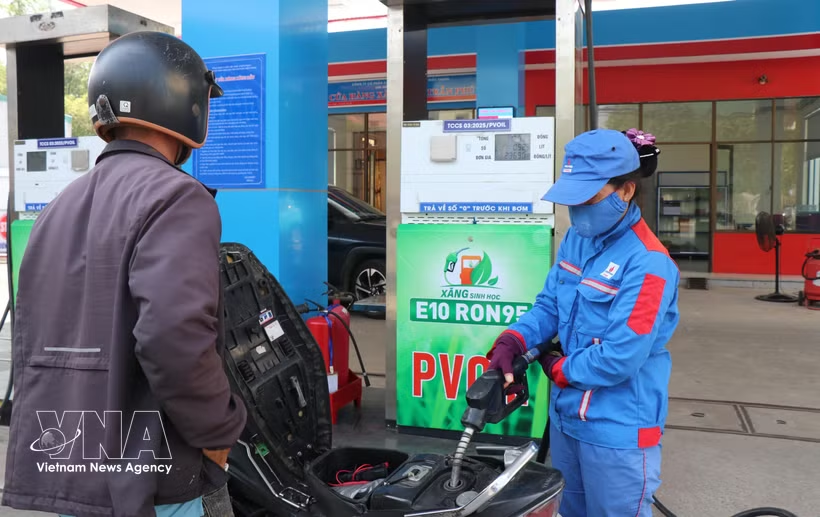
Hanoi (VNA) – As demand for blending E10 RON95 biofuel continues to rise, ensuring a stable supply of input materials such as cassava and maize for ethanol production remains a significant challenge, requiring coordinated and comprehensive solutions.
Feedstock supply remains unstable
According to the Vietnam Biofuels Association, the country currently operates six fuel ethanol plants with a combined designed capacity of approximately 600,000 cubic metres per year. At full capacity, these facilities could meet around 40% of the demand for E10 RON95 blending. However, securing sufficient feedstock to operate at full capacity continues to face considerable difficulties.
In practice, most domestically produced ethanol is derived from cassava, a feedstock with limited availability and relatively low efficiency, leading to higher production costs.
Associate Prof. Dr. Chu Tien Quang, former head of the rural development policy department at the Institute for Policy and Strategy Studies, noted that local cassava cultivation areas have been shrinking due to declining yields, rapid soil degradation and environmental impacts. In addition, fragmented farming and limited mechanisation have kept productivity low and harvesting costs high. Farmers also lack incentives to cultivate cassava due to low purchase prices and the absence of stable off-take contracts.
Sharing a similar view, Nguyen Tri Ngoc, Vice Chairman and General Secretary of the Vietnam General Council of Agriculture and Rural Development, said that cassava cultivation linked to ethanol feedstock supply has been promoted for years. However, ensuring sustainability requires appropriate policies and technical processes, as cassava is both a valuable raw material for biofuel production and a potential source of environmental overexploitation.
From a business perspective, Pham Van Tuan, Director of the Nha Xanh Vietnam One-Member Ltd. Co., stated that his firm’s ethanol feedstock is primarily sourced from cassava and maize. Cassava is entirely procured domestically, while maize is sourced both locally and imported from South American markets such as Argentina and Brazil, as well as from the US.
He added that maize offers a more stable supply and consistent quality in terms of starch content, impurities and technical specifications for ethanol production. By contrast, cassava is highly seasonal, with abundant supply and low prices during harvest periods, followed by sharp price increases in the off-season.
Developing integrated value chains
To ensure the sustainable development of feedstock areas, it is essential to build strong linkages between farmers, cooperatives and processing enterprises. In particular, companies must guarantee off-take agreements and offer sufficiently attractive purchase prices to sustain raw material zones, Quang underlined.
Alongside value chain development, better utilisation of existing agricultural by-products, such as bran, straw and corn cobs, should also be considered a key solution for ensuring feedstock supply for ethanol production. This approach would help reduce environmental pollution, minimise waste and prove far more cost-effective than establishing new cultivation zones, he added.
Similarly, Ngoc proposed that farmers should be placed at the centre of feedstock development, with mechanisms ensuring stable income per unit of land.
According to Do Van Tuan, Chairman of the Vietnam Biofuels Association, it takes several years to develop an ethanol production industry. In Vietnam, stronger linkages within the ethanol supply chain will be a key driver for expanding production.
Drawing on industry experience, Tuan stressed that additional policy support is needed to foster the sustainable development of the biofuels sector. This includes clearly zoning off key cultivation areas for maize and cassava to supply ethanol plants, alongside investment in transport and irrigation infrastructure to reduce logistics and procurement costs.
Furthermore, the Government should consider granting corporate income tax exemptions or reductions for a period of 5–10 years for ethanol production projects in order to encourage long-term investment. With the current import tariff on ethanol set at 5%, businesses have called for this level to be maintained to provide reasonable protection for domestic production./.
See more
Textile industry expo gathers over 1,000 firms
Participating companies are showcasing a wide range of products and technologies across the textile and garment value chain, including machinery, equipment, fabrics, yarn, cotton, accessories and garment materials.
Vietnam–Russia Economic Forum highlights internal strength in new context
The Vietnam–Russia Economic Forum 2026 (VREF 2026), themed “Unleashing internal strength in the new era,” took place in Hanoi on April 8 in a hybrid format, bringing together scholars, policymakers, experts and business representatives to discuss economic development and strengthen bilateral cooperation in the evolving global landscape.
Vietnam Trade Promotion Office inaugurated in China’s Haikou city
Leaders of the Vietnamese Ministry of Industry and Trade described the office as a concrete outcome of cooperation with the People’s Government of Hainan Province, following the Memoranda of Understanding signed a year earlier, enhancing economic and trade ties and establishing the Haikou office.
Vietnam sees ample opportunities in AI-powered economy
The “Vietnam AI Economy 2025” report, released by the National Innovation Centre, Japan International Cooperation Agency (JICA), and Boston Consulting Group, puts hard numbers on the opportunity for the first time. It forecasts that AI could add up to 130 billion USD to Vietnam’s GDP by 2040, equivalent to roughly 25% of the country’s current economy.
US businesses look to advance long-term investment in Vietnam
Despite ongoing global economic uncertainties, the size of the coming delegation reflects strong US business interest in expanding trade, investment, and long-term partnerships in Vietnam, as well as confidence in the country’s economic growth prospects.
Positive FTSE Russell assessments spotlight Vietnam’s stock market reforms
With a strengthened foundation and continued reform commitment, Vietnam’s stock market has a solid basis to develop in a more stable, transparent, and internationally aligned direction.
Faster public investment disbursement crucial to growth targets
Public investment was a major contributor to the economy’s 7.83% GDP growth in the first quarter, achieved despite global uncertainties and rising input costs. Nonetheless, the figure fell short of the 9.1% growth scenario outlined in the Government’s Resolution No. 01/NQ-CP.
Reference exchange rate goes down on April 8
The State Bank of Vietnam set the daily reference exchange rate at 25,106 VND/USD on April 8, down 2 VND from the previous day.
Vietnam approves action programme to implement ASEAN Economic Community plan
Vietnam's action programme to implement the ASEAN Economic Community (AEC) Strategic Plan aims to translate the strategic priorities of the AEC into concrete actions aligned with Vietnam’s development conditions.
Green industrial parks drive next-generation FDI
Ho Chi Minh City needs to strengthen investment in supply chain data systems, smart warehouses, regional logistics centres and inland container depots, while promoting stronger linkages between FDI firms, large domestic companies and small and medium-sized enterprises to support technology transfer and workforce development.
Stock market enters new cycle as reforms, foreign inflows converge
Despite record net foreign outflows in 2025, many experts view those withdrawals as cyclical rather than structural, while medium- and long-term fundamentals remain supportive.
Programme pushes Vietnam’s international market expansion for 2026–2030
The programme for expansion into international markets for the 2026–2030 period is designed to address institutional and policy bottlenecks in order to encourage, facilitate and manage risks associated with enterprises’ investment and business activities abroad.
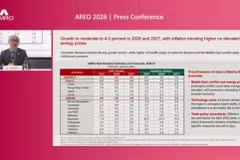
Vietnam weathers economic shocks effectively: AMRO
The report highlights that Vietnam continues to benefit from strong domestic demand, robust export performance and sustained foreign investment inflows, particularly in high-tech manufacturing and electronics.
Vietnam – RoK expand industrial, energy cooperation in new phase
The meeting between Acting Minister of Industry and Trade Le Manh Hung and RoK Ambassador to Vietnam Choi Young Sam focused on advancing collaboration in key sectors as both countries prepare for the upcoming state visit to Vietnam by the RoK President.
Vietnam waives transport fees to support businesses
The Ministry of Finance has announced the waiver of several fees and charges to support production and business activities in the transport sector. The policy takes effect from April 7, 2026 to June 30, 2026.
Hanoi's growth holds firm despite fuel price pressures
In Hanoi, the decisive implementation of socio-economic development programmes from the start of the year helped sustain growth, with GRDP rising 7.87% year-on-year in the first quarter.
Customs uncover nearly 8,900 violations in six months, online smuggling on the rise
From October 15, 2025 to March 15, 2026, customs forces nationwide detected, seized and handled 8,879 violations, with an estimated total value of more than 8 trillion VND (303.68 million USD).
Reference exchange rate rises slightly on April 7
With the current trading band of +/- 5%, the ceiling rate applicable for commercial banks during the day is 26,363 VND/USD, and the floor rate 23,853 VND/USD.
Dong Thap intensifies action to tackle IUU fishing
Local officials have been assigned to work closely with fishing communities, supporting compliance with regulations while reinforcing coordination mechanisms to monitor vessel movements at sea and prevent potential violations at an early stage.
Vietnam’s pepper exports rebound strongly despite supply and shipping challenges
The US and China maintained their positions as Vietnam’s largest buyers, importing 8,059 tonnes and 3,663 tonnes respectively. Exports to the US jumped 121% from the previous month, while shipments to China soared 134.7%.